More channels won't automatically produce better results when a company advertises to real estate agents. Agents and brokerages already see plenty of social posts, search ads, emails, software demos, and event offers. The campaigns that earn attention connect spend to a business outcome, such as a qualified seller inquiry, a booked appointment, a listing presentation, or a closed account.
That distinction matters in a market where agents typically allocate 10% to 20% of their annual budget to marketing and lead generation, according to Revenue Memo's real estate marketing analysis. A vendor isn't competing for casual interest. The vendor is asking to become part of an operating budget that agents scrutinize because it affects lead flow, listing acquisition, and visibility.
Table of Contents
- Why Most Campaigns Targeting Real Estate Agents Fall Short
- Audience Segments Among Real Estate Agents
- Choosing the Right Advertising Channels
- Crafting Messaging That Resonates With Agents
- Setting Up and Targeting Your Campaigns
- Measuring ROI and Optimizing for Lead Quality
Why Most Campaigns Targeting Real Estate Agents Fall Short
A campaign can reach thousands of agents and still fail commercially. The problem usually starts with the question, “Where can real estate agents be reached?” A stronger starting point is, “What evidence will show that this expense produced a useful business result?”
Social platforms and search engines offer distribution, but distribution alone does not indicate whether an ad created a listing conversation or buyer inquiry. Strong engagement may come from photographers, renters, students, or agents outside the vendor's service area. Those interactions can improve dashboard metrics while giving sales representatives few prospects they can pursue.

Visibility does not equal commercial value
Agents operate under intense budget pressure. The estimated value of U.S. residential real estate agent marketing ranges from $4.2 billion to $16.2 billion, while the same analysis describes marketing and lead generation as a recurring budget allocation rather than an occasional purchase. That scale creates opportunity for vendors and raises the standard for proof. See the full context in Revenue Memo's marketing spend analysis.
Campaign reporting should connect the first interaction to a captured lead, a qualification event, a sales conversation, and, where the sales cycle allows, a purchase or retained account. For agent-facing offers, attribution should also show lead quality, speed-to-lead, and whether the activity contributed to a listing outcome.
Practical rule: Every campaign aimed at agents needs a defined answer to “What happens after the click?”
The offer often sounds like a nice-to-have
Generic claims such as “stand out online” or “grow your brand” rarely create urgency. Agents are focused on winning the next listing, responding quickly to inquiries, presenting a property clearly, and demonstrating value to sellers.
Position the product within that revenue process. A visual marketing tool, for example, can support property presentation, lead capture, follow-up, or seller reporting. The message becomes more credible when the advertiser identifies the tracked action, sets a response-time expectation, and defines the handoff that follows.
Resilient campaigns connect the asset to a measurable workflow. They give agents enough information to judge whether the resulting leads are qualified, whether the team can respond quickly, and whether those conversations can support future listings or retained business.
Audience Segments Among Real Estate Agents
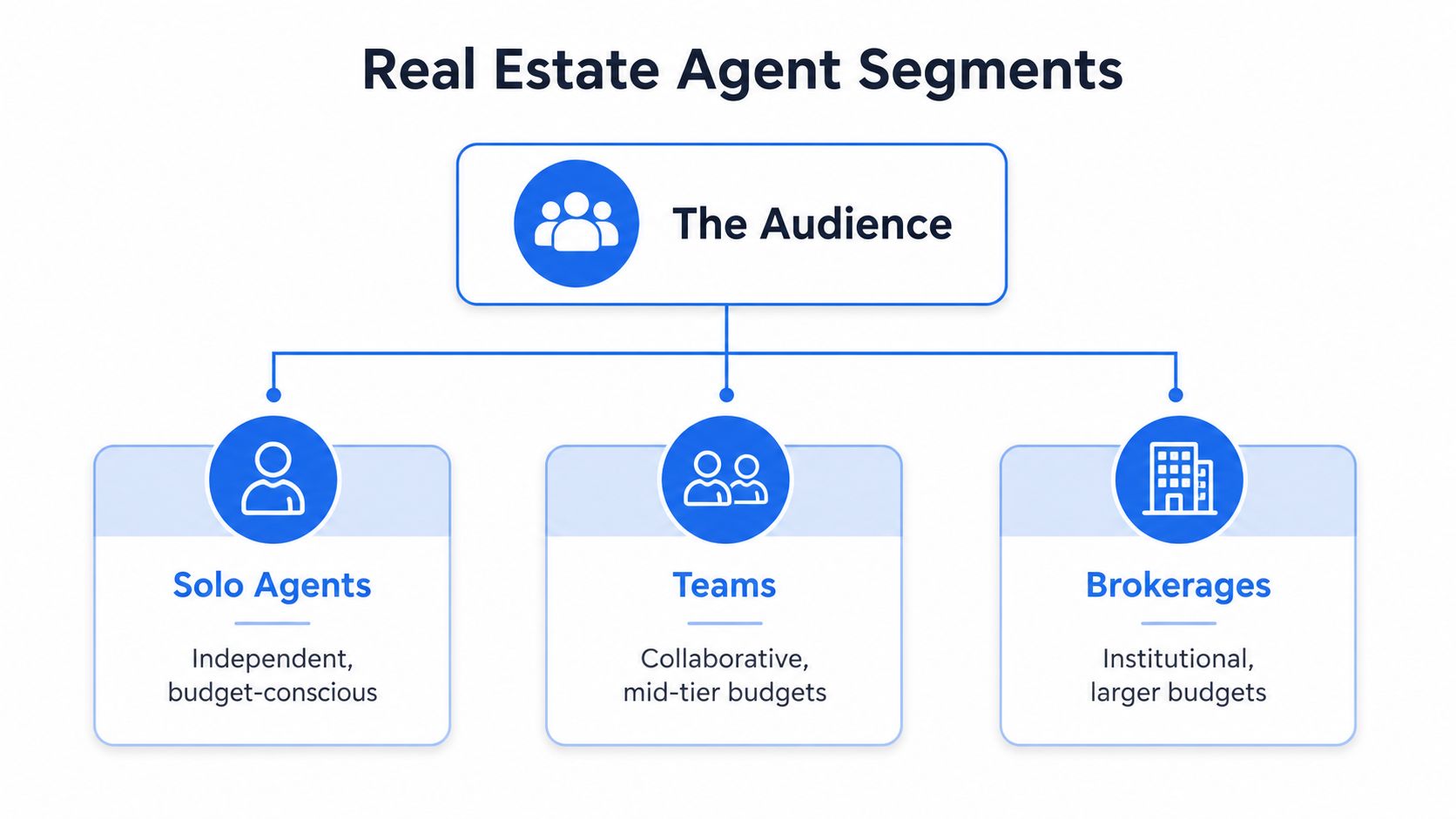
A solo agent can approve a tool in one conversation. A brokerage may require input from marketing, operations, and the agents who will use it. Solo agents, growing teams, and brokerages all search for marketing support, but approval process, workload, setup tolerance, and success criteria shape how they assess a purchase.
Solo agents buy clarity and speed
Solo agents usually need a direct path from purchase to usable marketing output. They may handle prospecting, listing preparation, client communication, and follow-up themselves, so lengthy implementation can delay the first measurable result.
Messages for this segment should stay concrete. Focus on producing listing media faster, capturing inquiries from a property page, or creating a shareable asset for email and social campaigns. The landing page should state setup requirements, pricing structure, and the next action clearly. Connect the offer to outcomes the agent can inspect, such as qualified inquiries, response speed, or progress toward a listing conversation.
Teams need repeatability
Teams often evaluate a repeatable process rather than one attractive asset. Shared templates, consistent branding, lead routing, and visibility into campaigns that generate conversations can matter more than creative polish alone.
Show how several people use the product without producing inconsistent outputs or losing attribution. Demonstrations should feature the workflow and its reporting, not only the finished creative. Team buyers typically need evidence that the system improves daily efficiency while preserving a usable record of lead quality and follow-up.
Brokerages evaluate control and adoption
Brokerage purchases can involve several stakeholders. A marketing leader may assess brand governance, an operations manager may examine permissions and reporting, and agents may decide whether the tool is practical enough to adopt.
Address those concerns by role. A brokerage campaign can emphasize standardized assets, account administration, reporting, and support. Agent-facing creative can focus on the daily use case and the actions that lead to inquiries or listing opportunities. Sending both groups to one generic page weakens relevance and makes attribution harder to interpret.
The broader market includes solo agents, teams, and brokerages making recurring decisions about digital advertising, content, signage, and promotional assets. Their buying triggers differ, so campaign structure should reflect the account's operating model.
Match the trigger to the segment
A useful segmentation brief should define:
- Business structure: Identify whether the account is an independent practice, a team, or a brokerage.
- Primary commercial need: Separate listing acquisition, buyer lead generation, property presentation, and internal marketing operations.
- Decision owner: Determine whether the user, team leader, marketing manager, or brokerage executive controls the purchase.
- Proof required: Specify whether the buyer needs a quick demonstration, campaign reporting, team controls, or a broader implementation plan.
This structure keeps broad agent language from carrying the entire sales argument. It also gives reporting a clearer baseline, so performance can be compared by segment, lead quality, speed-to-lead, and contribution to listing outcomes.
Choosing the Right Advertising Channels
Channel selection should follow the buying objective and the proof required. Search captures active demand, social demonstrates a visual workflow, email supports nurturing, and partnerships transfer trust. Each option also creates a different attribution challenge, so define the conversion event before spending.
Search offers a useful benchmark. A 2026 benchmark reports a 3.70% overall conversion rate for real estate search ads, while “Homes for Sale by Agent” campaigns converted at 1.83%. “Real Estate Broker” and “Residential Real Estate Agent” campaigns converted at 1.53% and 1.29%, respectively, according to LocaliQ's real estate search advertising benchmarks. Search performs well when intent is precise. Blended averages obscure differences in audience structure and conversion behavior, so report results by keyword theme, agent segment, qualified conversation, and downstream listing opportunity.
| Channel | Avg Conversion Rate | Best For | Key Consideration |
|---|---|---|---|
| Paid search | 3.70% overall real estate search benchmark | Capturing active demand | Separate campaigns by intent and audience |
| Paid social | No universal rate stated | Demonstrating visual value and generating discovery | Optimize for qualified actions, not engagement alone |
| No universal rate stated | Nurturing known prospects and customers | Segment by agent type and buying stage | |
| Trade events | No universal rate stated | Building trust and handling objections | Track meetings and opportunities after the event |
| Partnerships | No universal rate stated | Borrowing credibility from adjacent providers | Define referral ownership and attribution |
Paid social can demonstrate value quickly, especially when the offer changes how agents present listings or handle inquiries. An industry roundup reports that 48% of agents identify paid social as their most effective advertising channel. It also reports that listings with even a 30-second clip receive 403% more inquiries than photo-only posts, according to America's Best Marketing's real estate marketing trends roundup. Treat those figures as directional. Account-level attribution still needs to connect the ad, landing-page action, speed-to-lead, and qualified outcome.
Use each channel for a distinct job
- Paid search works when keywords, landing pages, and intent-specific offers align. It is often the clearest channel for proving demand capture.
- Paid social shows the product in context, particularly when the benefit depends on a visual or workflow demonstration. Optimize toward inquiries, booked calls, or qualified actions.
- Email supports longer consideration cycles when recipients receive useful proof, such as case evidence, reporting examples, or workflow details.
- Trade events create conversations that require disciplined source tracking, meeting notes, and follow-up.
- Partnerships can produce warmer introductions. Define a qualified referral and record which opportunities become sales conversations or listings.
Teams building a broader B2B acquisition system can review Lead Printer for B2B growth for demand-generation and pipeline-measurement ideas. For visual campaigns aimed at agents, the real estate social media advertising guide provides channel-specific guidance.
A practical mix pairs one intent channel with one value-demonstration channel. Compare qualified conversations, response speed, opportunity creation, and listing outcomes rather than raw lead volume. If social produces attention but search produces sales-ready inquiries, budget decisions should reflect that difference.
Crafting Messaging That Resonates With Agents
Agents don't need another vague promise about “more exposure.” They need to know what the product changes in the workday and how the vendor will prove that change created commercial value.
A useful message has four parts:
- Name the job: Explain whether the product helps win listings, present properties, capture inquiries, or support follow-up.
- Describe the mechanism: Show the asset, workflow, integration, or process that creates the opportunity.
- Define the tracked action: Identify a form submission, booked appointment, phone call, qualified inquiry, or sales conversation.
- Reduce the adoption concern: State what the agent must provide and how quickly the first useful output can be created.
Replace visibility language with operational language
Weak headline: “Make every listing stand out.”
Stronger headline: “Give sellers a measurable property experience that captures buyer inquiries.”
The second version still needs proof, but it points toward a business process. It gives the landing page a clear job: demonstrate the experience, explain how inquiries are captured, and show what the agent can track.
Email subject lines should follow the same discipline. “A new way to market listings” is broad and forgettable. “How agents can connect property views to buyer inquiries” creates a more specific reason to open, without promising an unsupported outcome.
The supporting copy should acknowledge the agent's constraint. A concise message might explain that an agent can share one property asset through a listing page, email, QR code, or social post, then review engagement and captured contact details in one reporting flow. The claims must match the product's actual capabilities.
Agents don't buy visibility. They buy a credible path from attention to a business conversation.
Build proof into the creative
A product demonstration often outperforms a polished brand statement because it lets the buyer judge relevance quickly. Show the listing experience, the contact point, the reporting screen, and the handoff to the agent. If the offer serves brokerages, show the administrative controls and repeatable workflow instead of presenting only a single property.
The guide to ads for real estate agents can support campaign planning around audience, creative, and offer structure. The key is consistency. The ad, landing page, demonstration, and sales follow-up should all describe the same action and outcome.
A strong call to action is also specific. “See how the property experience works” is more useful than “Learn more” when the next page contains an interactive demonstration. “Request an attribution review” fits a brokerage offer better than “Start today” because it speaks directly to the buyer's measurement concern.
Setting Up and Targeting Your Campaigns
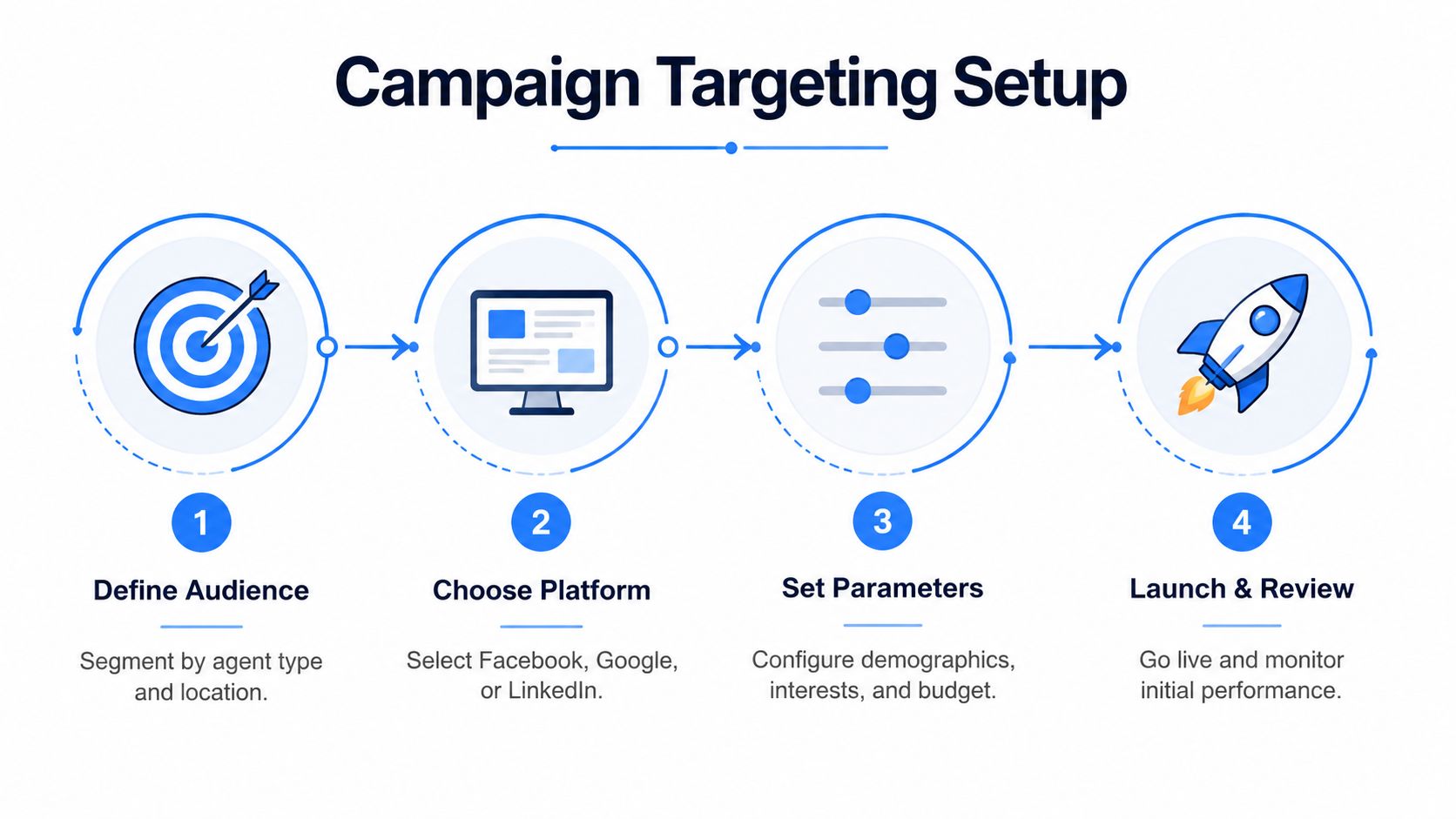
Campaign setup should mirror the commercial segments rather than forcing every prospect into one ad group. A solo agent looking for listing media may respond to a practical demonstration, while a brokerage marketing leader may need a team workflow and reporting discussion.
Start with separate audience paths
On LinkedIn, advertisers can test job functions, company characteristics, and role seniority where the platform provides sufficient audience quality. On Meta, interest and behavior signals may help discovery, but they need tighter lead qualification because “real estate” interests can include people who aren't commercial buyers. On Google Ads, keyword intent and ad-group structure provide the strongest control.
A useful setup includes:
- Solo agent campaign: Use a direct product demonstration and a low-friction consultation or trial action.
- Team campaign: Highlight shared workflows, repeatable branding, and lead handling.
- Brokerage campaign: Route qualified prospects to a sales conversation focused on governance, adoption, and reporting.
- Retargeting campaign: Show proof, demonstrations, and objections to visitors who didn't convert on the first visit.
Keep ad groups narrow enough to learn
The LocaliQ benchmark demonstrates why broad real estate segmentation can mislead campaign decisions. Search campaigns should separate terms and landing pages by intent, such as agent marketing software, listing presentation tools, or brokerage marketing systems. The advertiser can then compare conversion behavior without allowing unrelated searches to distort the result.
Budget allocation should follow the funnel stage. Allocate enough to test a defined audience and offer, protect a separate amount for retargeting, and reserve sales capacity for the leads the campaign produces. A campaign that generates more forms than the team can qualify isn't efficient growth.
Creative testing should change one meaningful variable at a time. Test a workflow demonstration against a static benefit claim, or a listing-focused headline against a brokerage-focused headline. Keep the conversion event stable so the result remains interpretable.
The landing page should carry tracking parameters that identify source, campaign, audience, and creative. Forms should collect enough information to qualify the opportunity without creating unnecessary friction. Useful fields may include business type, current marketing challenge, service area, and intended use case.
Measurement starts before launch. If the campaign lacks a defined conversion event and ownership rule, the reporting will remain descriptive instead of useful.
Measuring ROI and Optimizing for Lead Quality
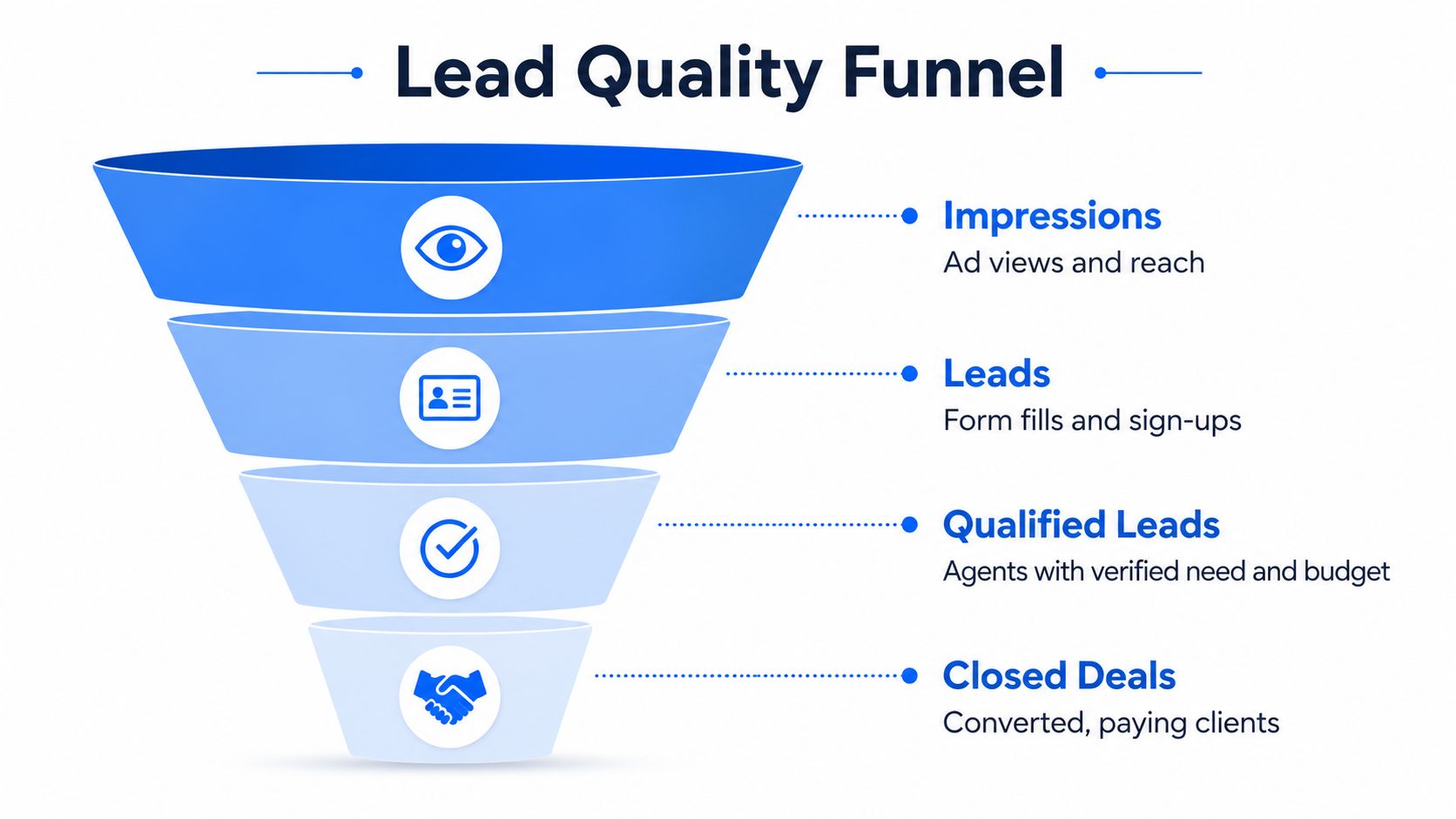
Lead volume is an incomplete performance measure in real estate marketing. A vendor can generate forms and still lose money if the contacts lack budget, urgency, authority, or a relevant use case. The measurement system needs to connect acquisition to qualification and, eventually, revenue.
Track the full path
A campaign dashboard should distinguish between:
- Lead creation: The person submitted a form, booked a call, or initiated contact.
- Lead qualification: The sales team verified need, fit, decision authority, and commercial potential.
- Sales opportunity: The account entered a defined sales process.
- Closed revenue: The account purchased, renewed, or expanded.
That structure prevents a cheap but irrelevant lead source from appearing more successful than a smaller source that produces real opportunities. The lead source tracking guide provides a practical reference for connecting campaigns to downstream actions.
The economics make follow-up especially important. Multiple 2026 datasets place the average real estate lead-to-close rate at about 2% to 5%, with internet leads often closer to 2% to 3% and portal-specific leads around 0.4% to 1.2%, according to DealMachine's 2026 lead generation statistics. The same source places average cost per lead around $448 to $503, making poor qualification and slow response expensive problems rather than minor process flaws.
Treat response time and nurturing as campaign variables
A campaign doesn't end at form submission. The sales team should define who receives the lead, what information appears in the handoff, and which response channel fits the prospect's stated preference. Immediate acknowledgment can confirm the request, while a human follow-up can address the specific agent segment and use case.
Nurturing also needs a deliberate sequence. The cited dataset describes a 10-week homebuyer search cycle and recommends a three-step funnel of capture, immediate response, and nurturing for at least 10 weeks. The source also reports that 66% of sellers find agents through referrals or past relationships, which reinforces the need to measure not only direct response but also trust-building and assisted conversion.
Optimization should happen at the qualified-lead level. If a social campaign produces many forms but few qualified conversations, the advertiser can narrow the audience, change the offer, add qualification fields, or revise the landing page. If search produces fewer leads but stronger opportunities, the account may deserve more attention even when its top-line conversion rate looks less impressive.
The right question is not “Which channel generated the most leads?” It's “Which channel produced the most valuable, traceable opportunities after the sales process did its work?”
Virtual Tour Easy helps real estate teams create shareable virtual tours, add lead capture and analytics, and distribute property experiences through web embeds, email, QR codes, social media, and Google Street View. Visit Virtual Tour Easy to see how measurable listing media can support stronger attribution and faster lead qualification.