The seller has invited three agents to the kitchen table. One arrives with a glossy deck full of brokerage branding, another opens a laptop and starts reading market statistics, and the third asks why the owner is moving before showing a single slide. The third agent usually has the strongest chance of winning the room, because a listing presentation for real estate isn't a speech about the agent. It's a live decision tool that helps sellers decide how to price, present, and launch their property.
A successful appointment connects four conversations that agents often separate: the seller's motivation, the evidence behind the price, the marketing assets that will attract qualified buyers, and the objections that could stop the appointment from converting. The deck supports those conversations, but it shouldn't replace them.
Table of Contents
- Setting the Stage Before the Listing Appointment
- Slide-by-Slide Structure That Holds Attention
- Building a Defensible Pricing Strategy With Your CMA
- Integrating Virtual Tours and Immersive Media Into Your Marketing Plan
- Handling the Five Objections That Kill Listing Appointments
- Leave-Behinds and Follow-Up That Close the Listing
Setting the Stage Before the Listing Appointment
A seller opens the door, offers coffee, and points toward the kitchen. The agent has roughly the first minute to establish whether the meeting will feel personal or rehearsed. If the agent immediately plugs in a laptop and starts reciting credentials, the seller learns that the presentation matters more than the property. If the agent notices the unfinished renovation, asks about the move, and confirms the desired timing, the seller sees a professional who has come prepared to solve a specific problem.
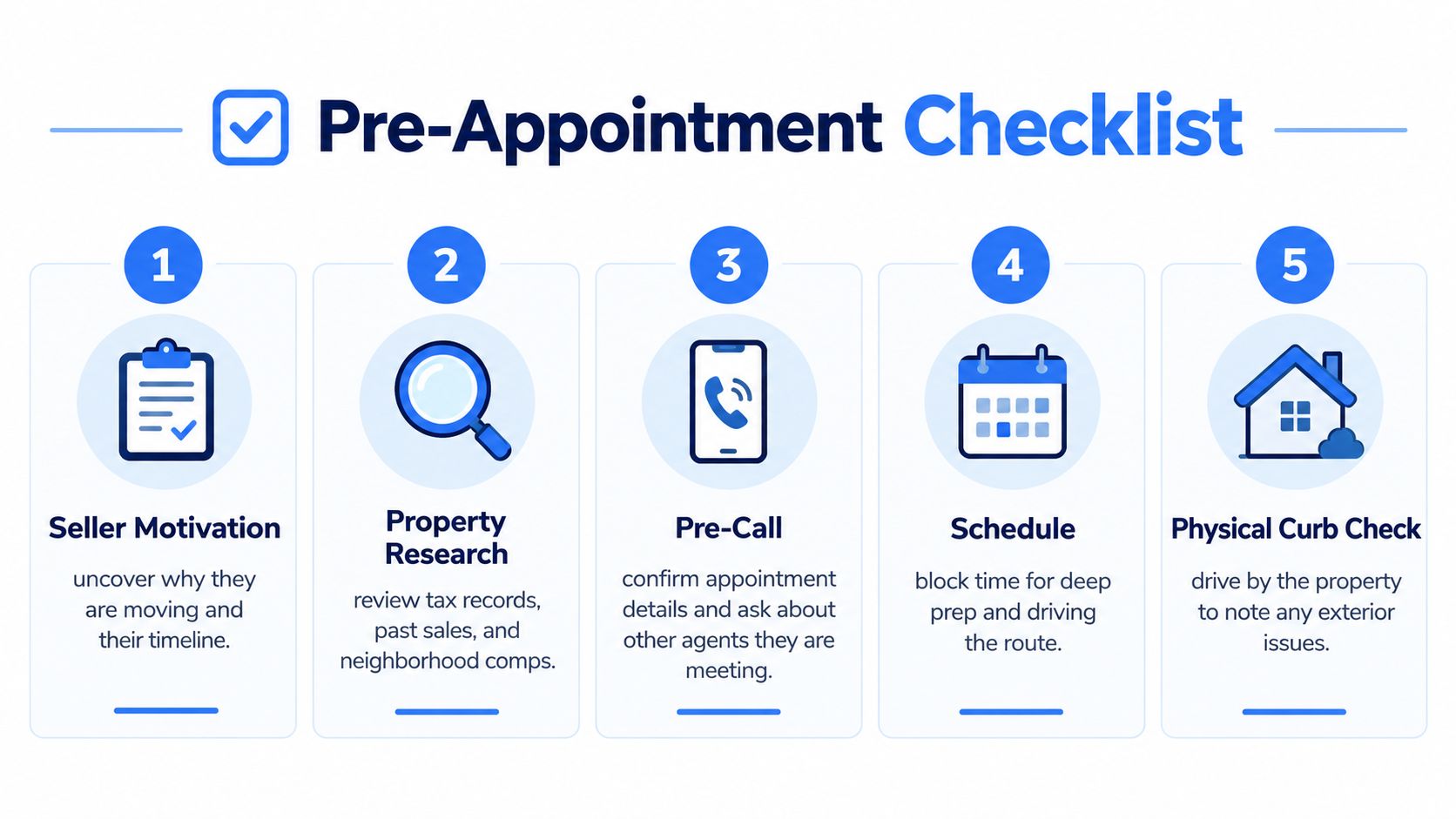
The pre-appointment work begins with a short phone conversation. The agent should clarify why the seller is moving, what must happen after the sale, whether speed or price carries greater weight, and whether other agents are being interviewed. The agent should also ask about improvements, known defects, occupancy, preferred communication style, and any date that could affect the launch.
Build a seller profile before building slides
A one-page profile keeps the appointment focused. It can include:
- Primary motivation: Record the reason for selling in the seller's own language, not a generic category such as “downsizing.”
- Timing pressure: Note a planned purchase, relocation, school schedule, lease expiration, or other constraint.
- Decision priorities: Separate the highest possible price from certainty, convenience, privacy, and speed.
- Property facts: Capture improvements, deferred maintenance, standout features, access limitations, and rooms that need attention.
- Likely objections: Flag concerns about commission, pricing, showings, repairs, staging, or the seller's preferred agent.
- Conversation cues: Mark personal details that can make the meeting more natural without turning rapport into a performance.
The agent can then customize the opening slide, CMA commentary, photography recommendations, and follow-up materials around that profile. A seller who wants a predictable move needs a different presentation from an owner focused on testing an ambitious price.
Within the first two minutes, the agent should read the room. Are both decision-makers present? Does one person answer every question? Are the sellers asking about the commission before discussing the property? Are they standing near the laptop, or have they invited the agent to sit down? These cues don't determine the outcome, but they reveal whether the appointment needs more listening, more evidence, or a faster route to the marketing plan.
The 24-hour preparation checklist
The final preparation block should include a preliminary CMA, a property record review, a street-view inspection, and a customized marketing snapshot. The agent should check the route, charge presentation equipment, download an offline copy of the deck, and print a concise backup packet. A drive-by can reveal landscaping, visibility, neighboring construction, access issues, or curb appeal details that online records won't show.
Practical rule: The seller should recognize the property strategy before recognizing the template.
Arriving early matters, but arriving overprepared matters more. A polished agent can still lose the appointment by presenting an outdated comparable, misunderstanding the seller's timeline, or recommending generic photography for a home whose layout needs explanation. Preparation turns the first ninety seconds into evidence that the agent has already started working.
Slide-by-Slide Structure That Holds Attention
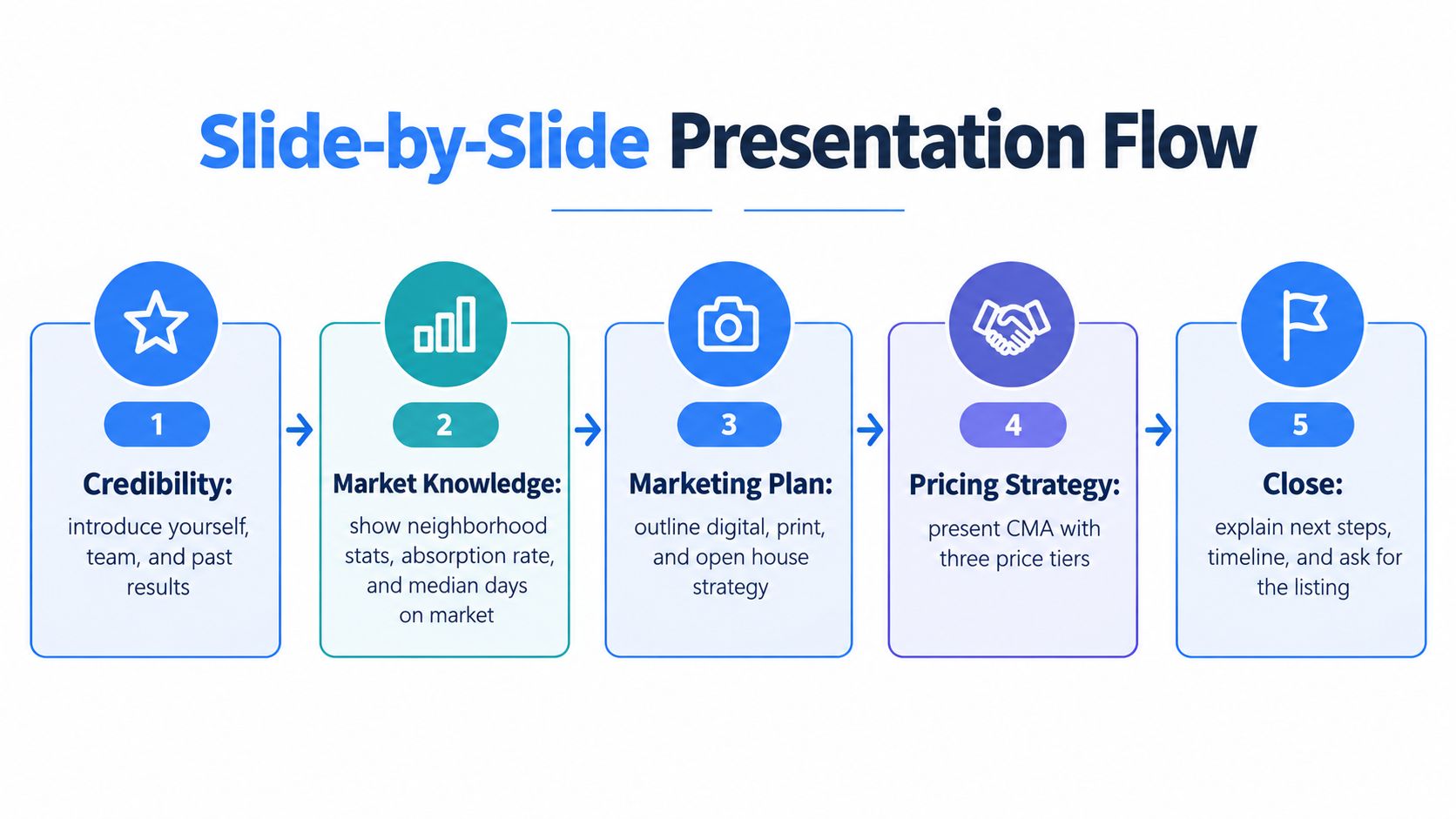
A strong deck follows the seller's decision sequence, not the brokerage's internal hierarchy. The recommended framework can fit a focused presentation of 12 to 15 slides, with room to add or remove pages according to the property and the seller's questions. Each slide should answer one question, then create a natural reason to continue.
Slides one through five establish relevance
Slide 1, the seller's situation. Open with the property, the reason for moving, and the desired outcome. Suggested script: “The plan needs to protect your timing while positioning the home for the strongest qualified response.” Transition: “Before discussing the home, let's establish how the local market is behaving.”
Slide 2, why this agent. Keep credentials relevant to the assignment. Show local knowledge, team support, negotiation capability, and proof that can be documented. Don't spend the opening on a career autobiography. Transition: “That background matters because the strategy has to fit this neighborhood and this buyer pool.”
Slide 3, market context. Use clear charts for current competition, recent sales, buyer behavior, and time on market where reliable local data is available. Explain the implication instead of reading every label. Transition: “Those conditions give us the frame for evaluating this home.”
Slide 4, the property opportunity. Present the home's strongest selling points, likely buyer profiles, and any presentation risks. A floor plan, annotated photo, or room sequence can communicate more than a paragraph. Agents who want a visual reference for structuring property-focused material can review this interior design presentation guide. Transition: “Now the marketing plan can show how those advantages will appear to buyers.”
Slide 5, the launch concept. State the positioning in one sentence. For example, the home may be framed around flexible living, architectural character, outdoor entertaining, or turnkey convenience. Transition: “The next slides turn that positioning into a buyer-facing campaign.”
Slides six through twelve make the plan tangible
Slide 6, preparation and staging. Separate repairs that protect buyer confidence from cosmetic changes that may not justify their cost. Explain what the seller should do, what the agent will coordinate, and what can remain untouched.
Slide 7, photography and video. Show the intended visual treatment, including exterior timing, room order, detail shots, and video style. The script should connect each asset to a buyer question.
Slide 8, immersive media. Demonstrate how a buyer can understand circulation, room relationships, and scale before requesting a showing. This is particularly useful when the home has an unusual layout or remote buyers are likely.
Slide 9, distribution. Map the listing's path across the MLS, property page, email, social channels, agent outreach, print, and open-house materials. Sellers should see a system, not a promise to “post everywhere.”
Slide 10, communication timeline. Show preparation milestones, launch decisions, showing feedback, offer review, and negotiation updates. State who communicates what and when.
Slide 11, the CMA. Present the defensible comparable set, adjustments, and price scenarios. The CMA should be discussed, not dropped into the deck as a spreadsheet.
Slide 12, the working agreement. Explain services, responsibilities, compensation, and the listing agreement in plain language. Address likely concerns before the seller has to interrupt.
Slides thirteen through fifteen create a decision
Slide 13, launch choices. Give the seller clear options involving preparation, timing, and pricing. Avoid presenting choices that the agent won't support operationally.
Slide 14, questions and risks. Invite questions about price, showings, marketing, repairs, and communication. A calm answer is more persuasive than defensive certainty.
Slide 15, next steps. Ask directly whether the seller is comfortable moving forward. If the answer is yes, identify the paperwork and launch tasks. If the answer is no, ask what remains unresolved.
A deck should make the next decision easier, not make the agent look busier.
Agents lose attention by front-loading every credential, burying the marketing plan, or showing data without an interpretation. The most effective presentation uses the slides as prompts, pauses after important decisions, and lets the seller's questions change the order when needed.
Building a Defensible Pricing Strategy With Your CMA
A CMA earns trust when the seller can follow the reasoning from property facts to pricing recommendation. It fails when the agent selects flattering comparables, hides inconvenient differences, or presents a single number as if the market delivered a verdict.
The first filter is relevance. Start with properties that compete for the same buyer, then narrow by location, property type, size, condition, layout, and recency. A nearby home with a different buyer profile may be less useful than a slightly farther property that matches the subject's condition and design. Each comparable should have a job in the argument, whether it establishes a ceiling, supports the likely range, or shows how presentation affects buyer response.
Turn the CMA into a decision conversation
The agent should explain adjustments aloud. A renovated kitchen, inferior lot, finished lower level, parking arrangement, view, or deferred maintenance can move a comparable's usefulness even when the homes appear similar online. Sellers don't need a lecture on every line item, but they do need to understand why one sale deserves more weight than another.
A price range is usually more honest than false precision. The agent can present a defensible range, then discuss three practical positions within it:
- Conservative position: Designed to encourage early attention and reduce resistance from price-sensitive buyers.
- Market-supported position: Balances the comparable evidence with the home's condition and presentation.
- Aggressive position: Tests the upper edge of buyer willingness, with a clear explanation of the response risk.
The seller should choose with the agent, based on the desired outcome and tolerance for adjustment. When a seller cites a Zestimate or another automated estimate, the response shouldn't attack the tool. A better script is: “That estimate can be a useful reference point, but it can't see the renovation quality, buyer competition, showing access, or the differences between these homes. The CMA gives us a property-specific range we can defend.”
The broader evidence supports careful framing. A 2022 peer-reviewed study examined 90,897 U.S. home sales and found that virtual tours were used in 45.19% of transactions when non-VR tours were included, while true VR tours appeared in 3.88% of sales. The research also linked virtual marketing with a statistically meaningful improvement in the balance between price and time to sale. Agents can use that finding as context for presentation quality, but it shouldn't replace local comparable analysis. The Journal of Real Estate Research study provides the underlying methodology.
A separate Harvard Business School review of 75,000 home sales found that roughly 22% of houses used virtual tours and associated those tours with about a 1.1% increase in sale prices after controlling for key factors. The same review contrasted that result with earlier estimates of a 2% to 3% lift, a useful reminder that disciplined analysis often moderates enthusiastic marketing claims. Harvard Business School's review of the research is a suitable reference when sellers ask whether presentation improvements have measurable value.
The CMA also needs a market-context page. Use absorption, competing inventory, pending activity, and days on market when those figures are available from reliable local sources. The agent's job isn't to manufacture urgency. It's to show what could happen if the home enters above the range, launches without preparation, or sits while comparable listings attract attention.
The preparation process is becoming more deliberate. A July 2026 industry survey reported that nearly 48% of agents prepared the CMA at least a day before the listing presentation, compared with 35.3% in 2020. The survey also reported that the average comparable range narrowed from 5 to 11 comps to 3.7 to 8.7 comps, while 76.4% still presented the CMA in person and about 10% said they were very likely to conduct virtual presentations in the next six months. These figures come from the Real Estate News survey coverage.
| Metric | 2020 | 2026 |
|---|---|---|
| Agents preparing the CMA at least a day before the presentation | 35.3% | Nearly 48% |
| Average comparable range | 5 to 11 comps | 3.7 to 8.7 comps |
| In-person CMA presentation | Not provided | 76.4% |
| Agents very likely to present virtually in the next six months | Not provided | About 10% |
The agent can use the same discipline when selecting creative references. A resource such as pricing for content creators may help agents think more carefully about production inputs and creative scope, but the seller-facing recommendation should remain tied to the home's buyer, budget, and expected use of each asset.
Integrating Virtual Tours and Immersive Media Into Your Marketing Plan
Generic photography and a promise of social media exposure don't distinguish a marketing plan. A seller needs to see how the listing will answer buyer questions before a showing request arrives. 360° virtual tours, cinematic walkthroughs, interactive floor plans, and strong still photography each solve a different information problem.
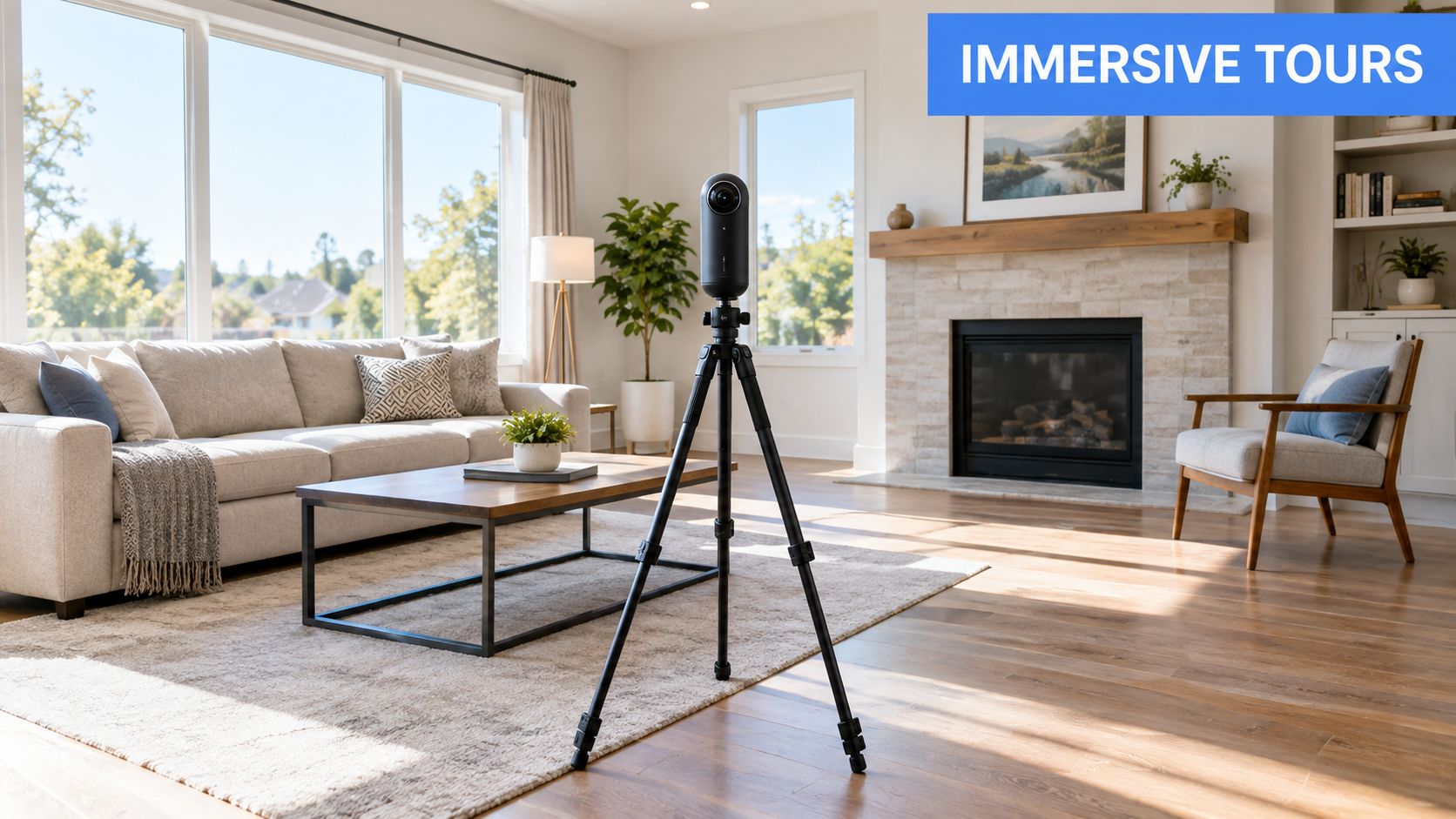
The evidence supports adding immersive media as a complement, not treating it as a replacement for in-person showings. A 2024 peer-reviewed study reported that VR tours shortened marketing time by 6.4% and narrowed the bid-ask spread by 2%, after controlling for other factors. The practical implication is strongest early in the funnel, where a tour can help buyers decide whether a property deserves a visit. The residential property marketing study supports that positioning.
Show sellers what each asset does
A 360° tour lets buyers inspect circulation and room relationships. A cinematic walkthrough creates an emotional sequence. An interactive floor plan clarifies size and access. Still photography controls the first impression on listing portals. Together, these assets reduce ambiguity without pretending that digital viewing can answer every question.
Another academic study found that interactive digital visualization improved buyer understanding, engagement, and purchase intention, but wasn't sufficient by itself to close sales. The effect was strongest among mid- to high-budget buyers, while first-time and low-budget buyers continued to value physical visits for reassurance. The study of interactive digital visualization tools supports a balanced recommendation that includes floor plans, neighborhood context, transparent pricing, and an easy showing path.
The presentation should include a short demonstration, not a technical explanation. The agent can open the tour at the best starting view, move through two or three rooms, tap a hotspot, and explain where the link will appear. If the workflow includes an unfamiliar production vendor, agents can use this corporate video production companies guide as background when evaluating video standards and deliverables.
Virtual staging requires a separate decision. It can help buyers understand an empty room or test a furnishing concept, but it shouldn't conceal permanent conditions or create expectations the property can't meet. Physical staging remains more appropriate when scale, texture, traffic flow, or a seller's accumulated belongings dominate the visual problem.
VirtualTourEasy can generate immersive tours from text prompts or regular photos, accept existing 360° images, and assemble scenes with hotspots, labels, floor plans, audio, and custom starting views. It also supports shareable links, website embeds, QR codes, cinematic video exports, lead capture, and engagement analytics, so an agent can present the workflow as part of a broader listing campaign rather than as a novelty. Agents can review the real estate virtual tours workflow before deciding which capabilities fit the property and the brokerage process.
The seller-facing promise should stay measured: better information can help serious buyers self-qualify, remote prospects can inspect the home earlier, and the agent can use engagement signals to guide follow-up. Analytics should inform conversations, not become a substitute for buyer feedback or showing activity.
Handling the Five Objections That Kill Listing Appointments
Objections usually appear before the seller states them. A seller leans back when the price range appears, looks at a spouse when commission is mentioned, or starts collecting the printed pages while the marketing plan is still open. The agent should pause, ask a neutral question, and address the concern before continuing.
The higher-price request
Seller concern: The owner fears leaving money on the table.
Response: “A higher number may be possible, but the comparable evidence needs to show which buyers would support it and what response risk comes with testing it. The recommendation is built around attracting serious attention, not choosing the most flattering number.”
Pivot: “Let's compare the likely buyer response at each position, then choose the strategy that fits your priorities.”
The commission challenge
Seller concern: The fee feels more concrete than the value.
Response: “The fee should be evaluated against the work required to prepare, position, expose, negotiate, and manage the transaction. The relevant question isn't whether a lower fee exists. It's what service, reach, communication, and accountability would change.”
Pivot: “Which part of the plan would you want reduced if the fee were reduced?”
The friend or family agent
Seller concern: Loyalty and trust compete with professional fit.
Response: “That relationship matters, and the decision should feel comfortable. The comparison should also include the person's pricing process, launch plan, availability, negotiation approach, and communication standards.”
Pivot: “Would it help to place both plans beside the same seller priorities?”
Waiting for a better market
Seller concern: Delay feels safer than making an imperfect decision.
Response: “Waiting may be appropriate if your timing allows it, but no one can promise that future conditions will improve. The useful decision is whether the current opportunity fits your move and whether preparation can begin without rushing.”
Pivot: “What would need to change for waiting to become the better choice?”
Listing with multiple agents
Seller concern: More agents appear to mean more exposure.
Response: “Multiple representatives can create conflicting prices, inconsistent presentation, and unclear accountability. A coordinated plan gives one person responsibility for the message, buyer response, negotiations, and reporting.”
Pivot: “Let's identify the exposure you want, then show how one accountable campaign will deliver it.”
The agent shouldn't rebut every objection immediately. Acknowledge the underlying concern, answer with evidence or process, and ask a question that returns the conversation to the seller's decision. That approach preserves trust even when the seller doesn't sign at the table.
Leave-Behinds and Follow-Up That Close the Listing
The leave-behind should continue the appointment's logic. A thick branded booklet filled with generic brokerage pages creates work for the seller. A concise package with the seller's goals, CMA summary, recommended price position, launch sequence, sample creative, communication standards, and next steps gives the household something useful to discuss after the agent leaves.
The digital version should be equally intentional. A personalized property page can hold the marketing concept, sample photography direction, floor plan approach, virtual tour link, and a clear contact path. Printed materials can include a QR code that opens the same destination, but the seller should also receive a direct link that works without scanning.
A follow-up sequence with a purpose
The follow-up cadence should respect the seller's decision timeline while keeping the agent's work visible. The first message confirms that the agent heard the priorities. The next conversation resolves questions. A later delivery adds something tangible rather than repeating the original pitch.
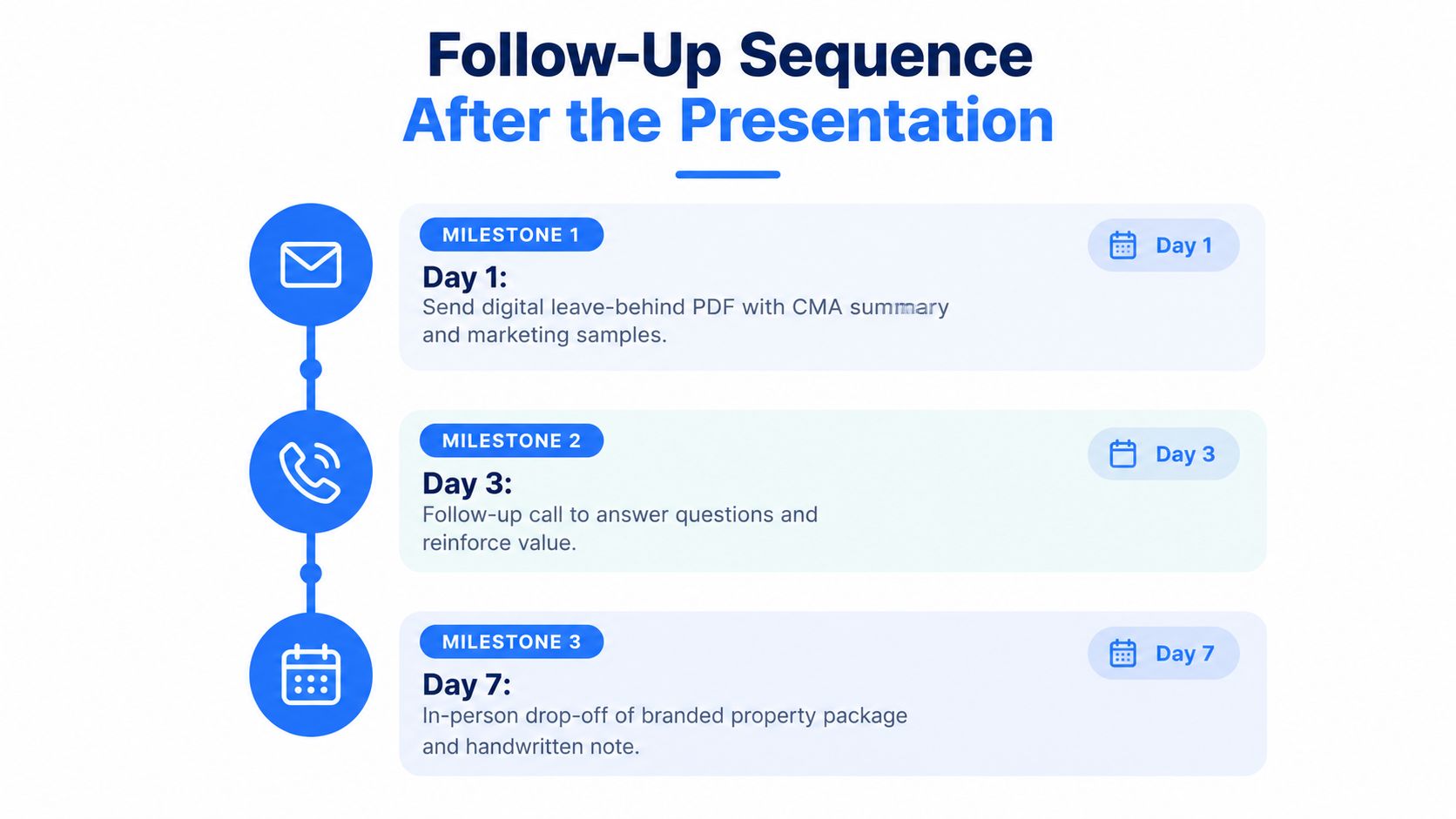
A practical sequence looks like this:
- Day 1 digital recap: Send the CMA summary, marketing samples, recommended preparation steps, and the agreed decision point. Mention the seller's stated priority in the opening paragraph.
- Day 3 conversation: Call or use the seller's preferred channel to answer questions about price, commission, timing, or showings. Ask what still feels uncertain.
- Day 7 physical package: Deliver a branded property package with the proposed launch plan and a handwritten note. Include any revised material promised during the appointment.
Make every template feel specific
Templates save production time only when they preserve room for customization. A condo package may need building rules, access instructions, and amenity positioning. A rural property may need land context, outbuildings, utilities, and travel considerations. A luxury home may require controlled distribution and a more visual presentation, while an investor-owned property may respond better to an operational timeline and net-sheet clarity.
Use analytics carefully. If a virtual tour records engagement, the agent can tell the seller which marketing assets received attention and whether additional questions or showing requests followed. The update should report activity without implying that a view equals an offer.
A connected workflow can reduce duplicate work. Agents exploring automation can review this guide to marketing automation integration and then choose only the automations that preserve a personal seller experience. The system should make follow-up more consistent, not make it sound automated.
The appointment closes when the seller understands the plan, trusts the evidence, and knows the next action. The leave-behind and follow-up make that clarity easier to maintain after the kitchen conversation ends.
Virtual Tour Easy helps real estate agents create immersive 360° tours from regular photos, text prompts, or existing 360° images, then share them through links, embeds, QR codes, and cinematic walkthroughs. Add the tour workflow to the marketing slide and give sellers a concrete way to see how buyers will experience the property. Visit Virtual Tour Easy to explore the platform and start building a more useful listing presentation.