An agent can have a polished listing, a full social calendar, and plenty of website traffic, yet still struggle to explain which activity produced a qualified buyer or seller conversation. That's the problem with most sample marketing plans in real estate. They list tactics, but they don't connect those tactics to the decisions that lead to a showing, an offer, or a signed listing agreement.
A practical plan works differently. It defines the audience, assigns each channel a job, places virtual tours at the consideration stage, and tracks movement through the funnel. The result is a working system that helps an agent decide what to publish, where to spend, what to automate, and what to stop doing.
Table of Contents
- What a Modern Real Estate Marketing Plan Actually Looks Like
- Segmenting Your Audience by Buyer Type and Property Category
- Choosing the Right Channel Mix for Maximum Reach
- Using Virtual Tours as a Conversion and Qualification Tool
- Building a Realistic Budget and Timeline for Your Plan
- Tracking KPIs That Actually Predict Closings
- Your Ready-to-Use Sample Marketing Plan Template
What a Modern Real Estate Marketing Plan Actually Looks Like
A useful sample marketing plan real estate agents can adapt begins with a business outcome, not a preferred platform. “Post more on social media” isn't a strategy. “Generate qualified seller consultations in a defined service area through local content, listing proof, and follow-up” gives the team something it can execute and measure.
The plan should map three connected stages:
- Awareness: Short-form video, local search content, signage, referrals, and community activity introduce the agent or property.
- Consideration: Listing pages, professional photography, virtual tours, market explanations, email, and SMS help prospects decide whether the opportunity deserves attention.
- Decision: Lead forms, scheduling, agent response time, showing workflows, and offer follow-up remove friction at the point of action.
A modern plan also records the audience, property category, message, channel, owner, timeline, budget, and success metric for every campaign. That structure keeps an agent from judging a post by likes when the primary question is whether it generated a useful conversation.
Build the plan around the journey
A seller needs proof that the agent can position and distribute a property. A remote buyer needs confidence that a listing deserves travel or a scheduled showing. An investor wants efficient access to relevant details. The same content cannot serve all three equally well.
The agent should therefore define one primary objective for each campaign, then assign supporting actions. A listing launch might use video to attract attention, a landing page to capture intent, a virtual tour to help prospects evaluate the home, and automated follow-up to move qualified contacts toward a showing.
Practical rule: Every tactic needs a next action and a measurable handoff. If a channel creates attention but no identifiable path to inquiry, it belongs in testing, not at the center of the plan.
Agents building the digital foundation can also review this digital marketing guide for real estate to connect website content, listing promotion, and lead capture. The plan should be reviewed regularly because channel performance, inventory, and buyer expectations change.
Segmenting Your Audience by Buyer Type and Property Category
A broad audience produces broad messaging, and broad messaging usually makes an expensive listing sound interchangeable. Segmentation gives each campaign a clear reason to exist.
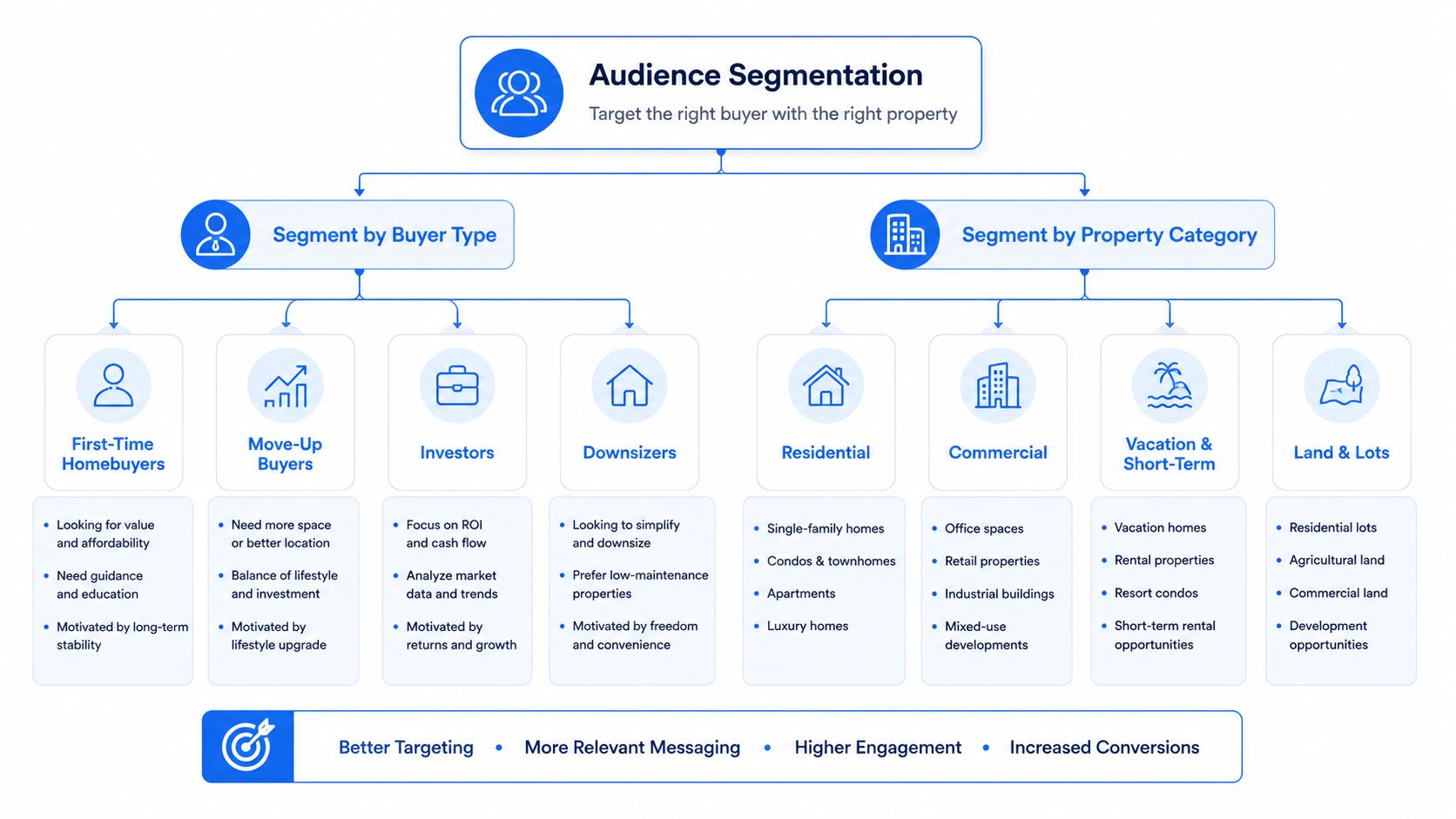
Start by separating buyer motivation from property category. A first-time buyer may need plain-language guidance, payment education, and reassurance about the process. A relocation buyer may prioritize commute context, neighborhood orientation, remote viewing, and a fast response. An investor generally looks for operational details, rental potential, condition, and access to documentation. A downsizer often responds to convenience, maintenance considerations, accessibility, and proximity to familiar services.
Property type changes the message as much as buyer motivation does:
- Starter homes: Emphasize livability, practical features, neighborhood access, and clear next steps for an inexperienced buyer.
- Condos: Explain building amenities, shared spaces, rules, fees, parking, and the lifestyle the property supports.
- Luxury homes: Use restrained presentation, cinematic video, detailed photography, private outreach, and a tour that lets qualified prospects inspect the experience without reducing it to a slideshow.
- Commercial property: Organize information around use, access, layout, customer or employee experience, and the operational questions that influence a business decision.
Turn segments into channel decisions
The segment should determine where the team invests effort. A relocation campaign may lean on search content, video walkthroughs, email nurturing, and remote consultation. A neighborhood-focused seller campaign may rely more on local search, community relationships, direct outreach, and evidence of nearby listing activity.
The message also needs a behavioral trigger. Someone who watches a property video but never visits the listing page is still in an early stage. Someone who returns to a detailed tour, downloads information, or requests a showing has demonstrated stronger intent. Those actions should move the contact into a more relevant follow-up sequence.
A simple planning matrix can include:
| Segment | Primary concern | Message angle | Useful conversion action |
|---|---|---|---|
| First-time buyer | Confidence and clarity | Explain the process and property fit | Request a consultation |
| Relocation buyer | Remote evaluation | Show the home and surrounding context | Schedule a virtual or in-person appointment |
| Investor | Efficiency and property details | Present decision-relevant information | Request documents or a call |
| Downsizer | Convenience and fit | Focus on ease, access, and lifestyle | Book a private showing |
The point isn't to create separate campaigns for every possible person. It's to prevent a single generic listing message from carrying the entire burden of persuasion.
Choosing the Right Channel Mix for Maximum Reach
Channel selection should follow the segment and funnel stage, not the agent's personal comfort. A small brokerage can't execute every channel deeply, so the plan needs an allocation model that protects the activities most likely to create qualified demand.
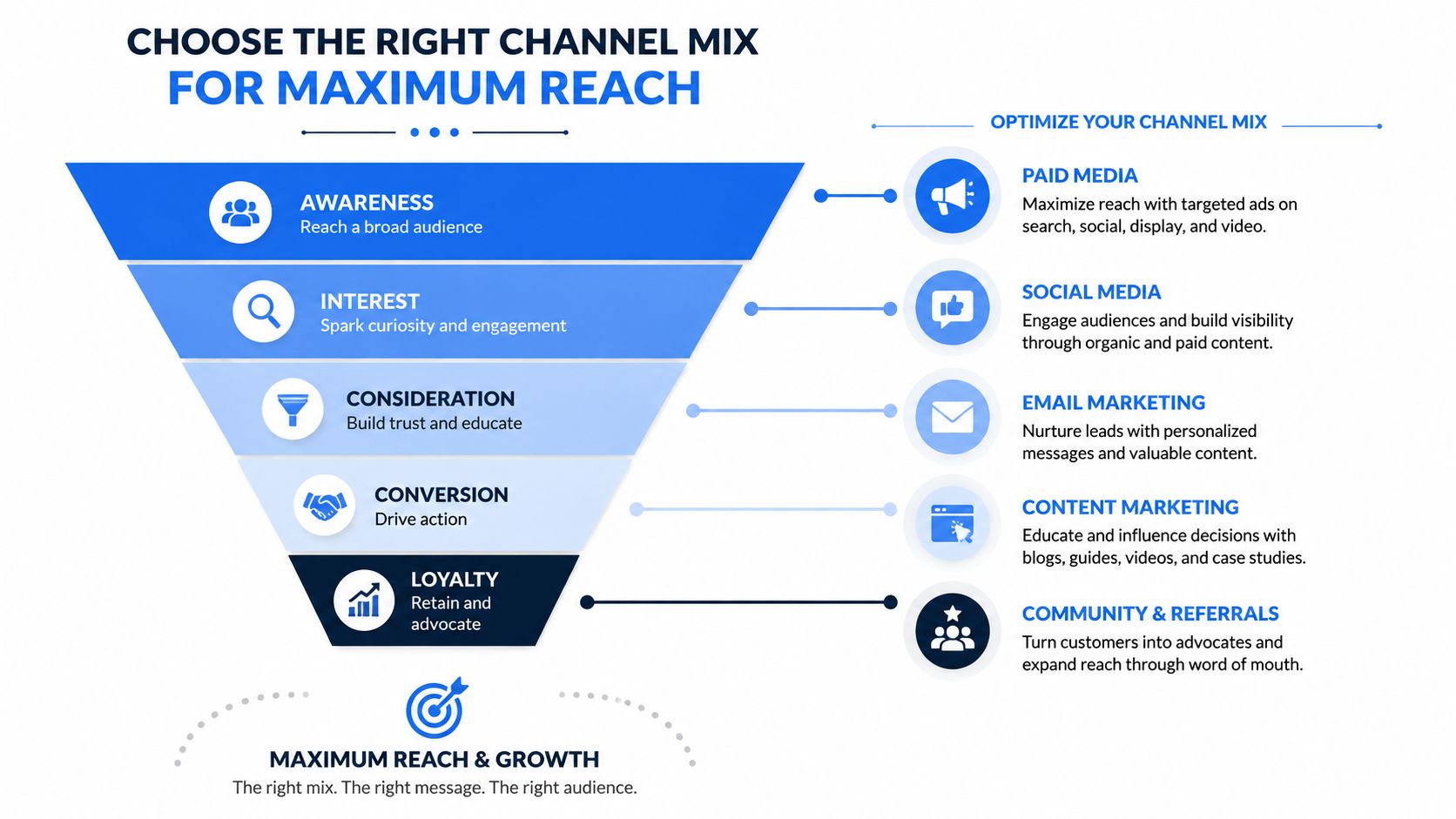
A practical starting model assigns attention and budget by job:
- Visibility: Short-form video and property-focused social content create repeated exposure and make listings easier to discover.
- Compounding discovery: Hyper-local SEO gives the brokerage a durable place to answer neighborhood and property questions.
- Conversion: Landing pages, forms, tour links, and clear calls to action turn interest into identifiable prospects.
- Nurture: Email and SMS automation keep the team present after the initial inquiry, especially when the prospect isn't ready to act immediately.
- Trust and referral: Open houses, local events, partnerships, and direct conversations reinforce credibility in the service area.
Recent industry coverage identifies short-form video, hyper-local content, and automated email or SMS follow-up as important parts of the changing real estate channel mix in 2025, while also raising the practical question of how smaller teams should redistribute labor across them. The 2025 real estate marketing trends roundup is useful context, but the allocation still needs to reflect local response data.
Make trade-offs explicit
An agent with limited capacity should usually protect listing presentation, fast follow-up, and measurable distribution before adding more content formats. A team with stronger production support can increase video output, while a brokerage with established local authority may shift effort toward neighborhood pages and search optimization.
Paid social can create reach quickly, but it needs a defined audience, a compelling creative concept, and a landing page that continues the message. Local SEO takes longer to build, yet it can keep producing discovery after a single listing campaign ends. Email and SMS automation reduce manual repetition, but poor segmentation turns them into noise.
Agents who need help planning social content can use this AI Tools for Local SEO guide to social media posts for real estate as a production resource. Automation should support a clear strategy, not fill an empty calendar.
Using Virtual Tours as a Conversion and Qualification Tool
Virtual tours deserve a more strategic position than “extra listing media.” They sit naturally in the consideration stage, where a prospect decides whether a property merits a call, a showing, a second look, or a conversation with another decision-maker.
The engagement evidence is substantial. One industry compilation reports that listings with virtual tours can receive 87% more views, while buyers spend 5 to 10 times longer on websites that include a virtual tour than on sites without one. The same compilation reports that 95% of buyers are more likely to call about properties with tours, 67% want to see one, and 54% wouldn't consider a home without one. These figures come from Matterport's discussion of 3D virtual tours, and they point to a practical conclusion: the tour can influence both attention and action.
A separate report on buyer behavior says 54% of buyers skip listings without virtual tours or professional visualizations, 75% prefer virtual tours over static photos, and serious prospects spend 5 to 10 minutes in a tour. It also describes tours being revisited after in-person showings and shared with family or other decision-makers, which supports using the asset as decision support rather than top-of-funnel decoration. The buyer behavior analysis of virtual tours provides that context.
Design the tour around qualification
The tour should answer the questions that normally create wasted appointments. Can the layout work? Does the room sequence make sense? Is the property suitable for a remote buyer's shortlist? Which feature deserves a closer conversation?
A measurable setup includes:
- A dedicated landing page for the property.
- A lead form with a clear reason to submit.
- GA4 and GTM events for tour opens, scene interactions, form starts, and completed inquiries.
- A source field that distinguishes social, search, email, QR code, and referral traffic.
- Follow-up that reflects the prospect's action, not just the fact that a lead exists.
The peer-reviewed U.S. market study cited by the NBER working paper on virtual tours and property marketing found that properties marketed with virtual tours sold for about 1% more on average, while adoption varied by region. That finding doesn't prove every tour creates a premium. It does justify testing the tactic market by market, using photo-only listings as a comparison where practical.
Virtual Tour Easy can create tours from existing images or uploaded 360° assets, publish shareable links and embeds, add lead capture, and connect analytics through GA4 and GTM. For scheduling friction after a prospect qualifies, agents can also evaluate SkipCalls for real estate agents as part of the appointment workflow.
Building a Realistic Budget and Timeline for Your Plan
A budget becomes useful when each line item has a job, an owner, and a review point. Agents shouldn't commit to every possible format at once. Photography and listing presentation protect the first impression, while tracking and follow-up determine whether that attention becomes pipeline.
The ranges below are planning placeholders rather than universal market prices. Local production costs, listing volume, team capacity, and property type should determine the final amount.
| Channel | Solo Agent Monthly Range | Small Team Monthly Range | Expected ROI Timeline |
|---|---|---|---|
| Photography | Adapt to listing schedule | Adapt to listing schedule | Immediate listing launch |
| Virtual tours | Adapt to listing schedule | Adapt to listing schedule | Immediate to mid-funnel |
| Short-form video | Adapt to production capacity | Adapt to production capacity | Short to mid-term |
| Paid social | Test within available budget | Scale after conversion evidence | Short-term testing |
| Local SEO tools | Start with essential tools | Add reporting and content support | Longer-term compounding |
| CRM automation | Use a focused workflow | Expand segmentation and routing | Short to mid-term |
Because the verified brief provides no permitted dollar ranges, a responsible plan should not fabricate costs. Instead, the agent can define a monthly ceiling, reserve a portion for listing-specific production, and release additional spend only when the campaign produces qualified activity.
Use a 90-day sequence
Days 1 to 30 should establish the foundation. Confirm audience segments, audit listing pages, install analytics, create source fields, prepare templates, and define response ownership. Launch one repeatable short-form format and one local content theme.
Days 31 to 60 should test distribution. Promote selected listings, publish neighborhood content, place tours on landing pages, and review inquiry quality rather than surface-level reach. Remove channels that generate activity without meaningful handoffs.
Days 61 to 90 should improve conversion. Compare creative, calls to action, landing-page structure, and follow-up timing. Keep a record of which segment, property type, and source produced the strongest progression toward a showing or consultation.
The budget should follow the evidence. A channel that earns attention but fails to produce identifiable next steps deserves a smaller test, not automatic expansion.
Tracking KPIs That Actually Predict Closings
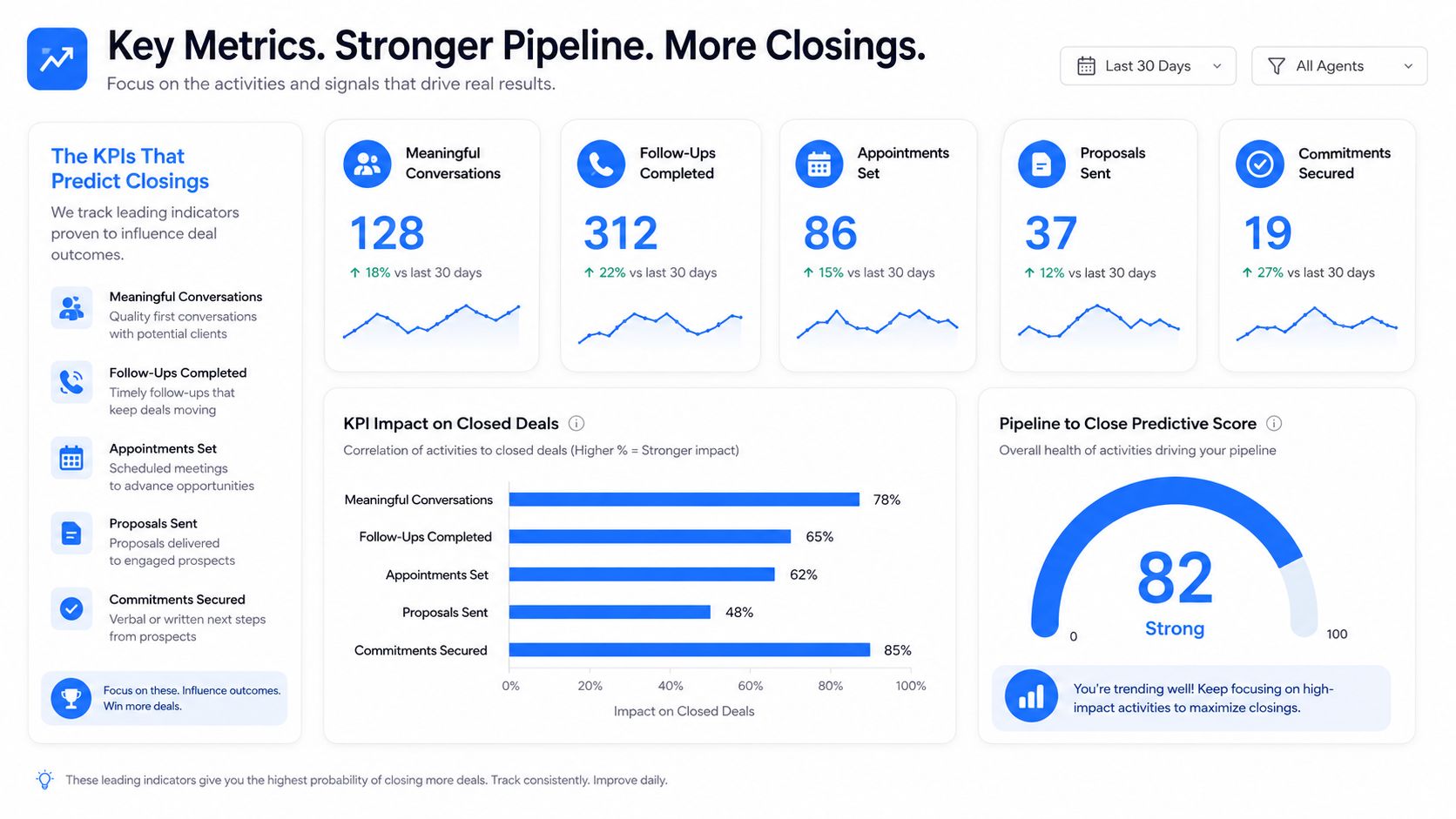
Followers and impressions can help diagnose awareness, but they don't tell an agent whether a prospect is moving toward a transaction. A useful dashboard follows the handoffs between stages.
At the awareness level, track reach by audience and property category, video completion behavior, local search visibility, and visits to the relevant listing page. At the consideration level, track tour starts, meaningful scene engagement, return visits, form starts, email replies, and scheduled appointments. At the decision level, track inquiry-to-showing, showing-to-offer, and offer-to-close progression.
Give every channel a downstream measure
Short-form video should connect to profile visits, listing-page sessions, or tracked inquiries. Local SEO should connect to relevant page visits and contact actions, not rankings alone. Email should be judged by replies, booked conversations, and movement in the CRM, not merely opens.
Virtual tours need their own event trail. A team can compare source, tour engagement, form completion, showing requests, and offers against photo-only listing experiences. The purpose is to identify incremental value, not to assume that every engaged viewer is a qualified prospect.
The lead source tracking guide can help agents structure source data so offline and online activity don't disappear into one undifferentiated “website lead” category. For broader social execution, the realtor social media tips for closing deals offer additional context on connecting social activity to business outcomes.
Measurement standard: If a report can't show what happened after the click, it's a diagnostic report, not a performance report.
A weekly review should identify one winning pattern, one weak handoff, and one test for the next period. A monthly review should compare segments, property types, and channels. That rhythm turns the plan into an operating system rather than a document that gets opened only when a new listing arrives.
Your Ready-to-Use Sample Marketing Plan Template
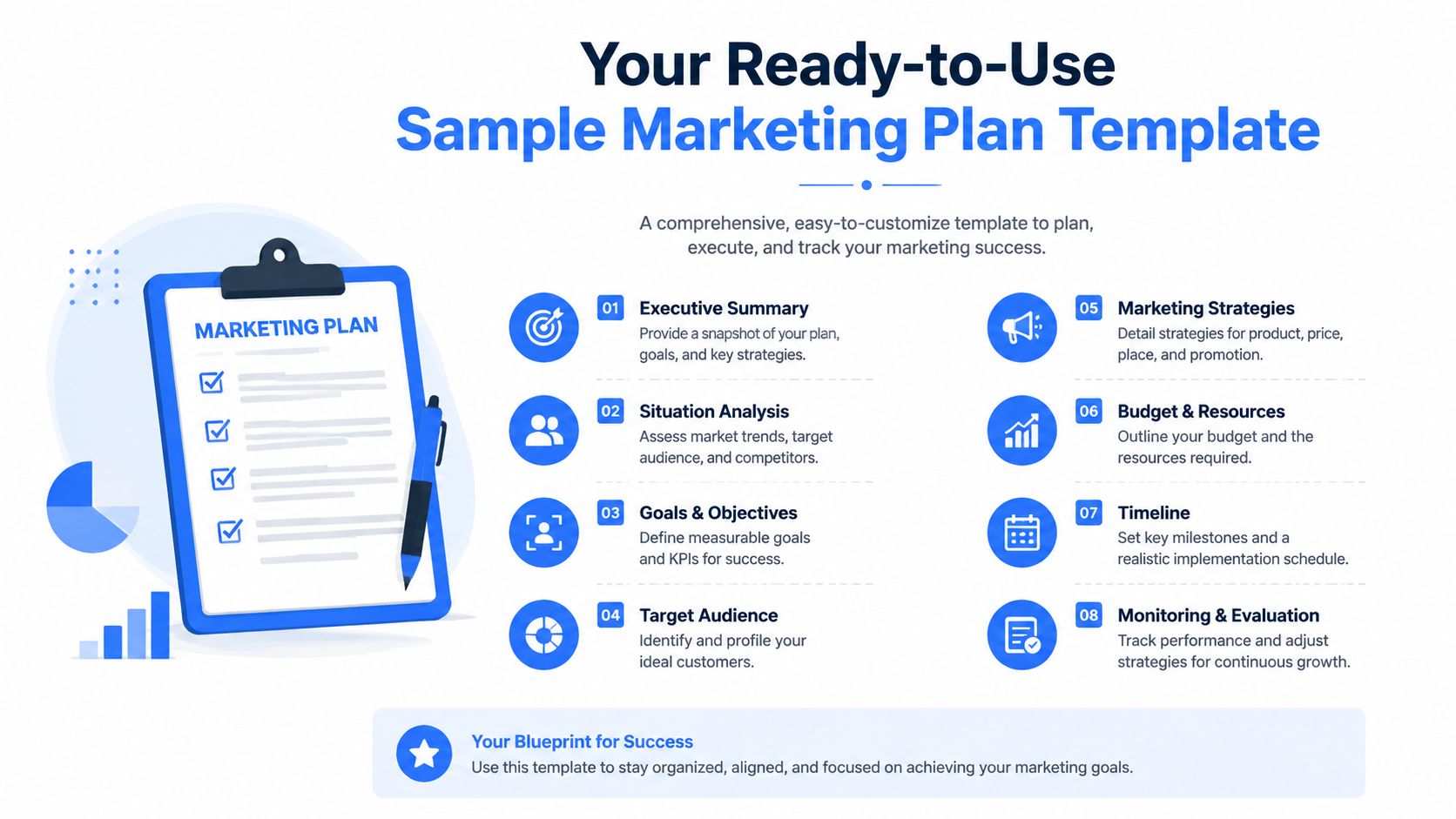
Agents can adapt the following structure for a listing, buyer campaign, neighborhood campaign, or brokerage-wide program.
Campaign objective: Define the transaction or qualified conversation the campaign should produce.
Audience: Name the buyer or seller segment, property category, service area, motivation, and likely objections.
Message: Write one core promise, three supporting points, and one proof element.
Channel mix: Assign a visibility channel, a local discovery channel, a conversion page, and a nurture sequence. Add events or print only when they support a tracked next step.
Virtual tour integration: Add the tour to the listing page, email, social posts, QR-enabled print materials, and follow-up. Record tour opens, engagement, form activity, and source.
Launch checklist:
- Before launch: Confirm photography, copy, tracking, forms, links, and response ownership.
- Launch day: Publish the listing, tour, short-form content, email, and selected paid distribution.
- Weekly: Review source quality, follow up with active prospects, refresh local content, and log objections.
- Quarterly: Compare channels, segments, property categories, cost allocation, and downstream conversion.
Copy prompts: “Explore the layout before scheduling a showing.” “See how the rooms connect.” “Request the property details and choose the next step.” “Book a conversation about homes that fit this search.”
A plan earns its place when the team can explain what each activity does and what evidence supports continuing it.
Virtual Tour Easy helps real estate teams create immersive property tours, publish them through shareable links and embeds, capture leads, and connect tour activity to analytics. Visit Virtual Tour Easy to build a measurable virtual-tour layer for the next listing campaign and give qualified prospects a clearer path from exploration to action.