The hotel is busy enough to look healthy, yet the monthly channel report tells a different story. Direct bookings sit below the level the commercial team wants, OTA commissions absorb margin, and the marketing calendar is full of campaigns that generate activity without proving their contribution to net revenue. The usual response is to add another paid campaign or refresh social content. That response misses the core problem.
A hotel marketing strategy should be managed as a channel-economics system. Each channel buys something different, whether that's reach, conversion, repeat demand, guest data, or short-term occupancy. The commercial question isn't just which channel produces bookings. It's which channel produces the most profitable booking while preserving the hotel's ability to market to that guest again.
Table of Contents
- Why Hotel Marketing Is Really a Channel Economics Problem
- Setting Objectives Personas and the Direct Versus OTA Math
- Building the Channel Mix That Actually Fills Rooms
- Merchandising the Property With Content and Virtual Tours
- Measuring What Works in a Zero Click and AI Discovery World
- Budget Allocation and a 90 Day Implementation Roadmap
- The 90 Day Playbook Distilled Into Decisions and Warning Signs
Why Hotel Marketing Is Really a Channel Economics Problem
A hotel can post healthy occupancy and still lose margin through the wrong channel mix. An OTA may fill a need date quickly, yet its commission reduces the booking's contribution and the platform retains much of the guest relationship. A direct reservation usually gives the property greater control over the booking path, guest data, merchandising, and post-stay communication. Occupancy and rate matter, but they do not explain the full commercial result.
That is why a hotel marketing strategy should start with channel economics, not a checklist of campaigns. The question is not which channel produces room nights. It is which channel creates profitable demand, what the booking costs to acquire, and whether the hotel can market to that guest again.
Direct demand has gained strategic importance. The D-EDGE industry report records direct revenue share rising from 23.6% in 2019 to 29.5% in 2023, a 24% increase over the period (D-EDGE hotel industry benchmark data). Separate hotel industry benchmark data also shows that direct bookings and OTAs can each represent substantial portions of a property's revenue, depending on the hotel and its market. Channel mix therefore affects both margin and control.
Commercial rule: A booking earns its value only after acquisition cost, commission, cancellation exposure, and future relationship value are included.
Every channel buys a different asset
- OTAs buy distribution and demand access. Use them for new-market visibility, last-minute demand, and occupancy gaps. Accept the trade-off: the platform controls much of the guest interaction.
- Paid search buys immediate visibility. It captures existing intent, particularly around branded searches. It does little to create demand that was not already present.
- SEO and content build owned discoverability. They require sustained effort before results mature, then can support direct acquisition without a commission on every reservation.
- Email and CRM buy retention. They let the hotel reactivate past guests, tailor offers, and create demand for need periods.
- Metasearch supports comparison and direct conversion. Its return depends on accurate rate presentation, a capable booking engine, and the property's ability to convert high-intent visitors.
The channel mix is the strategy. Campaigns are execution. A hotel that measures only clicks or bookings will miss the value and cost of the asset each channel provides.
Channel Economics at a Glance
| Channel | Effective Cost per Booking | Margin Retained | Data Ownership |
|---|---|---|---|
| OTA | Commission-based and often material | Lower after commission | Limited hotel control |
| Paid search | Media cost per click or conversion | Depends on conversion efficiency | Moderate, subject to platform limits |
| SEO and content | High upfront effort, lower long-run acquisition cost | Strong once demand compounds | High on owned channels |
| Direct booking engine | Technology and acquisition costs | High relative to commission-led distribution | High |
| Email and CRM | Platform, creative, and list-management costs | Strong for repeat demand | High |
| PR and partnerships | Relationship and production investment | Variable, often valuable for originating demand | Moderate to high |
Do not eliminate OTAs. Assign them a job. Use intermediaries where they provide reach the hotel cannot efficiently create, while directing sustained investment toward owned channels that originate demand and preserve the guest relationship. A property that relies on in-market search alone is renting demand. A stronger strategy builds demand it can reach directly.
Setting Objectives Personas and the Direct Versus OTA Math
A hotel can fill rooms and still weaken its business if each booking carries too much acquisition cost. Set the commercial objective first, identify the guests who can produce it, then calculate the value of each channel.
Make direct-booking share the lead objective, supported by cost per acquired room night and marketing-sourced RevPAR contribution. Reach, impressions, and clicks belong in the diagnostic layer. They do not belong at the top of the scorecard. More traffic is a poor result if net contribution falls.
Direct revenue has gained ground, while OTAs still control a substantial part of hotel distribution, as the D-EDGE data cited earlier shows. The response should be commercial rather than ideological. Keep OTA demand that earns its cost, and measure what the hotel pays for the reach, conversion, and guest access those platforms provide.
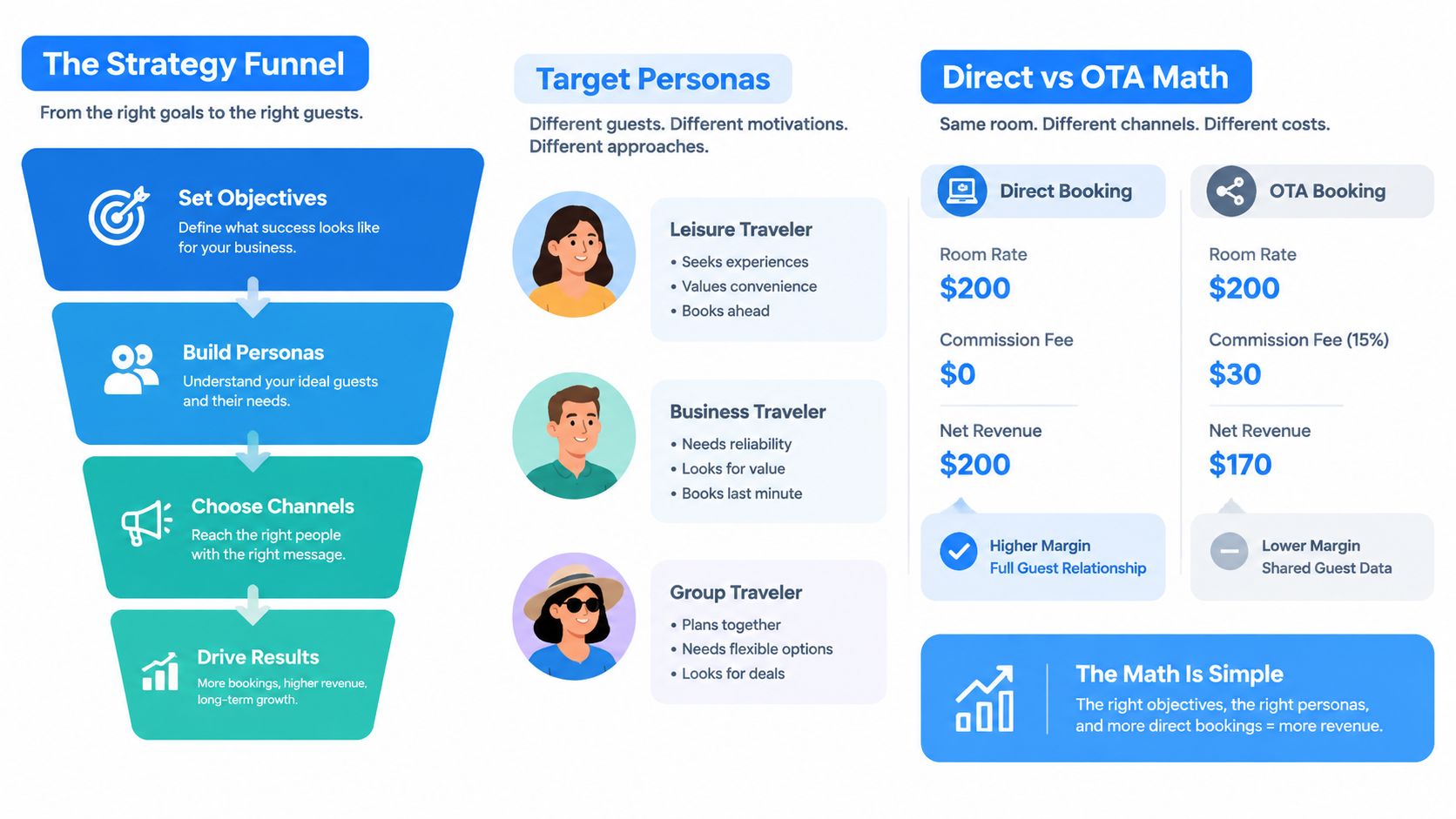
Segment by booking behavior
Demographics rarely explain channel economics well. Booking behavior does.
- The rate-sensitive OTA loyalist compares aggressively, values platform convenience, and may respond to a direct value add more readily than to a small rate difference.
- The experience-driven independent planner researches the property, neighborhood, amenities, and room details before booking. This guest needs persuasive owned content and a booking engine without friction.
- The corporate transient buyer prioritizes reliability, policy clarity, location, and repeatability. A structured landing page, negotiated offer, and concise email path can outperform lifestyle creative.
Give each persona a primary message, preferred channel, likely objection, and defined conversion event. The hotel's room pages and booking path must make those differences clear. Teams assessing their digital presentation can use hotel website design inspiration as a reference point, then judge every page against actual booking questions.
Run the booking math
For every segment, compare four measures:
- Acquisition cost: commission or media cost tied to the room night.
- Contribution margin: revenue remaining after acquisition and distribution costs.
- Relationship value: ability to collect consented first-party data and encourage a future stay.
- Ancillary potential: room upgrades, dining, parking, spa, meetings, or local experiences that can be presented directly.
Put the decision rules on one commercial page:
| Objective | Key result | Owner | Review rhythm |
|---|---|---|---|
| Increase profitable direct demand | Direct share moves toward the property's approved target | Commercial and marketing lead | Weekly |
| Reduce avoidable distribution cost | Cost per acquired room night is reported by channel | Revenue manager | Weekly |
| Improve booking quality | Look-to-book and cancellation patterns are visible by source | E-commerce lead | Weekly |
| Build repeat demand | Consent-based guest audiences receive lifecycle communication | CRM owner | Monthly |
The goal is not to force every guest into a direct booking. It is to make every channel accountable for the margin, demand, and guest relationship it produces. An OTA can earn its place when it creates reach the hotel cannot efficiently generate. Owned channels should receive sustained investment because they preserve access to the guest and help the property originate demand instead of renting it from a marketplace.
Building the Channel Mix That Actually Fills Rooms
A hotel with weak midweek demand needs a different channel mix from a resort protecting peak-season rates or a roadside property filling last-minute gaps. Start with the demand problem, then assign each channel a commercial job. Do not let a platform's sales pitch decide the plan.
SEO and content should receive sustained investment because they can create demand before a traveler chooses a hotel. Destination guides, neighborhood pages, meeting content, room comparisons, and experience-led itineraries attract guests earlier in the decision process. They require accurate commercial intent, consistent publishing, and patience. They will not repair occupancy overnight.
OTAs work best as targeted distribution. Use them to reach travelers unfamiliar with the brand, capture short booking windows, and support weak periods. Their cost and limited guest access make broad, permanent dependence expensive. Set an OTA role by market, date, room type, and need period, then remove that support when direct or repeat demand can carry the dates.
The direct booking engine and metasearch convert demand already close to a decision. Rate displays must be clear, mobile journeys fast, cancellation policies easy to understand, and room pages specific enough to answer practical questions. A metasearch listing that sends visitors to a slow or confusing booking path only pays to expose a problem.
Paid search needs a contribution threshold. Branded campaigns can protect visibility and send existing demand to the hotel's booking path. Non-branded campaigns require a credible landing page, a defined audience, and enough expected contribution to justify the spend. Buying generic destination clicks without a conversion plan is a cost, not a strategy.
Social and influencer activity can create desire for lifestyle properties, resorts, and distinctive independent hotels. It has less influence when guests mainly choose on price, location, or basic convenience. Match the channel to the reason people book, not to the channel's popularity.
Email and lifecycle marketing deserve regular funding because the hotel already has permission-based guest relationships. Pre-arrival, post-stay, abandoned-booking, and need-period messages can support retention and reactivation without rebuilding the acquisition funnel for every stay.
PR and partnerships give the property a reason to visit beyond the room. Local attractions, restaurants, event organizers, universities, employers, and travel creators can connect the hotel to demand that paid media may struggle to create.
Channel Mix Allocation by Property Type
Use the table as a planning framework, not a fixed formula. Adjust it after contribution reporting and demand forecasting.
| Channel | Urban Hotel % Spend | Resort % Spend | Roadside % Spend | Primary Role |
|---|---|---|---|---|
| SEO and content | 25% to 35% | 25% to 35% | 25% to 35% | Capture and originate qualified demand |
| Direct engine and metasearch | 15% to 20% | 15% to 20% | 15% to 20% | Convert high-intent traffic |
| Paid media | 25% to 35% | 25% to 35% | 25% to 35% | Defend demand and target need periods |
| Email and lifecycle | 10% | 10% | 10% | Retain and reactivate guests |
| PR and partnerships | 5% to 10% | 5% to 10% | 5% to 10% | Create demand and local relevance |
| OTA support | Tactical | Tactical | Tactical | Fill gaps and extend reach |
The allocation intentionally favors originating demand in owned channels. The discussion of first-party data, AI personalization, and zero-click discovery reinforces that shift (hotel marketing trends and zero-click search). Hotels that only chase travelers already searching for accommodation compete at the most expensive point in the funnel. Build demand you can reach again, then use OTAs selectively to cover the gaps your owned channels cannot fill.
Merchandising the Property With Content and Virtual Tours
A room page must sell the stay before a guest contacts reservations. Show the view, bed configuration, usable space, bathroom, accessibility, policies, and best-fit use case on one page. Requiring several tabs or a phone call to answer basic questions creates avoidable booking friction.
Use a clear content hierarchy:
- Hero image: Show the actual room from the guest's perspective, with scale and layout visible.
- Decision details: Surface bed type, occupancy, view, bathroom features, and working space.
- Proof of fit: Use captions and short descriptions to identify the guest or trip the room suits.
- Commercial clarity: Place rates, inclusions, cancellation terms, and the booking call to action near the decision.
- Technical structure: Add descriptive alt text, fast-loading assets, and structured data suited to the hotel and room content.
Stock photography strips away the property's context. Owned channels should show real room types, public spaces, event areas, the arrival experience, and nearby reasons to stay. Short mobile clips should load quickly and communicate one feature at a time. Keep clips under 15 seconds as a production constraint, not as proof of a particular performance result.
Choose immersion by commercial job
Static photography remains efficient and necessary, but guests must infer scale and movement from still images. A virtual tour lets them inspect connected spaces, room layouts, amenities, and event areas without leaving the booking path. Guidance on virtual tours and hotel bookings reports roughly three times more conversion opportunities than static imagery alone. Treat that figure as a sourced industry claim, then judge the asset by its placement and revenue contribution.
| Format | Production Cost | Time-on-Page Lift | Direct Conversion Lift |
|---|---|---|---|
| Static photography | Low to moderate after a scheduled shoot | Limited to moderate | Foundational |
| Virtual tour | Moderate, depending on capture and build method | Potentially strong through exploration | Designed for multiple booking CTAs |
| Video tour | Moderate to high, depending on scripting and editing | Strong when story-led | Useful for emotional and experiential decisions |
Assign each format a commercial job. A tour buried on an “About” page supports branding. Embedded beside room selection, venue inquiry, or upgrade content, it supports conversion. Teams reviewing property merchandising and promotion can also consult marketing strategy from Global for planning context.
Virtual Tour Easy can create and publish immersive hotel tours from generated panoramas, transformed regular photos, or existing 360-degree images. Its visual builder includes scenes, hotspots, information panels, audio, starting views, booking links, analytics, lead capture, and connections with GA4 or GTM. Configure those features around a specific booking or inquiry path, rather than publishing an impressive tour with no measurable next action.
Measuring What Works in a Zero Click and AI Discovery World
A hotel can appear to win on direct traffic while missing the discovery that created it. A traveler may find the property in search, an AI-generated answer, a map interface, or a conversation with an assistant, then return later through a bookmark or typed URL. Analytics records the final route as branded direct traffic, even when another channel created the demand.
Judge performance through financial, behavioral, and brand indicators:
- RevPAR: Shows whether marketing-sourced demand improves commercial performance.
- Direct booking share: Measures control over profitable distribution.
- Cost per acquisition by channel: Exposes media and commission trade-offs.
- Look-to-book ratio: Reveals friction between consideration and reservation.
- Net Promoter Score: Adds a guest advocacy signal to acquisition reporting.
Treat zero-click discovery as an evidence problem
A zero-click interaction produces no conventional session, UTM parameter, or cookie. An AI assistant can recommend a property in a chat response, after which the traveler books through another route. Standard analytics cannot assign that influence with confidence.
Build extra signals instead of forcing false precision:
- Run periodic brand-lift surveys. Ask how guests first heard about the property, separating search, OTA, recommendation, social, PR, and AI-assisted discovery.
- Review server logs and landing patterns. Examine crawler activity, unusual referral behavior, and changes in direct visits after major content releases.
- Track branded search as a directional proxy. Rising branded interest can indicate stronger demand, but it does not prove one channel created it.
- Add a check-in prompt. A tagged email or booking message can ask guests which campaign or content influenced their decision.
- Maintain an assisted-conversion view. Record content exposure, email engagement, metasearch interaction, and final booking source separately.
Use this conversion tracking setup guide to connect booking actions, events, and campaign signals without purchasing an enterprise CDP.
Report channel contribution, not only last-click bookings. The revenue team should label assumptions, preserve raw observations, and protect owned-channel investment when incomplete attribution makes an OTA or paid channel look more productive than it is. The measurement goal is better budget decisions, not a perfectly explained customer journey.
Budget Allocation and a 90 Day Implementation Roadmap
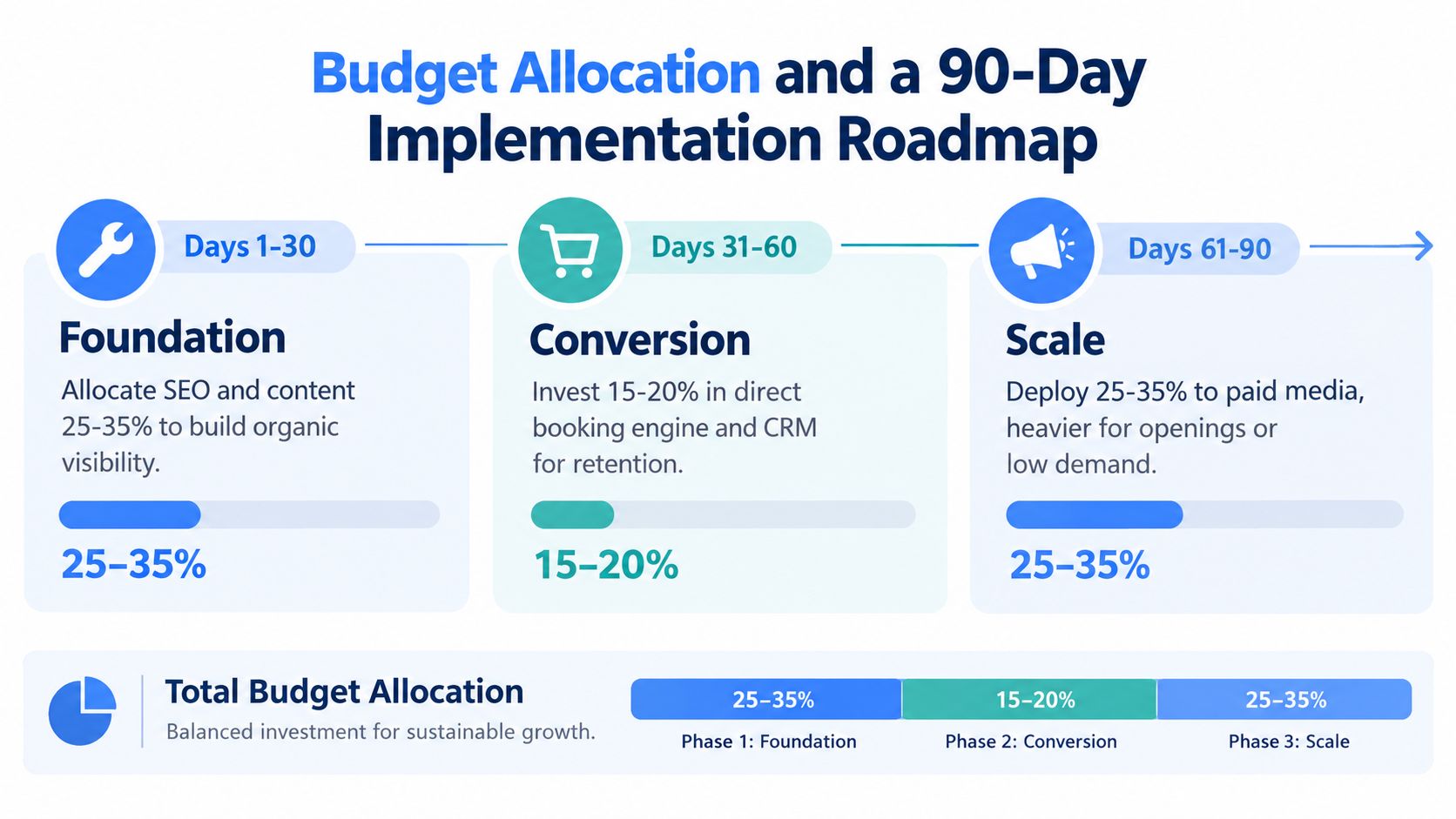
A hotel budget should answer one question: which channels create profitable demand and which channels only capture it? Allocate funds around need periods, direct contribution, and guest ownership, then revise the mix as performance changes. A practical starting framework assigns 25% to 35% to SEO and content, 15% to 20% to the direct booking engine and CRM, 25% to 35% to paid media, 10% to email and lifecycle, and 5% to 10% to PR and partnerships. These ranges guide planning. They do not guarantee results.
Paid media deserves more weight during an opening, a weak demand period, or a period of low direct share. Protect SEO and content because cutting them whenever occupancy softens increases dependence on channels that charge for access on every booking. Owned channels should originate demand, not merely receive traffic created elsewhere.
Days 1 to 30 build the foundation
Start with a commercial baseline. Review channel cost, net ADR, cancellation behavior, and direct versus OTA contribution. Record RevPAR, direct share, acquisition cost, look-to-book ratio, and booking-engine abandonment. Refresh the primary personas using booking behavior and guest feedback.
Check rate parity, room names, policies, photography, and landing-page consistency. Verify analytics events for search, room selection, booking starts, completed bookings, and lead forms. These checks expose whether the problem sits in demand generation, merchandising, or conversion.
The first checkpoint is a signed baseline report. Without it, later budget changes become opinion rather than controlled decisions.
Days 31 to 60 activate the mix
Turn the baseline into limited, accountable activity:
- Publish or improve content for priority destination and room-intent themes.
- Launch branded paid search and one clearly scoped non-branded campaign.
- Build abandoned-booking, pre-arrival, post-stay, and need-period email flows.
- Review OTA room presentation and availability rules.
- Improve room merchandising, adding an immersive tour when layout, scale, views, or amenities need explanation.
- Hold a weekly channel contribution meeting with marketing, revenue, and reservations.
Every active channel needs an owner, a purpose, a cost, and a defined conversion event. Traffic growth alone is not a checkpoint. A channel that produces visits without acceptable net contribution should not receive more budget because its dashboard looks busy.
Days 61 to 90 optimize contribution
Use the final phase to make explicit trade-offs. Test booking-engine copy, room comparison layouts, value-add messaging, and calls to action. Compare direct conversion by device, audience, room type, and landing page. Review assisted conversions and survey responses beside last-click reporting, then shift variable spend toward channels producing acceptable net contribution.
Set rules for when OTA exposure expands, narrows, or pauses by need period. Present a 90-day commercial review with actions for the following quarter. The review should identify which channels originated demand, which converted existing intent, and which consumed budget without enough return.
For a 120-room independent hotel operating at approximately 70% occupancy, scale the template from revenue rather than copying a fixed amount. Apply the allocation ranges to the approved marketing revenue base, reserve a variable portion for need periods, and keep technology, content, and lifecycle costs visible as separate line items. The right budget connects spending to net contribution and guest ownership. A larger spreadsheet total does not make the channel mix better.
The 90 Day Playbook Distilled Into Decisions and Warning Signs
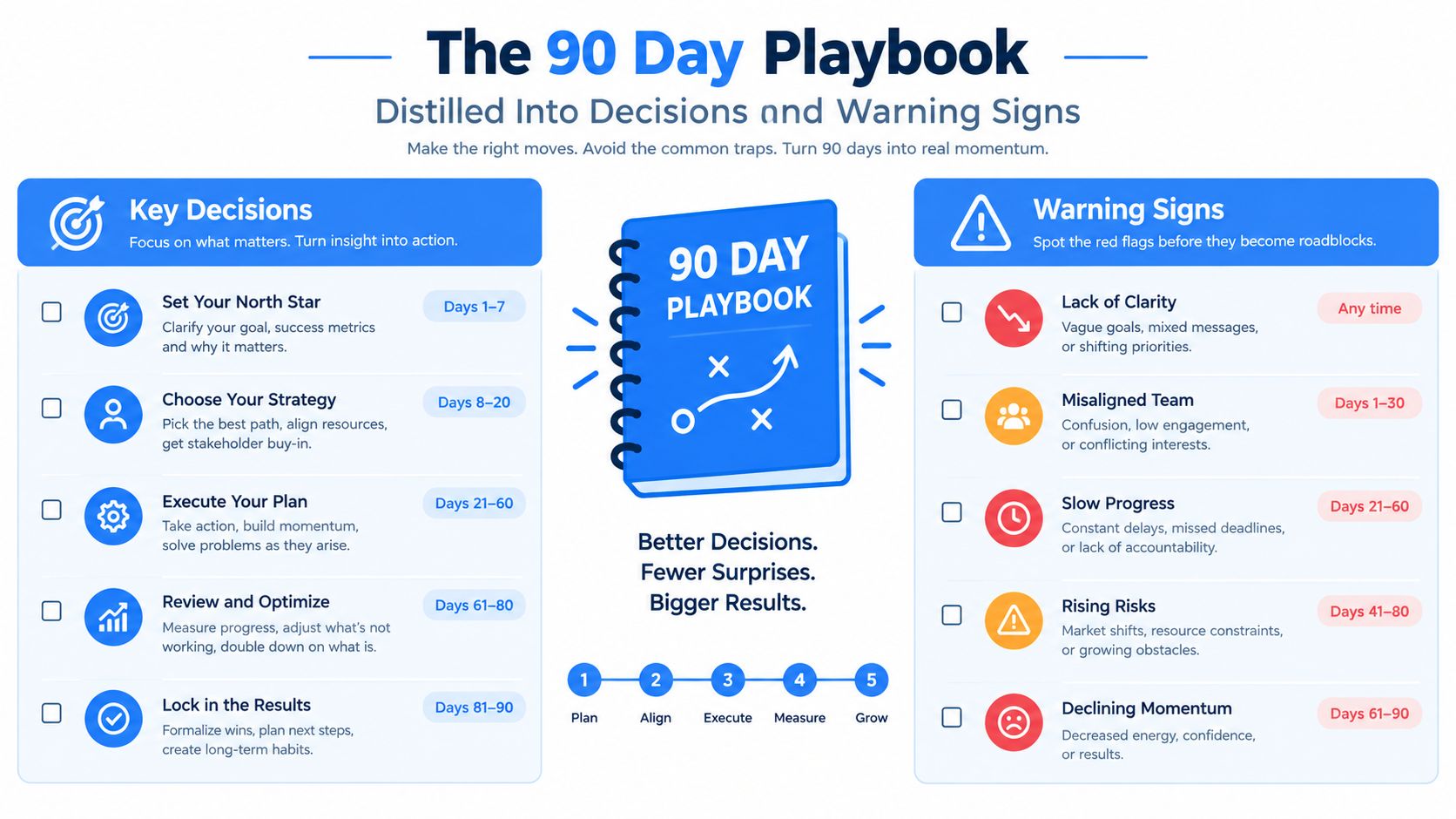
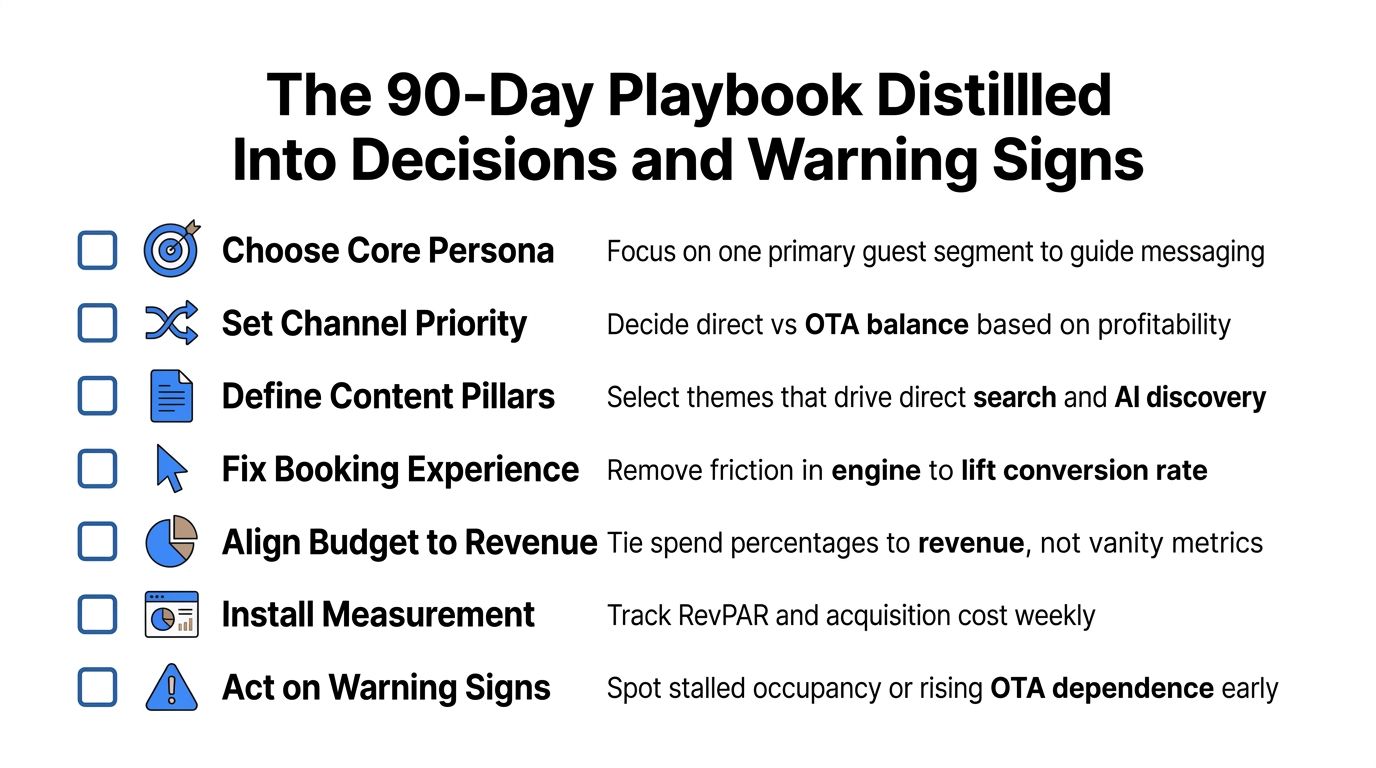
A hotel marketing strategy fails when the team protects familiar channels instead of making commercial choices. Treat every channel as an investment with a job, a cost, and a margin consequence. Assign ownership to these seven decisions.
Choose the first persona. Begin with the segment showing clear demand, a credible property fit, and a realistic route to direct booking. Generic creative and weak landing-page relevance signal that the campaign is trying to address everyone.
Set the direct-share target. Base it on property economics, market position, and guest mix, then make revenue and marketing accountable to the same target. If direct share stays flat after the first 90 days, inspect the booking experience and direct value proposition before blaming SEO.
Select the two priority channels. Put discretionary budget behind channels that originate demand or convert existing intent profitably. Scattered minor tests indicate that the property has no clear channel thesis.
Choose the lead merchandising format. Static photography is required. Properties with meaningful differences in layout, views, or amenities should add a virtual tour or video. Repeated guest questions reveal missing or unclear product information on the page.
Name the north-star KPI. RevPAR contribution from marketing-sourced demand is a stronger commercial anchor than traffic alone. If sessions rise while net contribution falls, reporting is rewarding attention rather than value.
Protect variable budget. Keep funds available for need periods, openings, and sudden demand gaps. A budget committed months ahead leaves revenue managers unable to respond to the calendar.
Define the firing rule. Reduce a channel's budget when its net contribution, data value, or strategic role no longer covers its cost. Rising OTA dependence alongside underfunded direct content, CRM, and booking-engine improvements means the hotel is renting demand instead of building owned demand.
Hotels commonly fail by treating marketing as a campaign calendar. A stronger portfolio view gives each channel a defined role, cost, margin effect, and measurement plan. Traffic matters only when it creates profitable demand, stronger guest relationships, or a deliberate long-term position. Prioritize originating demand through owned channels instead of relying on in-market search and OTA visibility alone.
Virtual Tour Easy helps hotel teams create immersive 360-degree tours from generated panoramas, transformed photos, or existing 360-degree images, then add hotspots, booking links, analytics, and lead capture to conversion-focused pages. Marketers assessing virtual merchandising for rooms, amenities, or event spaces can visit Virtual Tour Easy and build a tour-led direct-booking test.