A buyer opens a showroom link late at night, finds the product or space difficult to understand from flat images, and closes the tab before contacting anyone. The sales team may never know whether the problem was distance, scheduling, uncertainty about scale, or a lack of useful information. A physical showroom can create confidence, but it can't serve every visitor at the moment they're ready to explore.
A virtual showroom turns that missed visit into an interactive digital experience. Visitors can examine a room, product collection, venue, or design concept from a phone or computer, then move from curiosity toward a qualified inquiry without arranging an appointment. The strongest virtual showroom benefits aren't limited to convenient access. They include richer buyer understanding, measurable interaction data, and lower reliance on repeated travel, samples, and physical coordination.
That distinction matters. A polished virtual space can look modern while producing little commercial value if nobody tracks what visitors inspect or follows up on meaningful actions. This guide separates the practical benefits from the symbolic ones, explains where the model works best, and shows how teams can build an experience that supports sales rather than merely decorating a website. For a concise foundation on the broader format, the guide to 360 virtual tours offers useful context.
Table of Contents
- Introduction Why Virtual Showrooms Matter Now
- What a Virtual Showroom Is and How It Works
- Key Benefits That Make Virtual Showrooms Worth It
- Virtual Showroom Benefits Across Real World Use Cases
- Measuring ROI and Performance With Real Metrics
- How to Implement a High Converting Virtual Showroom
- Examples FAQs and Next Steps for Your Virtual Showroom
Introduction Why Virtual Showrooms Matter Now
A property buyer living in another city may need to compare several homes before booking travel. A hotel planner may need to understand guest flow, meeting-room access, and reception layout before requesting a proposal. A school administrator may want to inspect facilities while coordinating with colleagues who can't all attend an open day. In each situation, physical-only viewing creates friction at exactly the point when interest is still fragile.
A virtual showroom keeps the experience available beyond opening hours and geographical boundaries. It doesn't replace every physical visit, especially for products that require touch, fitting, testing, or personal reassurance. Instead, it helps visitors answer early questions before a salesperson, agent, designer, or admissions team invests time in a live conversation.
The commercial value comes from reducing uncertainty. A photograph can show a surface, while a video can demonstrate movement, but an interactive tour lets a visitor choose the path and inspect details in context. Hotspots can explain materials, link to specifications, introduce a team member, or connect an area to a form. The visitor gets more control, and the business gains more opportunities to understand intent.
The shift from access to evidence
The phrase “available 24/7” describes only the starting point. A useful showroom also records visits, device information, geography, and interaction patterns, subject to the business's privacy and consent practices. Those signals can help a team distinguish a casual visitor from someone who repeatedly examines a product detail or returns to a high-value area.
That's why virtual showroom benefits vary by implementation. A tour embedded on a relevant landing page, connected to lead capture, and reviewed during sales follow-up can support a measurable funnel. A beautiful scene with no clear next step may remain a passive viewing tool. The guide's central question is therefore practical: what does the experience help a buyer decide, and what does it help the business learn?
What a Virtual Showroom Is and How It Works
A virtual showroom works like a digital twin that visitors can walk through. The twin may represent a real property, retail space, hotel, campus, studio, or display area. It can also present a designed environment that communicates a product range or concept before the physical version exists.
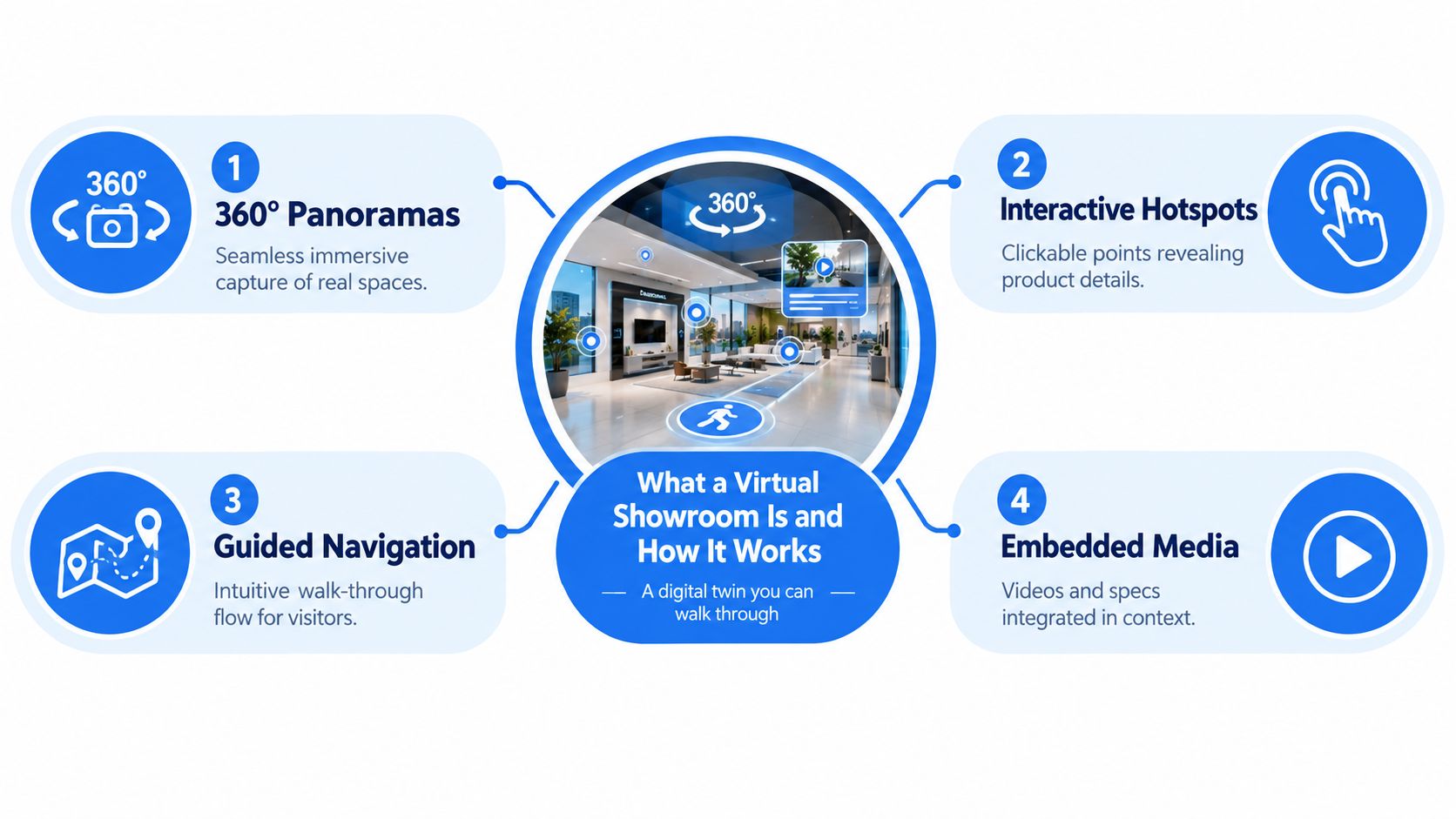
The experience usually develops through a few connected layers:
The visual layer
A 360-degree panorama gives visitors a view in every direction from a fixed point. Several panoramas can connect into a navigable sequence, allowing movement from a reception area to a product zone, from a hotel lobby to a guest room, or from one architectural space to another. Unlike a photo gallery, the visitor controls the viewpoint and decides which detail deserves attention.
Specialized cameras aren't always required. Some platforms can create panoramas from text prompts, transform regular photographs into 360-degree scenes, or accept existing 360-degree images. That flexibility lets a team choose between a fast concept presentation, a digitally enhanced space, and a faithful capture of a physical location.
The interaction layer
Hotspots act like signs placed inside the environment. A tap can open a product description, display a specification sheet, play a video, reveal an audio explanation, or move the visitor to another scene. The information appears where the question arises, rather than forcing the visitor to leave the showroom and search through separate pages.
Guided navigation creates a recommended route, while free navigation gives visitors room to explore. A strong experience supports both. A first-time visitor can follow a clear story, while a highly motivated buyer can jump directly to the product, room, or feature that matters most.
The conversion and measurement layer
Lead forms, booking buttons, enquiry prompts, and contact options turn inspection into an actionable step. Analytics can then show views, visitors, device information, geography, and behaviour within the tour. Integrated tools such as GA4 or Google Tag Manager can connect those interactions with broader website reporting.
A virtual showroom isn't automatically a sales tool because it contains immersive imagery. It becomes one when visual exploration, useful information, a clear next action, and measurement work together.
Key Benefits That Make Virtual Showrooms Worth It
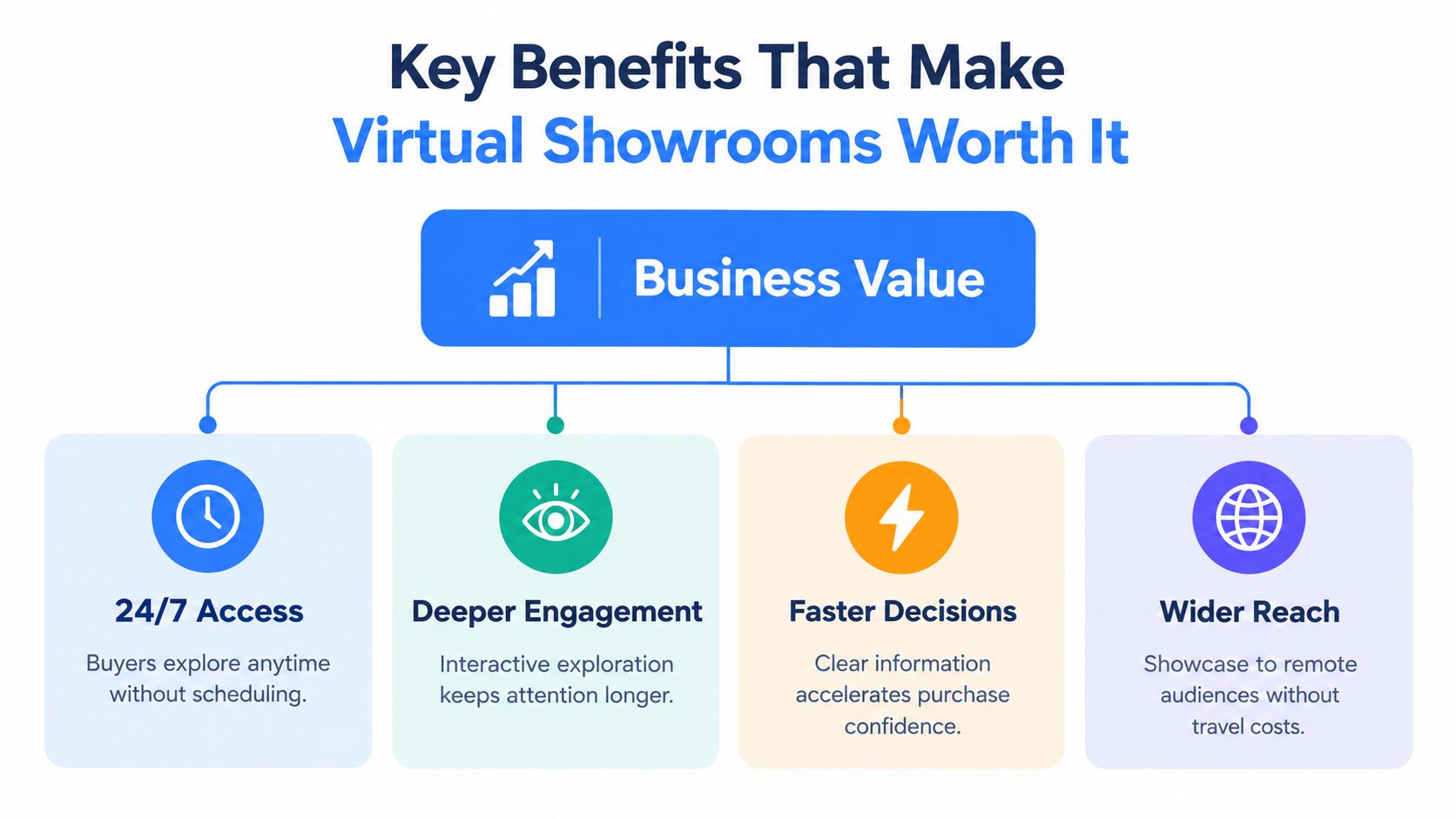
A property team receives enquiries from several time zones. A furniture brand presents samples to a buyer who cannot travel. In both cases, the benefit comes from removing a specific buying obstacle, then observing what the visitor does next. Virtual showroom benefits become meaningful when they improve access, reduce uncertainty, lower coordination costs, or produce useful funnel signals.
Access without appointment friction
Visitors can explore when interest appears, including outside staffed hours. That helps international audiences, shift workers, busy property buyers, and decision groups whose calendars rarely align. Access does not guarantee a sale, but it keeps a promising moment from ending as a missed lead.
More useful engagement
Interactive exploration gives visitors reasons to pause, inspect, compare, and return. Industry coverage reports that listings with virtual tours attracted 87% more views, five to ten times longer time on site, and 31% faster closings than comparable listings without them. Those figures describe a particular market context, so they should guide questions rather than serve as a forecast for every category (PhotoUp's real-estate virtual tour statistics).
Engagement becomes more valuable when it reveals intent. A visitor who opens specifications, revisits a scene, and then submits an enquiry has shown a different level of interest from someone who only loads the opening view.
Better decision confidence
A buyer can assess layout, scale, product relationships, and surrounding context before committing to a call or visit. The MDPI analysis of virtual showrooms and omnichannel retail finds that these experiences can improve consumer surplus and social welfare when offline travel costs are not too low, because richer product information reduces fit uncertainty and improves matching.
Central insight: A virtual showroom earns its place by reducing information asymmetry, not by looking futuristic.
Lower physical coordination
One digital environment can support remote presentations, early qualification, and internal alignment. Industry analysis describes possible reductions in shipping, storage, sample production, travel, and waste where teams repeatedly move physical materials between markets (the TeliportMe analysis of virtual tour software). The financial case is strongest when sample churn or travel burden is already high. A digital asset alone does not create those savings.
Teams can connect each benefit to a management question:
| Benefit | Business Outcome | Metric to Track |
|---|---|---|
| Always-on access | More remote and after-hours opportunities | Visitor activity by time and geography |
| Interactive detail | Stronger product or space understanding | Hotspot and media interactions |
| Guided qualification | More relevant enquiries | Form completions and enquiry quality |
| Lower coordination burden | Fewer unnecessary visits or sample exchanges | Travel, sample, or presentation activity replaced |
| Better content insight | More informed follow-up | Frequently viewed scenes and return visits |
For acquisition teams, the showroom should support a wider organic traffic growth strategy. Search visibility brings visitors in, while clear information and a visible next action help turn attention into enquiry. An outdoor-design business could let prospects explore visual concepts before contacting a specialist, with garden ai design offering a relevant example of early-stage visual planning.
Virtual Showroom Benefits Across Real World Use Cases
The same virtual showroom can act like a remote sales assistant, a product guide, or a planning workspace, depending on the buyer's decision. Its value is measurable when it reduces uncertainty, improves qualification, or replaces costly coordination. A polished 24/7 viewing experience alone may create attention without changing the sales process.
Real estate
A buyer's first question is often, “Does this property fit my needs?” A navigable tour lets remote prospects inspect room relationships, entrances, finishes, and surrounding context before arranging an in-person viewing. Interaction data can show which areas deserve attention during follow-up. The tour still supports, rather than replaces, disclosure, inspection, and physical due diligence.
The HBS working paper examining roughly 75,000 home sales found that virtual tours were associated with about a 1.1% increase in sale prices in one specification. An earlier benchmark discussed with that analysis found a 2% to 3% price bump, while the newer price effect became statistically insignificant after controls for better photos and captions were added (the Harvard Business School working paper). The practical lesson is narrow but useful: tours work best as part of strong digital merchandising, not as a substitute for it.
Hotels and venues
Event planners need to test a possible guest journey before committing time to a site visit. A virtual tour can connect meeting rooms, entrances, dining areas, breakout spaces, and amenities in one navigable story. That structure helps planners qualify a venue remotely and gives sales staff clues about the spaces that matter most.
The remaining question is emotional fit. Does the venue feel right for the event? Embedded video, audio, floor plans, and an enquiry form can provide context, but complex bookings still benefit from a sales conversation.
Retail and durable goods
Retail buyers may need to understand how products work together, while high-consideration purchases often depend on human reassurance. Peer-reviewed research found that a live showroom increased monthly offline sales by 6.5%, while a 360-degree showroom without human interaction reduced offline sales by 6.6%. In the studied setting, used cars saw 8.6% growth with live showrooms, compared with a 13% decline for new cars (the SSRN virtual showroom study).
The lesson is about fit. A self-guided showroom may support research, while a live-assisted version can matter more when trust and explanation influence the purchase.
Education and architecture
Schools can present facilities to families who cannot attend immediately. Architects can let clients examine spatial concepts before construction or revision. In both settings, the showroom creates a shared reference point for discussion.
Access is only the starting benefit. Clear labels, guided paths, and embedded explanations help visitors interpret what they see, so visual spectacle does not carry the entire experience.
Measuring ROI and Performance With Real Metrics
A virtual showroom can attract attention without producing business value. Set the measurement plan before launch so the team can distinguish casual browsing from useful inspection, qualified interest, and progress toward a sale.
Start with reach and attention. Views show whether people open the experience, while time on site suggests how long they stay. Neither figure proves engagement on its own. A long session could mean careful inspection, confusion, or an unattended browser tab. Pair duration with scene visits, hotspot activity, media plays, and return behaviour to see what visitors do.
The next layer measures commercial movement. Track form completions, booking requests, product enquiries, assisted conversions, and closing speed. These actions connect the showroom to outcomes that matter. Analytics can show which rooms, products, or information points visitors explored before submitting a form. A CRM can pass that context to sales staff, helping them tailor follow-up instead of sending every lead the same response.
What the available evidence says
Industry benchmarks associate virtual tours with stronger listing views, longer visits, and faster property closings than comparable listings without tours (the cited real-estate market statistics). Treat those figures as reference points rather than promises. Listing quality, audience, market conditions, placement, and tour quality can all affect the result.
As noted earlier, the HBS analysis found that the price association weakened after better photos and captions were included as controls. The surrounding content package may explain part of the apparent advantage, so businesses should compare complete experiences rather than treat the tour as an isolated feature (the HBS working paper on virtual tours and home sales).
A useful comparison is a shop with a door counter and a sales log. The counter records visits. The log shows what people examined, what they asked about, and whether someone followed up.
A practical tracking sequence
- Baseline the current journey. Record existing views, enquiries, conversion behaviour, and closing speed before changing the presentation.
- Tag meaningful interactions. Track scene changes, hotspot clicks, media plays, form starts, and form completions.
- Connect behaviour to follow-up. Mark leads who interacted with the showroom, then compare their progress with other leads.
- Review quality, not only volume. Look for qualified enquiries, repeat visits, and actions that precede commercial conversations.
Research on immersive-tour analytics examines what visitors inspect, where they hesitate, and which paths relate to conversion (the ACM research on immersive tour analytics). Teams can apply the same logic by treating interaction data as funnel intelligence. A guide to conversion tracking setup explains how to connect those actions to a wider reporting process.
How to Implement a High Converting Virtual Showroom
A successful implementation starts with the buying decision, not the camera or software. The team should identify the question visitors need answered, the evidence that will answer it, and the action that should follow.
Build the visual foundation
A team can capture existing 360-degree imagery, create scenes from regular photographs, or generate a concept environment from a text description. Existing spaces benefit from accurate imagery, while early product or architectural concepts may benefit from generated scenes. Each scene should have a purpose, such as orientation, comparison, proof, or conversion.
Add a deliberate visitor path
Start visitors at the point that explains the offer fastest. A hotel might open at the entrance and guide visitors toward the main event space. A property agent might open on the most informative room rather than a decorative hallway. Drag-and-drop hotspots, labels, info panels, audio, and embedded video can provide context without forcing visitors into a separate document.
A platform such as Virtual Tour Easy can create immersive tours from text descriptions, regular photos, or existing 360-degree images, then assemble scenes with hotspots and embedded media. It also supports shareable links, website embeds, analytics, lead forms, and integrations with GA4 and Google Tag Manager.
Connect exploration to action
Every important route should lead toward a clear next step. Useful options include a consultation form, viewing request, product enquiry, booking prompt, or downloadable specification. Forms should ask only for information the sales or service team can use, because unnecessary fields add friction without improving qualification.
Test the experience like a buyer
Check the tour on mobile and desktop devices, confirm that scene transitions load properly, and make sure labels remain understandable without spoken narration. A starting view should orient visitors immediately. Audio should be optional rather than forced, and branding should support recognition without covering the experience.
Common failures include oversized media, confusing navigation, outdated product details, missing accessibility considerations, and analytics that record views but not meaningful interactions. Teams should also define ownership for updates. A showroom that accurately reflects current inventory or spaces can support trust, while an abandoned one can create the opposite impression.
Examples FAQs and Next Steps for Your Virtual Showroom
A photographer can use a virtual tour as an interactive portfolio, helping prospects inspect the quality and range of work before a call. A real-estate firm can use scene visits and form activity to prioritise follow-up. A hospitality brand can guide planners through a venue, while a school can provide a remote introduction to facilities for families and staff.
Common questions
Does engagement guarantee buying intent? No. Longer browsing can mean interest, but it can also mean confusion. Interaction data becomes valuable when teams connect it to forms, enquiries, and sales conversations.
Is a virtual showroom sustainable in every category? Not automatically. The strongest cost and environmental case appears where digital presentation replaces repeated travel, sample production, storage, or physical coordination. The payback depends on the category, operating model, and update workload.
Should a business start with a large digital environment? A focused experience is usually easier to test. One property, venue, product collection, or flagship concept can reveal which scenes and interactions help visitors move forward.
The next step is to select one buyer question, build a short route around it, add one measurable conversion action, and review behaviour after launch. That process turns virtual showroom benefits from a vague promise into a working experiment with evidence.
Virtual Tour Easy offers an AI-powered way to create 360-degree showroom experiences from text prompts, regular photos, or existing 360-degree images, with hotspots, lead capture, and analytics for measurable follow-up. Visit Virtual Tour Easy to start with a focused virtual showroom and connect visitor exploration to the sales decision.