A growing travel agency often reaches the same awkward point. Customers want to search and book online, but the agency doesn't have an engineering team to connect airlines, hotels, payment providers, cancellation workflows, and customer accounts. Sending customers to a large online travel agency protects convenience, yet it weakens the agency's brand and control over the customer relationship.
A white label travel portal offers a middle path. The operator presents a booking experience under its own name, domain, design, and commercial rules, while a technology provider supplies much of the distribution and reservation infrastructure behind the scenes. The arrangement can shorten the path to market, but it doesn't remove the need for careful supplier selection, operational planning, or compliance.
Table of Contents
- The Branded Booking Site Most Operators Never Build From Scratch
- How a White Label Travel Portal Actually Works
- Who Uses White Label Travel Portals and Why
- Core Features That Make a White Label Travel Portal Worth Buying
- Integration, Customization, and the Technology Stack Behind the Portal
- Pricing Models and the Cost of Running a Portal
- Why One Global Portal Is Not Automatically Competitive Everywhere
- Choosing the Right White Label Travel Portal for Your Business
The Branded Booking Site Most Operators Never Build From Scratch
Consider a boutique hotel whose owner wants guests to book rooms directly from the hotel's website. A custom booking engine would require supplier connections, availability logic, payment handling, confirmation messages, refunds, and staff tools. Sending guests to an external OTA would be easier, but the guest would leave the hotel's environment and the hotel would have less control over the booking journey.
A white label travel portal places the hotel's identity at the front of that process. Customers see the hotel's logo, colors, domain, room descriptions, prices, and support details. Behind the interface, the provider may manage the search engine, inventory connections, reservation records, payment workflow, and booking documents. The same model can serve a retail agency selling flights, a tour operator selling packages, or a destination company combining transfers and activities.
The distinction matters because a portal isn't just a website template. It's a branded delivery layer over travel commerce infrastructure. The operator still needs to decide which products to sell, how to price them, how to handle customer service, and which markets to target.
Three routes to an online booking channel
A business normally chooses among three approaches:
- Custom development: Maximum control over design and workflows, but the operator carries the burden of building and maintaining the booking stack.
- Third-party resale or affiliate sales: Fast access to inventory, but the supplier's brand and customer journey may remain prominent.
- White-label delivery: A branded interface with external technology and supplier connectivity behind it.
That choice resembles a broader build, buy, or integrate decision. A practical framework for AI strategy can also help an operator evaluate ownership, integration effort, internal capability, and long-term operating responsibility before signing a technology contract.
The phrase white label means the technology provider's identity is largely removed from the customer-facing experience. It doesn't mean the operator owns every underlying system. The agency or hotel owns the visible relationship, while the platform provider supplies the machinery that makes search and booking possible. Businesses unfamiliar with the term can also review this explanation of what white-label branding means before comparing portal vendors.
How a White Label Travel Portal Actually Works
The simplest way to understand a portal is to separate it into two layers.
The front end is the branded experience. It includes the domain, navigation, search forms, filters, product pages, checkout, account area, confirmations, and customer messages. The back end connects to travel suppliers and performs the less visible work, such as checking availability, calculating prices, creating reservations, issuing documents, and recording status changes.
The model has deep roots. SABRE, developed by American Airlines and IBM, began automating reservations in the 1960s and could process more than 7,000 bookings per hour by 1964. Travel agencies gained access in 1976, and by 1985 more than 10,000 agencies used SABRE, according to this history of the GDS model. Amadeus was established in 1987 by Air France, Lufthansa, Iberia, and SAS. In 2006, internet reservations exceeded GDS reservations for the first time.
The booking journey behind the screen
A typical transaction follows this sequence:
- A traveler searches for a route, room, transfer, activity, or package.
- The portal sends the request to connected suppliers.
- The integration layer converts different supplier responses into a consistent format.
- The customer compares normalized offers on the branded interface.
- The portal checks availability again where required, authorizes payment, and submits the booking.
- The system stores the supplier reference and sends confirmation or a pending-status message.
- Staff manage changes, cancellations, refunds, vouchers, and customer questions through operational tools.
This historical progression explains why white-label portals exist. Agencies no longer need to recreate every supplier relationship and reservation workflow internally, just as agency terminals previously provided access to airline inventory without each agency building its own airline system.
A white-label portal differs from a simple resale or affiliate arrangement because the operator controls the brand presentation and customer relationship. In an affiliate flow, the customer may be redirected to another domain or see another company's identity. In a white-label flow, the platform should feel like the operator's own booking channel, even though external infrastructure remains underneath.
Who Uses White Label Travel Portals and Why
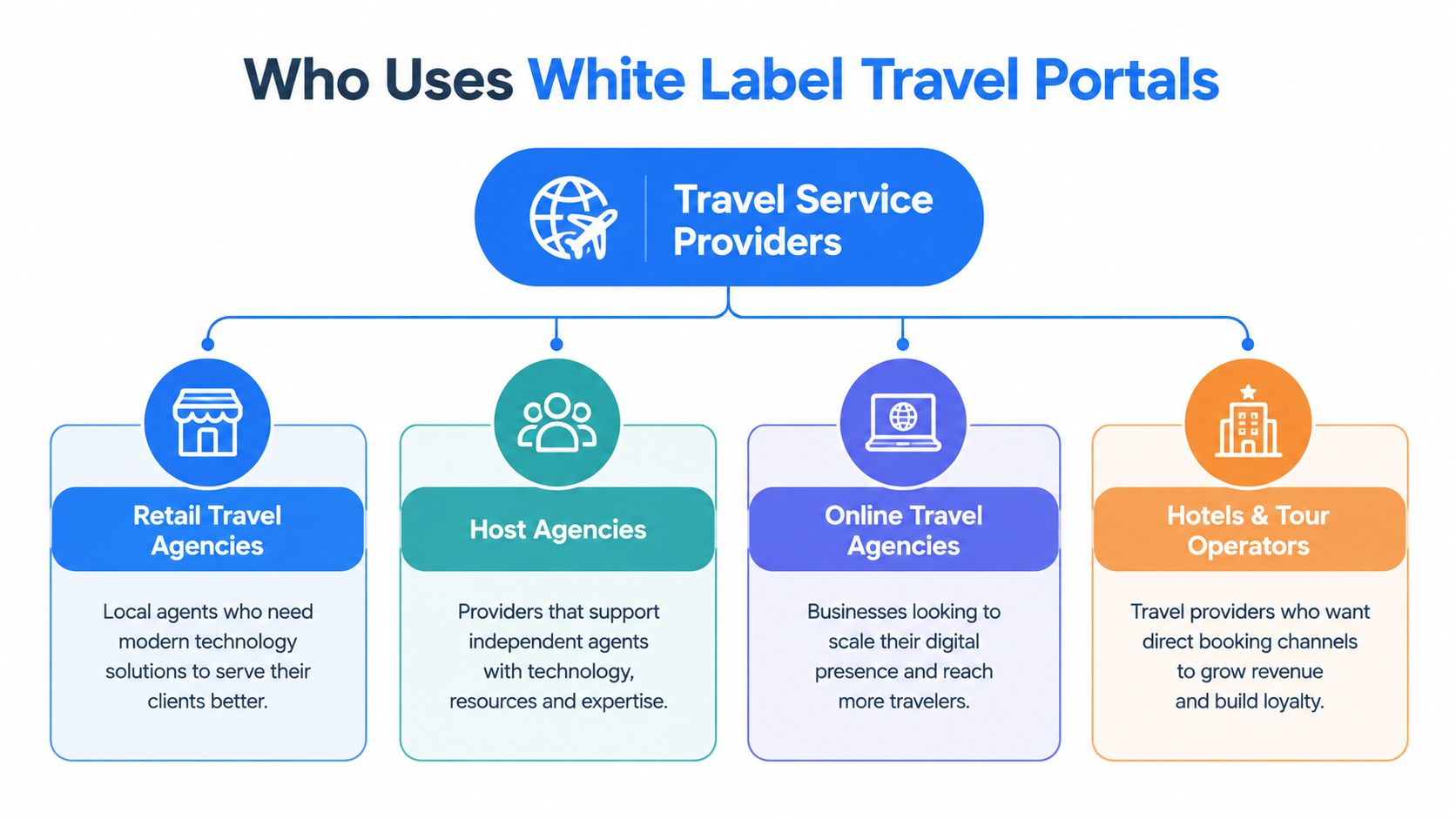
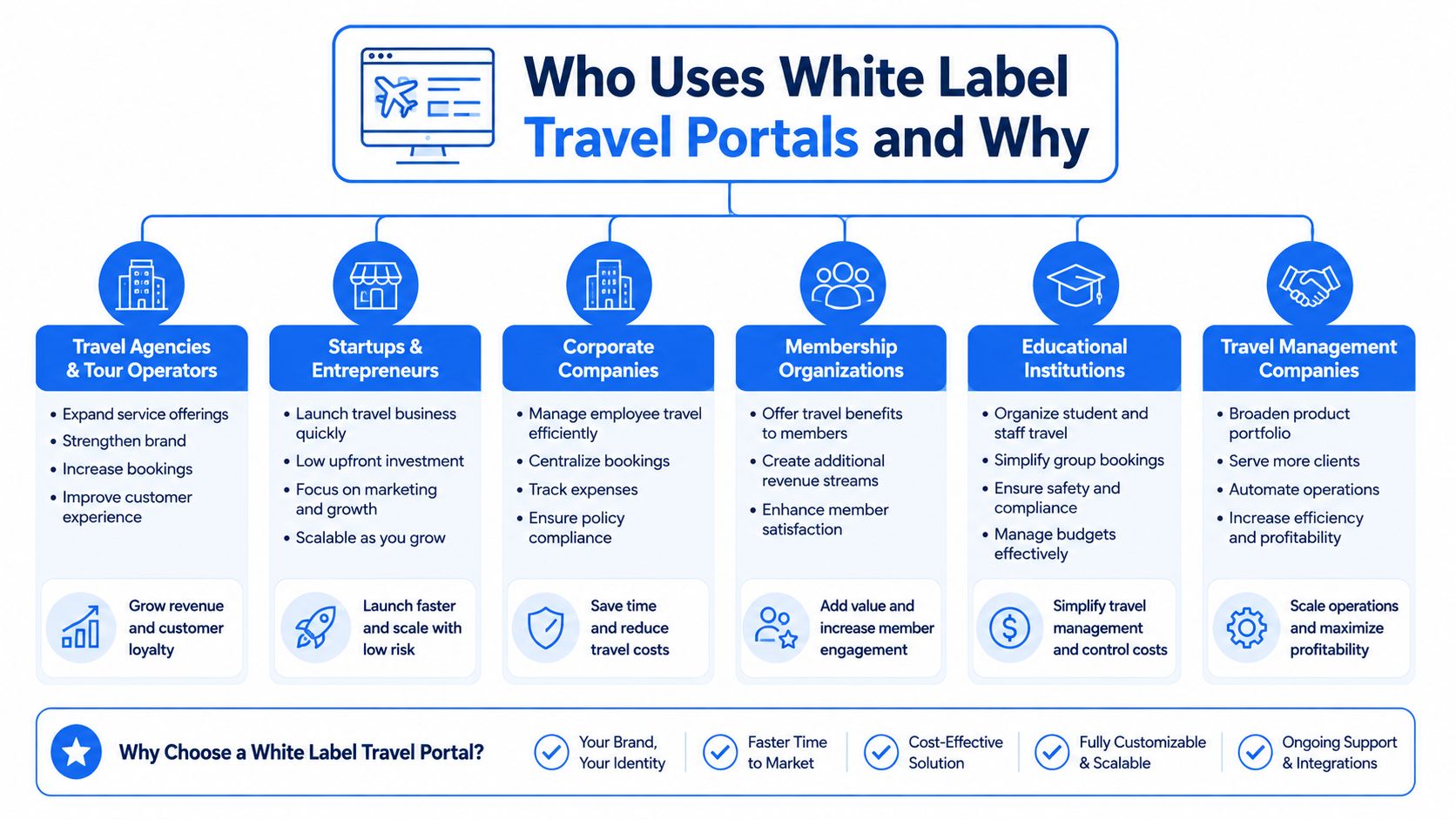
The buyer profile isn't limited to online travel agencies. A portal fits any organization that needs to sell travel products digitally without developing a complete distribution stack.
A retail travel agency may use it to offer flights, hotels, transfers, or activities alongside consultation-led sales. The agency can combine online self-service with human support and apply its own markup or commission rules. A host agency can provide branded booking tools to affiliated agents, while controlling accounts, permissions, and commercial settings centrally.
An online travel agency usually needs a scalable customer-facing channel. A white-label platform can provide a quicker route to a branded storefront, but the operator still has to test supplier quality, pricing, payment behavior, and support processes before expanding.
Hotels and tour operators have different priorities. A hotel may want more direct demand under its own brand. A tour operator may need to present packages, add-ons, transfers, and activities as one coherent product rather than as disconnected supplier listings. Destination management companies can use a portal to distribute regional services, while corporate travel desks may need controlled access, traveler profiles, approval rules, and reporting.
The market is large, but access isn't automatic
Phocuswright data reported in January 2025 estimated that global online travel bookings would reach approximately $1 trillion in 2024 and grow to $1.2 trillion by 2026. The same report placed North America at about $342 billion, Asia-Pacific at approximately $285 billion, and Europe at $254 billion in 2024, as reported by TravelPulse's coverage of the forecast.
Those figures show why branded booking channels attract agencies, hospitality businesses, and travel sellers. They don't prove that every portal will win demand. The operator still needs a clear audience, relevant inventory, useful localization, and a service model that works after payment.
Businesses serving hospitality audiences may also benefit from studying travel hospitality for Sitecore users, particularly when a booking portal must fit into a broader customer experience ecosystem. For operators focused on excursions and activities, online tour booking software provides a useful adjacent reference point.
Core Features That Make a White Label Travel Portal Worth Buying
A portal's feature list should be judged by the work staff must perform every day, not by the number of items printed in a sales brochure. Search, checkout, pricing, account management, reporting, and servicing need to operate as one connected workflow.
The customer-facing layer should support clear search forms, filters, sorting, responsive pages, multiple currencies, multiple languages, traveler details, fare or cancellation conditions, and transparent totals. A flight portal may need fare families and ancillary services. A hotel portal may need room policies, meal plans, taxes, and availability rechecks. A package seller may need to combine several components into one itinerary.
Features that affect revenue and control
Markup and commission rules deserve particular attention. A serious B2B portal may need agency-level pricing, sub-agent accounts, supplier-specific markups, currency overrides, credit limits, booking permissions, and hierarchical roles. A consumer widget rarely handles those requirements well.
The back office should also support:
- Booking operations: Search records, supplier references, vouchers, invoices, and status history.
- Post-booking service: Cancellations, amendments, refund requests, failed bookings, and pending confirmations.
- Communication: Branded email templates, payment receipts, booking updates, and customer notifications.
- Reporting: Sales, margins, commissions, supplier performance, cancellations, refunds, and outstanding balances.
- Administration: User roles, tenant separation, branding settings, payment configuration, and audit records.
A portal that supports booking but leaves cancellations and refunds to spreadsheets has only automated the easiest part of the business. Operators should test real scenarios, including a payment success followed by delayed supplier confirmation, before treating a feature as production-ready.
| Capability | What it does | What good looks like |
|---|---|---|
| Search and availability | Retrieves travel options and prices | Fast filters, clear rules, and availability checks before purchase |
| B2B account control | Manages agencies, agents, and sub-agents | Hierarchical roles, permissions, credit settings, and account-level pricing |
| Pricing management | Applies markup and commission logic | Supplier, product, currency, and partner-specific rules |
| Payment handling | Collects and records customer payments | Tokenized checkout, verified webhooks, refunds, and reconciliation |
| Post-booking servicing | Handles changes after purchase | Cancellation rules, vouchers, support queues, and status history |
Operators comparing portal products with broader agency tooling can also review this guide to a website portal for digital agencies. The useful question isn't whether a vendor has a dashboard. It's whether the dashboard gives staff enough control to resolve a real customer issue without contacting engineering.
Integration, Customization, and the Technology Stack Behind the Portal
Travel suppliers don't all speak the same technical language. Modern providers commonly expose REST/JSON APIs, while legacy GDS platforms and many bedbanks continue to use SOAP/XML. Airline NDC is an XML-based, voluntary data-exchange standard designed to support richer airline content, as explained in this overview of the travel technology stack.
A capable portal hides that variation from the customer and, ideally, from most business logic. Supplier adapters translate each external format into common objects such as offers, travelers, availability, fare rules, ancillaries, booking records, and ticketing details.
Why normalization matters
Without an integration layer, supplier-specific rules spread into search, checkout, fulfillment, and support. Adding or changing one connection can then create regressions across unrelated parts of the portal.
A stronger design separates:
- Supplier adapters: Handle each provider's authentication, schema, limits, and errors.
- Orchestration services: Coordinate searches, price checks, bookings, ticketing, and asynchronous responses.
- Canonical models: Give the front end a consistent representation of offers, travelers, rules, and records.
- Booking ledger: Records requests, responses, status transitions, supplier references, and reconciliation results.
The system also needs retry rules, timeouts, idempotency, and reconciliation. Idempotency prevents a repeated request from creating duplicate bookings when a response is delayed. Reconciliation compares portal, payment gateway, and supplier records so staff can identify a payment that succeeded while a supplier confirmation remains pending.
Payment security changes the design
Card data creates a compliance obligation under PCI DSS when it is stored, processed, or transmitted. A lower-risk pattern uses hosted payment fields or tokenization. The payment gateway receives the card details, while the portal stores a token and non-sensitive transaction metadata.
That approach still requires governance. The operator needs a clear responsibility split with the gateway, restricted access, MFA for relevant administrative systems, vulnerability management, monitoring, signed webhook verification, and appropriate PCI documentation. For multi-tenant portals, payment settings, refund permissions, webhook routing, audit logs, and personal data must remain isolated between businesses.
Practical rule: A small operator should judge architecture by the incident it prevents, not by the diagram shown during a sales demo.
Pricing Models and the Cost of Running a Portal
A portal quote can look simple at first. Then the detail shows up. What appears to be a software fee is often a mix of platform access, supplier connectivity, servicing tools, and support around a branded booking layer that still depends on older CRS and GDS style distribution underneath.
Most proposals fall into three models. Subscription pricing means a recurring platform fee, which makes budgeting easier if the scope is clear. The key question is whether supplier access, support, test environments, customization, and post-booking tools are part of that fee or sold separately.
Per-booking pricing ties cost to activity. That can suit an operator that wants a lower starting commitment, but each transaction fee needs to be tested against margin, especially once volume rises. Hybrid pricing combines a base fee with usage charges. It can spread risk between provider and operator, but it also makes the commercial picture harder to read because one part of the bill is predictable and the other moves with demand.
| Model | Main advantage | Main question |
|---|---|---|
| Subscription | Easier recurring-budget planning | Which features and support services are included? |
| Per booking | Lower commitment before demand develops | How does each transaction affect margin as sales increase? |
| Hybrid | Balances fixed and variable costs | What volume assumptions make the combined fee workable? |
The platform fee is only one cost line. Supplier access, payment gateway charges, custom design, training, data migration, support, monitoring, and post-booking staffing may sit elsewhere in the proposal. A portal can also create costs after launch through manual reconciliation, failed transactions, refund handling, supplier fallbacks, and slower customer support.
Many operators underestimate spend.
A weak integration does not remove cost. It pushes cost from the software budget into staff time. One failed booking can trigger payment checks, supplier follow-up, customer communication, and a manual refund. If price or availability mismatches keep appearing, margin can leak away even while the front end still looks polished and functional.
A practical comparison model should include:
- Fixed platform costs: Subscription, hosting, administration, and required modules.
- Variable transaction costs: Booking fees, payment charges, supplier charges, and refunds.
- Implementation costs: Branding, integrations, migration, testing, and training.
- Operating costs: Service staff, reconciliation, support, compliance, and incident response.
- Commercial leakage: Failed bookings, incorrect markups, delayed refunds, and unavailable fallback inventory.
The cheapest portal on paper can end up costing more if your team has to do work the system should have handled. In travel distribution, the branding layer is what the customer sees. The operating cost sits beneath it, in every exception your staff must clean up. A vendor's support process matters as much as its setup price.

Why One Global Portal Is Not Automatically Competitive Everywhere
A global supplier connection can create the impression that an operator has global competitiveness. It doesn't. Inventory access is only useful when the products, prices, policies, payment methods, and language fit the target customer.
The online travel market is large, but distribution varies by category and region. A connection that performs well for hotels may not provide the same depth for cruises, rail, activities, or locally important operators. Pass-through connections can also make it difficult to determine who owns the customer relationship, who handles servicing, and where the final availability or price originates.
APAC data illustrates the problem. Agoda's online travel share rose from 16.4% in 2022 to 20.9% in 2025, while wholesaler and tour-operator share nearly tripled from 1.8% to 5.1%. Hotel direct-booking-engine share fell from 11.8% to 11.2% over the same period, according to Phocuswright's regional market insights.
Questions a local market test should answer
Before launching in a new geography, the operator should verify:
- Supplier reality: Which connections are live, and which are only promised or routed through another intermediary?
- Inventory fit: Are the relevant hotels, airlines, transfers, activities, and regional operators available?
- Price behavior: Do taxes, fees, commissions, and cancellation conditions appear correctly for local customers?
- Payment access: Can customers use suitable local payment methods and currencies?
- Language and policy: Are search content, support messages, terms, and cancellation rules localized?
- Service ownership: Can staff resolve changes and refunds without depending on an overseas queue?
A white-label portal should therefore be treated as a multi-source distribution strategy, not a globally rebranded template. The best platform may use different suppliers for different regions and categories. Localization isn't a cosmetic layer added after launch. It determines whether the inventory is commercially useful.
Choosing the Right White Label Travel Portal for Your Business
The right provider should be evaluated as an operating partner, not just as a website vendor. Branding is the first test, but it isn't the hardest one. A credible portal should support a custom domain, secure delivery, branded notifications, customized design, and a clear explanation of whether the experience is fully white-label or co-branded.
Supplier depth deserves equal scrutiny. The operator should ask which connections are live, whether they are direct or pass-through, which products they cover, and how the provider handles supplier outages. A long supplier list doesn't guarantee useful inventory in the operator's target market.
A decision framework for buyers
The following criteria help turn a sales conversation into a practical evaluation:
- Brand ownership: Can the operator control the domain, customer-facing identity, emails, policies, and support presentation?
- Integration maturity: Does the platform support the required REST, SOAP, XML, and NDC connections through a normalized architecture?
- Payment posture: Does it use hosted fields or tokenization, verify webhooks, restrict administrative access, and explain PCI responsibilities?
- Operational depth: Can staff manage amendments, cancellations, refunds, pending bookings, vouchers, and reconciliation?
- Commercial clarity: Does the quote identify subscription charges, booking fees, supplier costs, gateway charges, customization, and support?
- Localization: Can the operator configure currency, language, taxes, payment methods, cancellation rules, and regional inventory?
- Tenant controls: For B2B use, can the system isolate accounts, permissions, pricing, payment settings, and customer data?
A useful white-labeling software guide can help clarify the broader difference between visible branding and the ownership of the underlying service. In travel, that distinction should be written into the contract rather than left to interpretation.
The shortlist test
Before signing, the operator should:
- Request a live demonstration using a realistic search and test booking.
- Ask for a reference customer in the same category and target market.
- Read the service-level agreement, escalation process, and refund responsibilities.
- Test a failed payment, delayed confirmation, cancellation, and partial refund.
- Model total cost at low, medium, and high booking volumes.
- Confirm how supplier changes, security incidents, and data requests are handled.
Operational standard: The right portal is the one that remains dependable on a Tuesday night when a flight cancellation creates several rebookings and refunds, not merely the one that looks polished during a launch presentation.
A white-label travel portal can give an agency, hotel, or tour operator a branded digital sales channel without recreating decades of travel-distribution infrastructure. The value appears only when the platform combines genuine supplier coverage, localization, secure payments, transparent economics, and dependable post-booking operations.
Virtual Tour Easy helps hospitality and travel businesses create branded immersive experiences with custom domains, interactive hotspots, lead capture, analytics, and team workflows. Visit Virtual Tour Easy to explore how a stronger visual layer can support the customer journey around a travel portal.