A listing has just gone live, the photos look polished, and the agent has shared it across social channels. Yet the inquiries are weak, the comments are mostly from other agents, and the next showing still depends on buyers asking basic questions that the listing could have answered online. That gap usually isn't a logo problem. It's a brand experience problem.
Effective real estate brand marketing helps buyers understand what a firm offers, trust the people behind its listings, and take a useful next step. The brand has to work across search, social, property pages, immersive media, and follow-up, not just on signs and business cards. The aim isn't to collect attention for its own sake. It's to make digital experiences informative enough to qualify interest before a showing.
Table of Contents
- Why Real Estate Brand Marketing Starts Before the Search
- Positioning, Visual Identity, and Brand Voice
- Virtual Tours and 360° Assets as Brand Infrastructure
- Content Marketing with AI That Does Not Erode Trust
- SEO, Local Search, and Paid Acquisition
- Social Proof, Community, and Lead Capture
- Measurement That Connects Brand to Deals
- Your 90-Day Real Estate Brand Marketing Rollout
Why Real Estate Brand Marketing Starts Before the Search
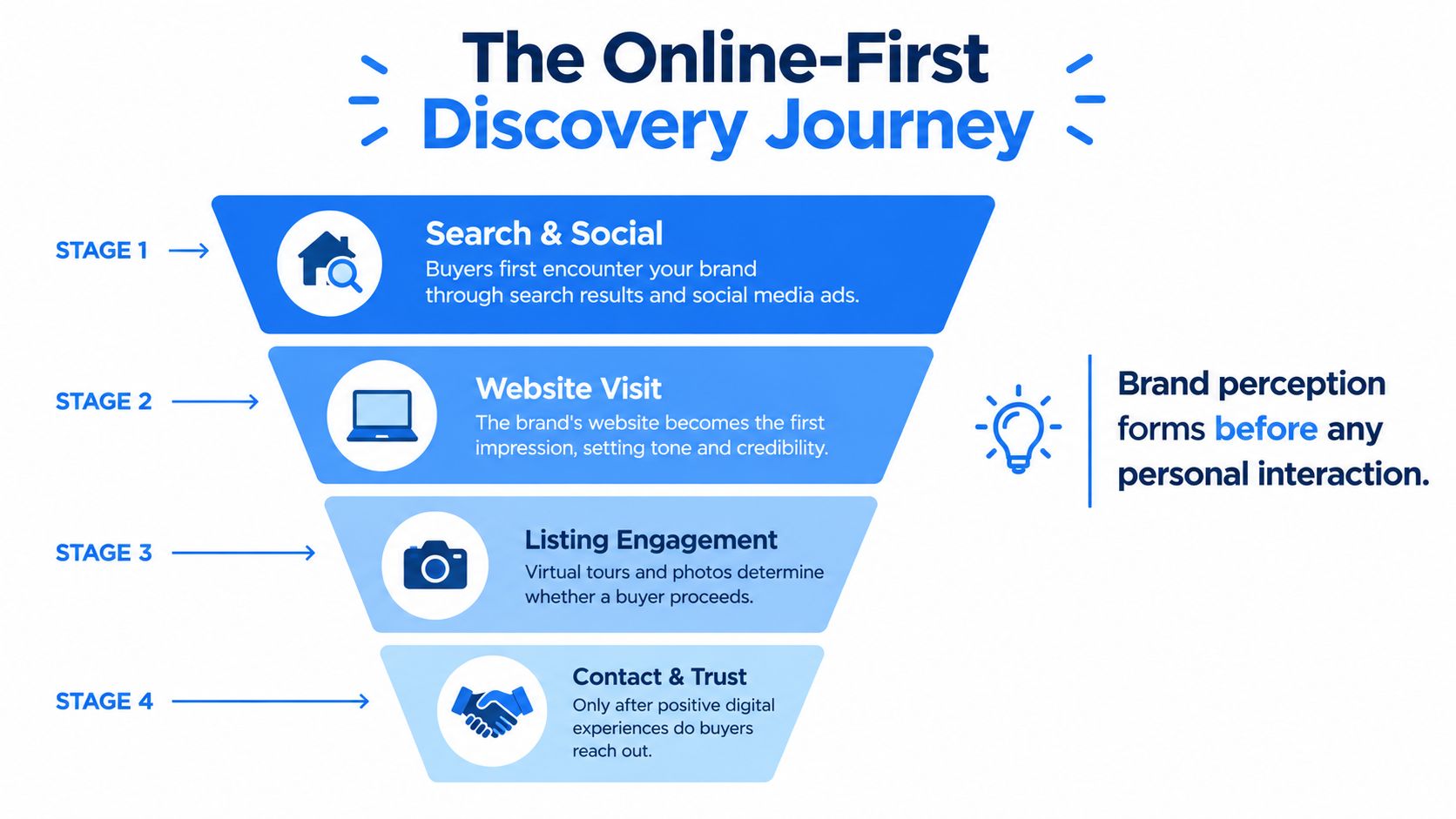
A buyer can encounter an agent's brand before seeing an office, a yard sign, or the property in person. The first impression might come from a search result, a social post, a property page, or a virtual tour. Each interaction contributes to the buyer's judgment about whether the agent understands the home and can be trusted with the next step.
That journey is mainstream, not a side channel. In NAR's 2024 Profile of Home Buyers and Sellers, 43% of buyers began their home search online, and all buyers used the internet at some point; buyers searched for a median of 10 weeks and viewed seven homes, including two online-only (NAR's 2024 buyer and seller profile). A brokerage's brand is therefore experienced as a sequence of digital signals, often before any personal conversation.
Make each touchpoint earn the next
A strong discovery path answers a buyer's next question at every step. Search and social introduce the property or local expertise. The website establishes identity and credibility. The listing gives buyers enough visual and practical detail to assess fit. A clear contact option turns meaningful interest into a conversation.
Every weak link makes the rest of the campaign work harder. A compelling post that leads to a slow, confusing website doesn't build trust. A polished listing with thin details leaves buyers uncertain. A tour that looks impressive but offers no useful context can create activity without helping someone decide.
NAR's survey also found that 41% of buyers considered photographs very useful, 39% valued detailed property information, and 31% valued floor plans. Those preferences point to a practical order of operations: make the property visually compelling, provide complete facts, then help buyers understand how the rooms connect. Treat those elements as part of the brand, not a task delegated to the listing upload.
Practical rule: The first click is not the finish line. It's the brand's chance to prove that the next click will be worth a buyer's time.
Positioning, Visual Identity, and Brand Voice
A brand gets stronger when its positioning, visual identity, and voice express the same promise. “Helpful local agent” is too broad to guide a campaign. A clear position tells buyers which needs the business understands and why its approach fits those needs.
Consider a two-agent brokerage competing with a national firm. It can't outspend a larger competitor on every channel, but it can own a narrower promise, such as helping relocating families compare a particular community's housing options. That positioning should shape the language on the website, the neighborhoods featured in content, and the way listings explain local context. The point isn't to claim expertise without proof. It's to make a specific, supportable commitment and consistently demonstrate it.

Build an identity that works on a phone
Visual identity has to survive across a yard sign, a listing page, a social thumbnail, and a small phone screen. NAR reported that 69% of buyers used a mobile or tablet device to search for a home, while 23% considered open houses very useful (NAR's 2024 buyer and seller highlights). That makes mobile legibility a basic design requirement, not a final formatting pass.
A small team should choose a restrained palette, readable type, consistent photo treatment, and a logo that remains clear at small sizes. Then document how those choices appear on listing graphics, agent profiles, email signatures, and tour covers. For a useful companion on translating an agent's identity into practical branding choices, consult this realtor branding strategy guide.
Give the whole team a usable voice
A voice guide should help multiple agents sound like the same business without making them sound like the same person. Define the audience, the promise, the tone, and the language the team avoids. For example, a neighborhood-focused firm might use plain explanations, specific local observations, and calm guidance, while avoiding unsupported claims such as “the best area” or “guaranteed value.”
A practical positioning worksheet can fit on one page:
- Audience: Who is the brokerage equipped to serve?
- Need: What decision or problem does that audience face?
- Promise: What will the team help them do?
- Proof: Which services, property information, or local knowledge demonstrate the promise?
- Expression: What visuals and voice make the promise recognizable?
Before a campaign goes live, check that the logo files, color and type rules, profile descriptions, image templates, and voice guidance are ready. Consistency is useful only when the team can apply it.
Virtual Tours and 360° Assets as Brand Infrastructure
A virtual tour is more than a digital substitute for walking through a home. It can help a buyer judge whether a property deserves a visit, show how the spaces connect, and present a brokerage's attention to detail. A rushed tour can do the opposite: it may leave viewers disoriented or make a well-prepared listing feel careless.
Choose a format according to the property and the material available. A dedicated 360° camera can provide real room imagery when a photographer has captured the space in that format. A tour assembled from regular photos can extend existing listing materials into an exploratory experience. AI-generated panoramas can help create scenes from a text prompt, but generated content must never be presented as an accurate depiction of the actual property unless it has been verified as such.
Edit the experience, not just the scenes
The order of scenes should follow a natural path through the home. Set a starting view that immediately communicates the property's strongest real feature, then use hotspots and information panels to answer relevant questions. Audio narration can explain context that photographs alone don't convey, but it should add useful information rather than repeat listing copy.
A tour also needs a distribution plan. Share a short link in social posts and follow-up messages, embed the experience on the property page, or connect it to Google Street View where that's appropriate. A cinematic video export can work for social promotion, while an interactive tour is more useful when a buyer wants to explore at their own pace. The two formats serve different jobs.
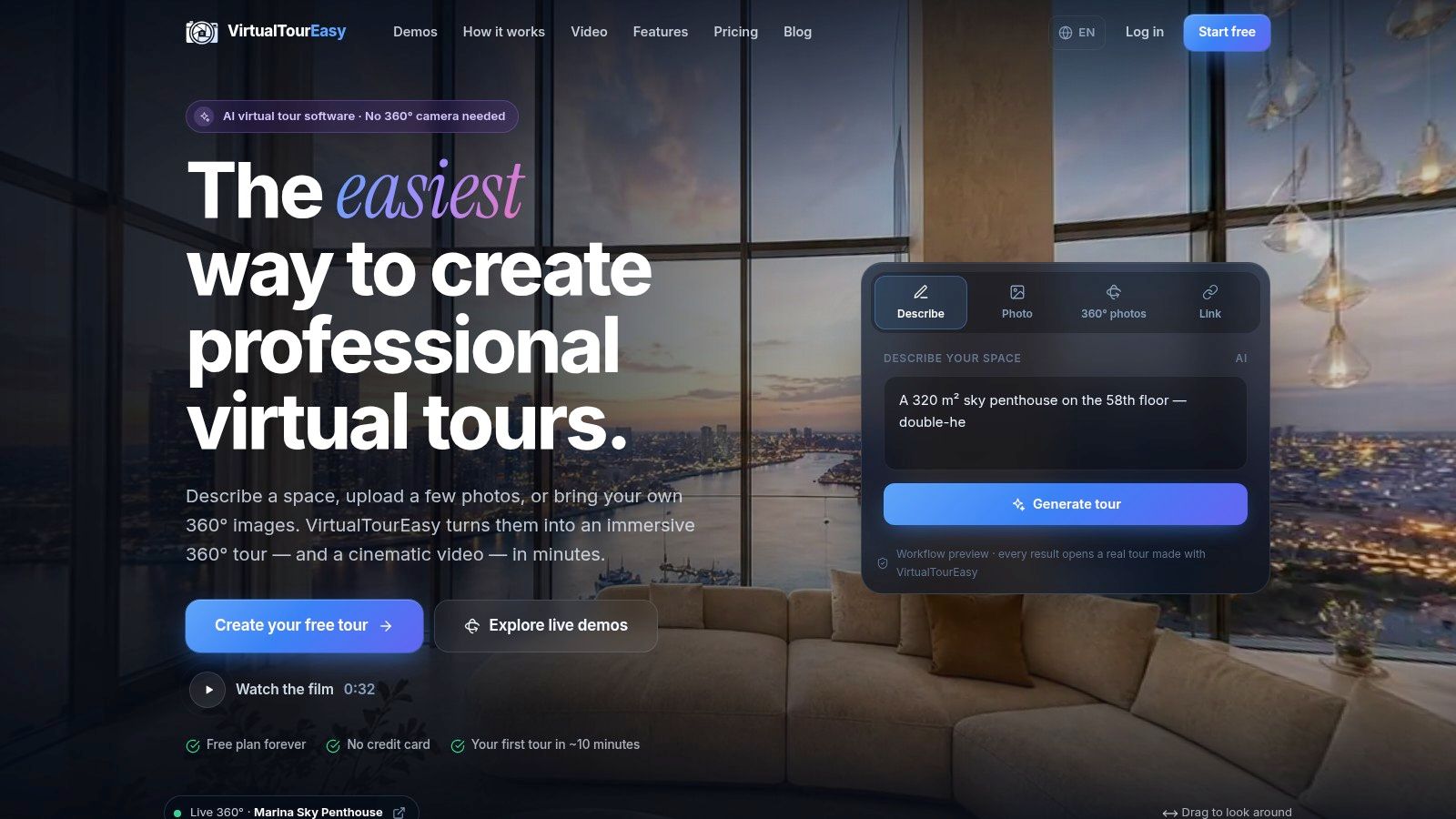
For agents choosing how to plan the experience, this guide to virtual tours for real estate agents offers a practical reference. Virtual Tour Easy is one option for creating tours from text prompts, regular photos, or uploaded 360° images, then arranging scenes, hotspots, information panels, audio, and starting views in a visual builder. Its tours can be shared through links and website embeds, and the platform includes analytics and lead capture.
Make the tour recognizable across listings
At brokerage level, tours should look like part of the same brand even when different agents prepare them. White-label branding, custom domains, consistent cover images, channel pages, and a shared scene-order standard can help establish that continuity. Analytics can show whether viewers return or explore a property in depth, while a form or qualification prompt can give an interested buyer a clear next step.
The objective isn't to add every feature to every listing. It's to choose the tools that improve the buyer's understanding and make the agent's expertise visible.
Content Marketing with AI That Does Not Erode Trust
AI can help agents draft listing descriptions, neighborhood guides, market updates, video scripts, and email follow-ups. It can also make it easier to publish generic content that says little about a particular property or market. Faster production doesn't automatically create a stronger brand. If a post contains inaccurate or irrelevant claims, the agent still owns the credibility problem.
Realtor.com's 2025 AI and Housing Survey found that 82% of housing-market information seekers use AI and about 90% use social media for housing content, yet 30% said social content wasn't applicable to their market and 30.5% considered it inaccurate. The same survey found that 62% viewed agents as the most accurate source, compared with 61% for AI (Realtor.com's AI and housing survey). The takeaway is direct: use AI to support an agent's knowledge, not to impersonate it.
Use a human-review workflow
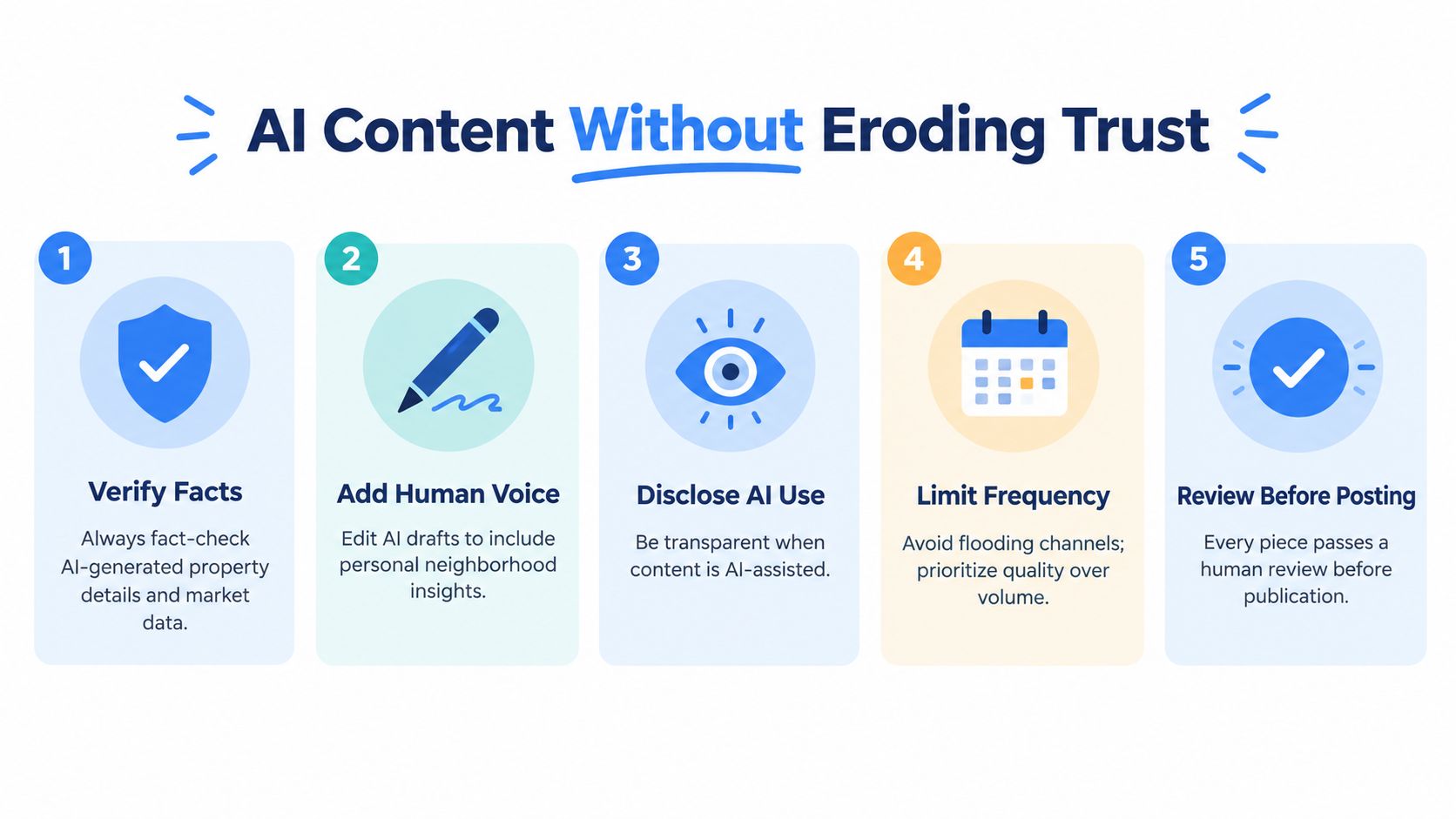
A dependable workflow gives AI a narrow task and assigns the agent responsibility for the claims. The model can produce a first draft from verified property details or a list of topics. The agent then checks facts, adds local insight, and removes phrases that could apply to any market. The team should also decide when and how to disclose AI assistance, following relevant platform rules and applicable regulations.
Before publication, a human reviewer should check:
- Accuracy: Are property features and market statements confirmed?
- Local relevance: Does the content reflect the area, rather than generic housing advice?
- Point of view: Does the agent contribute knowledge or a clear perspective?
- Support: Can factual claims be verified from a reliable source?
- Disclosure: Is AI assistance disclosed when appropriate?
A neighborhood guide, for example, should distinguish verifiable details from an agent's opinion. Specific claims about schools, travel, amenities, or local rules should be checked before publication. Where the agent can't verify a claim, it should be removed or clearly framed as something to confirm.
Choose credibility over volume
A steady publishing routine is useful only if the content helps a buyer or seller make a decision. A concise explanation of what a tour shows, how a floor plan clarifies the layout, or what questions to ask about a property can do more brand work than a stream of interchangeable posts. AI can make drafting faster; only human judgment makes the result locally credible.
SEO, Local Search, and Paid Acquisition
Search marketing should help a buyer or seller find a relevant answer, not send everyone to the same generic homepage. A neighborhood specialist needs pages that explain the areas served, the properties available, and the service offered. A seller-focused agent needs a clear path from a local search to a useful conversation about representation.
Start with the foundations. Organize the site around real service areas and audience needs, make property pages easy to use on mobile, and keep brokerage contact details consistent wherever they appear. A complete Google Business Profile, useful client reviews, and clear agent biographies reinforce credibility. Listing structured data can help search engines interpret property information, but it doesn't compensate for thin or inaccurate page content.
Earn organic visibility before buying broad reach
The most effective organic work usually comes from making existing pages more helpful. Write neighborhood content that answers real questions, link it to relevant listings and agent profiles, and make contact options easy to find. Track branded search interest alongside non-branded local searches. If more people search for the firm or agent by name, that can be a useful sign of familiarity, but it still needs to be connected to inquiries and appointments.
Paid campaigns work best when they have a defined audience and next step. Retarget people who have viewed a listing or tour, promote a specific property to a relevant local audience, or capture seller inquiries with a focused landing page. Avoid paying for vague awareness without deciding what action should follow.
A practical acquisition backlog can be prioritized as follows:
- Fix the destination: Improve the key website and listing pages before sending paid traffic.
- Strengthen local discovery: Complete business profiles, service-area pages, and review responses.
- Build a useful content base: Publish clear pages for priority neighborhoods and client needs.
- Test focused paid campaigns: Use a defined listing, audience, and conversion action.
- Review lead quality: Pause campaigns that produce activity but not relevant conversations.
The budget should follow readiness. A firm with incomplete listings and weak contact paths should fix those surfaces before expanding paid reach. More visibility isn't a substitute for a useful destination.
Social Proof, Community, and Lead Capture
Followers and likes can make a profile look active, but they don't show whether buyers are ready to talk. Social content should demonstrate how an agent works and give potential clients a natural reason to respond. Short neighborhood walk-throughs, listing reveals, renovation context, and client stories can all serve that purpose when they're specific and accurate.
A solo agent doesn't need an elaborate publishing machine. A manageable routine might pair a property or neighborhood feature with a practical buyer or seller explanation, then leave time to answer comments and direct messages. The agent's responses are part of the brand: a courteous answer to a basic question can build more trust than another polished graphic.
For format ideas and practical channel guidance, use this resource on real estate social media. The important strategic choice is what happens after someone engages. A listing page can invite a buyer to explore a tour, request more information, or ask for a showing. A qualification question can clarify timing or property needs, but it should feel relevant and easy to answer.
Capture interest without creating friction
A form should appear when it helps the prospect take the next step, not merely because the platform makes it possible. Letting someone begin a tour before asking for contact details can demonstrate value first. If a form is required, ask only for information needed to respond usefully, explain what the person will receive, and route the inquiry to the right agent.
The handoff matters as much as the form. A new inquiry should arrive with its source and context, including the listing or tour that prompted the contact. The agent should respond with a message that reflects the prospect's actual question, not an automatic greeting that ignores the interaction.
A useful lead form starts a conversation. A bad one asks buyers to surrender information before the brand has earned their confidence.
Social proof needs the same discipline. Share client experiences with permission, make the story specific, and avoid turning a testimonial into a guarantee. The aim is to help prospects understand the service, not to manufacture certainty about outcomes.
Measurement That Connects Brand to Deals
A brand dashboard can look busy while saying little about whether marketing helps create business. Views and follower counts describe exposure. They don't establish whether a prospect explored a listing, returned to a tour, submitted a question, booked a showing, or became a client.
Zillow's 2025 consumer research reported that 84% of buyers used an agent among the resources involved in shopping, searching, or purchasing a home. It also found that 41% of prospective buyers were more likely to hire an agent with a social-media presence, while 33% ranked a floor plan as the most important listing feature (Zillow's 2025 buyer housing trends research). Visibility can help buyers become familiar with an agent, but useful listing information still has to support evaluation.
Follow behavior toward a business outcome
Set up analytics around the actions that connect exposure to a conversation. Use tour analytics to understand how people engage with a property, GA4 events to record meaningful page actions, and Google Tag Manager or tracking pixels to help attribute campaign activity. Keep the CRM as the working record for lead source, response, appointment, and eventual outcome.
A clear measurement chain makes reporting more useful:
| Stage | Question it answers | Primary signal | Tool or source |
|---|---|---|---|
| Discovery | Are people finding the brand? | Branded and local search activity | Search and website analytics |
| Evaluation | Are prospects exploring the property? | Tour engagement, repeat visits | Tour analytics |
| Inquiry | Which experiences prompt contact? | Form completion and source | Website events and CRM |
| Response | Does the team follow up effectively? | Response time and appointment status | CRM |
| Outcome | Which sources create valuable business? | Listing, sale, or client outcome | CRM and transaction records |
Make the review decision-focused
Review the chain regularly and ask what action the data supports. If a listing attracts visits but few meaningful interactions, improve the property page or tour. If a source brings inquiries that don't fit the service, change the audience or the message. If visitors engage with floor plans or return to a tour, share that context with the agent before follow-up.
A practical lead source tracking approach helps connect marketing activity to the conversations and outcomes recorded by the team. The purpose isn't to credit every sale to a single click. It's to understand which touchpoints appear to help buyers move forward, then invest in those experiences with a clear reason.
Your 90-Day Real Estate Brand Marketing Rollout
A strategy is only useful when the team can execute it without turning every listing into a custom project. Sequence the work so the brand's promise is clear before the brokerage invests in more content, tours, or advertising. Each phase should produce something the next phase can use.
First 30 days: Set the foundation
Agree on the audience, positioning, and promise. Document the voice and basic visual rules, then audit agent profiles, property pages, reviews, listing media, and contact paths. Choose the audiences and areas the team can credibly serve, and identify the gaps that make the current experience inconsistent.
Before expanding activity, settle three decisions: who the brand serves, what it promises, and what evidence can support that promise. A clear position keeps the website, listings, social content, and tour presentation from pulling in different directions.
Days 31 to 60: Build the experience
Update the main website pages and priority property pages. Establish a repeatable workflow for photographs, floor plans, virtual tours, listing descriptions, and social assets. Add lead capture where it serves the buyer, and route inquiries into a CRM with enough context for an agent to respond personally.
Keep the production system simple. Use templates for recurring work, but leave space for property-specific facts and agent judgment. Generic automation may save effort while weakening the very distinction the brand needs to communicate.
Days 61 to 90: Measure and refine
Connect campaign sources with website behavior and CRM outcomes. Start focused paid tests only after the destination pages and follow-up process are ready. Review search activity, meaningful tour engagement, forms, response, appointments, and business outcomes together, then decide what to improve, continue, or stop.
Watch for drift back into vanity marketing: growing activity without relevant inquiries, AI content that lacks local review, tours with no clear next step, or lead forms that collect names without useful context. When the team sees those signs, fix the experience before asking the audience for more attention. A brand that helps buyers make better decisions is not just easier to recognize. It is more useful throughout the path from discovery to deal.
Virtual Tour Easy lets real estate teams build branded 360° tours from prompts, regular photos, or existing 360° images, then share them through links or website embeds with options for lead capture and analytics. Use Virtual Tour Easy to turn property presentation into a more informative, measurable part of the brand experience.