A logo won't win a listing presentation, reassure a nervous seller, or make an unfamiliar agent feel like the safest choice. Branding for realtors is a positioning problem before it's a design problem. The agent who looks polished but sounds interchangeable will lose attention to the specialist who clearly understands a neighborhood, a property type, or a client problem.
Real estate clients often make decisions with incomplete information. They may not compare every available agent, inspect every website, or distinguish one brokerage's color palette from another. They look for repeated signs of competence, familiarity, proof, and personal attention. A strong brand makes those signals easy to recognize across search, social media, listings, referrals, and immersive property experiences.
Table of Contents
- Redefining Brand Positioning Beyond the Logo
- The Behavioral Science of Real Estate Trust
- Engineering a Cohesive Visual Identity
- Adapting to AI and Off-Platform Discovery
- Virtual Tours as a Core Brand Asset
- Executing the Brand Rollout Strategy
- Measuring Brand Impact and Lead Quality
Redefining Brand Positioning Beyond the Logo
A logo will not create a defensible real estate brand. It may help people recognize your materials, but it cannot explain why clients should trust your judgment, choose your expertise, or contact you first. Branding for realtors is a positioning problem before it is a design problem. Start with the promise your market should associate with your name, then use design to reinforce it.
The brand is the expectation a client forms about the agent's judgment and service before the first serious conversation. That expectation develops through your niche, advice, listings, reviews, response speed, and property experience. An attractive identity with no clear market position gives prospects little reason to remember you.
Position around a client problem
“I sell homes” describes a service, not a position. A stronger agent might help relocating families compare school districts, commute patterns, renovation risks, and neighborhood fit. Another might guide remote buyers through property evaluation, digital due diligence, and 360° virtual tours before they visit in person. The position gives the market a specific reason to seek that agent.
A crowded profession makes this distinction more important. Your message must answer three questions directly:
- Who does the agent serve? First-time buyers, downsizing owners, remote workers relocating, investors, luxury sellers, or another defined audience.
- Where does the agent operate? A city may be too broad. Focus on selected neighborhoods, a property corridor, or a recognizable local market.
- What difficult problem does the agent solve? Address pricing uncertainty, complicated moves, property preparation, remote evaluation, or an unfamiliar buying process.
The goal is not to reject every other opportunity. It is to give the right prospect an immediate reason to believe you understand the situation.
Practical rule: If a competitor can copy the positioning statement by changing only the name, the position is too generic.
A defined niche improves every marketing decision after it. It determines the subjects you teach, the examples in listing presentations, the language on landing pages, and the proof you feature in social profiles. It also helps search systems, AI-assisted discovery tools, and referral sources identify what you are known for.
Build an identity that proves the promise
Your public experience must demonstrate the position. An agent focused on remote buying should provide detailed digital property experiences, clear explanations, responsive follow-up, and immersive tours that let prospects inspect a home before scheduling travel. An agent serving sellers of architect-designed homes should present materials, proportions, design details, and buyer fit, not just room counts.
Focused identity and consistency matter more than chasing every design trend, as explained in Luxury Presence on real estate brand positioning. The recommendation is direct: the logo should identify the position, not substitute for one. Use every brand asset to prove the expertise your ideal client is already looking for.
The Behavioral Science of Real Estate Trust
A polished logo rarely earns the first conversation. Trust does. Buyers often make a fast decision, and independent guidance citing the National Association of REALTORS®’ 2024 Profile of Home Buyers and Sellers reports that 76% of buyers contacted only one agent before choosing, as summarized in this real estate marketing statistics reference. Once a prospect reaches out to one agent, perceived expertise and familiarity can matter more than an extended comparison process.
The same source cites Realtor.com guidance that consumers typically need 5 to 7 brand impressions before remembering a logo or recognizing a brand, while 59% of consumers prefer familiar brands. Use that behavior to set a clear operating rule: every post, listing page, email, sign, and video should reinforce the same promise. Repetition builds recognition only when the message remains consistent.
Familiarity lowers the first-contact barrier
National Association of REALTORS® data shows broad awareness of the REALTOR® brand and stronger willingness to use a REALTOR® after exposure to its “Right by You” campaign. Sustained messaging can build an advantage beyond a single promotion, but individual agents should apply the principle at a more relevant local level.
Repeat the same face, language, visual treatment, local knowledge, and service promise wherever a prospect encounters the business. Consistency also helps search systems and AI-assisted discovery tools associate an agent with a defined area of expertise.
Make proof easy to verify
Trust grows faster when branding connects to evidence. Reviews, transaction explanations, neighborhood guides, market commentary, property walkthroughs, and 360° virtual tours give prospects something more useful than a polished claim. These assets show how an agent thinks, communicates, and handles the details that shape a decision.
Organize client feedback through a RealtyAPI.io reviews feed, then identify recurring themes for the website and listing presentation. Feature proof that supports the position, such as responsiveness, local knowledge, negotiation skill, or clear guidance.
Personal branding matters because clients experience the service through the individual agent, not only through the brokerage name. A 2022 study of the real estate brokerage industry connects customer loyalty with the estate agent and finds that personal brands can stand strongly against corporate brands. Keep the agent's identity consistent even when the brokerage provides the transaction infrastructure.
Engineering a Cohesive Visual Identity
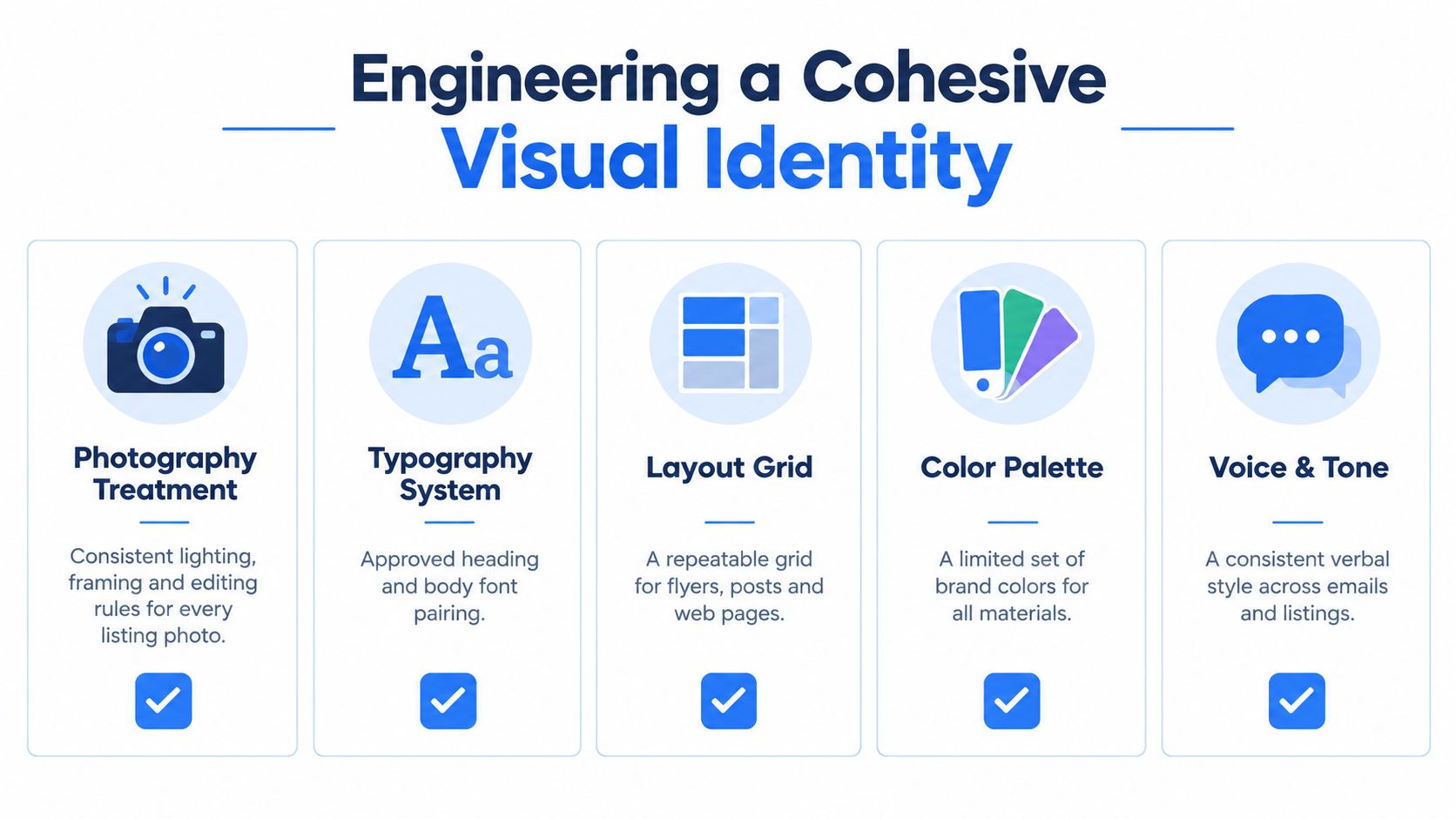
Once the market position is clear, the visual system should make that position recognizable without requiring explanation. The objective isn't decorative uniformity. Consistency reduces the mental effort required to decide whether every new asset comes from the same credible business.
A practical audit starts with the last group of listing graphics, social posts, email signatures, property pages, presentation slides, and physical signs. Place them side by side and look for conflicts. If the photography feels editorial in one channel and heavily filtered in another, or if the typography changes from premium to casual without a strategic reason, the prospect receives mixed signals.
Standardize what prospects notice first
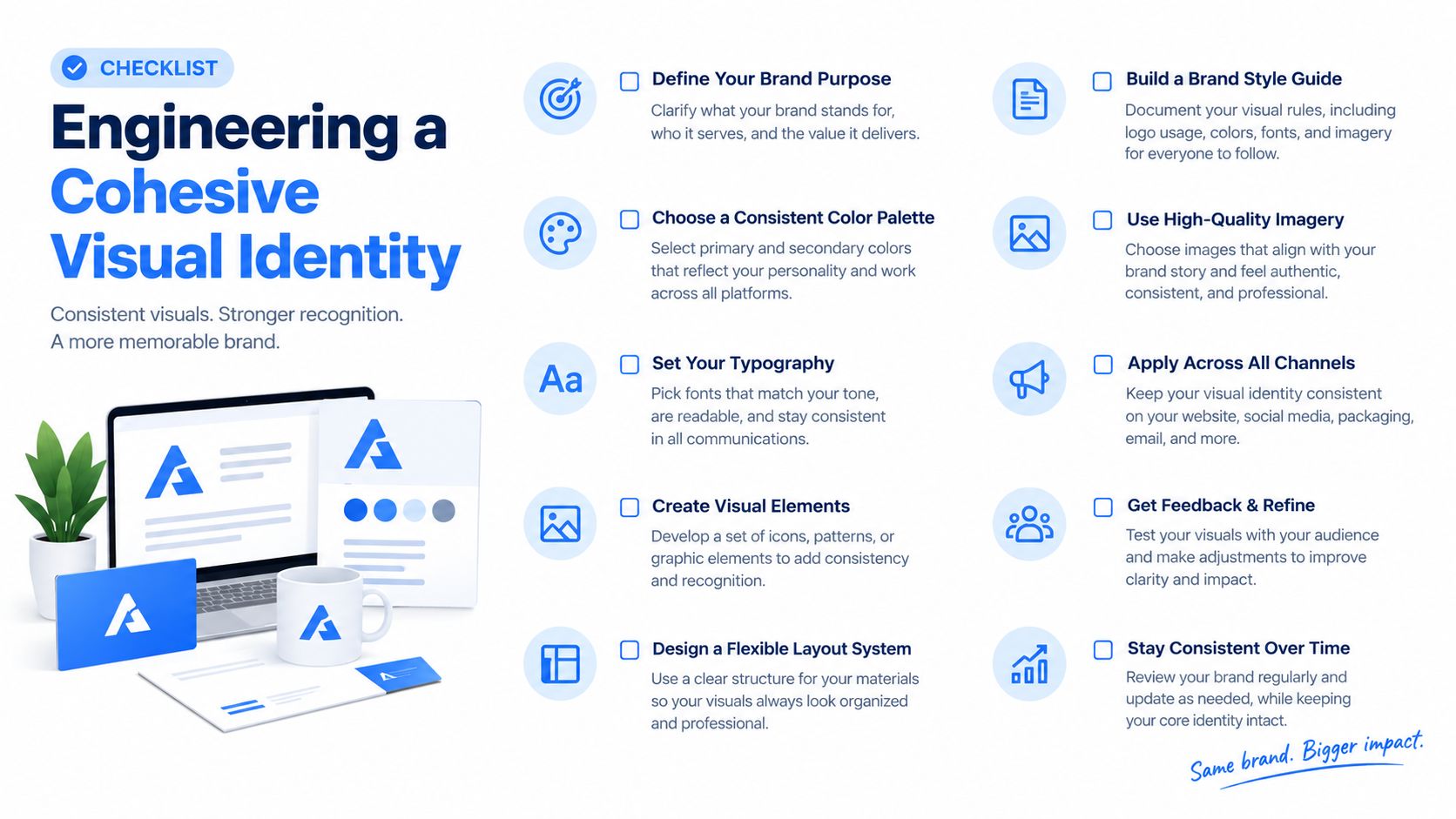
A compact brand guide should settle the decisions that teams make repeatedly:
- Photography treatment: Define lighting, framing, cropping, color correction, and rules for exterior, interior, agent, and neighborhood images.
- Typography system: Choose an approved heading and body pairing, then specify hierarchy for listing titles, captions, calls to action, and long-form guides.
- Layout grid: Establish repeatable spacing and alignment for flyers, property cards, social posts, email headers, and web pages.
- Color palette: Limit the working palette to colors that remain legible on screens, print, signage, and video overlays.
- Voice and tone: Decide whether the brand sounds analytical, reassuring, energetic, design-led, or conversational, then apply that decision to listings and follow-up messages.
The visual language should support the niche. A relocation specialist might prioritize clarity, maps, process diagrams, and practical explanations. A luxury advisor might use restrained layouts, spacious composition, and precise property narratives. Neither approach is universally correct.
Use design to increase perceived value
Visual coherence affects how a property is interpreted. An industry summary citing Zillow research says that unified visual styles and graphic language in advertisements can raise perceived property value by up to 13% without changing the price or location, as reported by Deptho's visual branding guidance for real estate. That claim should be treated as a reason to test a consistent system, not as a promise for every listing.
Agents should also separate branded and compliance-driven versions when needed. A branded website experience can carry the agent's identity, while an MLS-compatible asset can follow required presentation rules. For teams managing multiple properties and channels, white-label branding for virtual tours offers a useful framework for keeping the client-facing experience aligned with the brokerage or agent identity.
Adapting to AI and Off-Platform Discovery
A logo cannot carry an agent's reputation across every place prospects search. A buyer may see a neighborhood video, ask an AI tool for local guidance, read a review, open a shared property link, and visit the agent's website only at the end. Branding must survive outside the website, where the agent controls less of the layout and surrounding context.
Build a recognizable verbal signature instead. A historic-home specialist should repeatedly explain preservation issues, inspection questions, financing complications, and neighborhood character. A relocation advisor should publish practical guidance that answers the questions a remote buyer cannot resolve through a generic listing description. Repetition makes the specialty easier for people and AI systems to identify.
Create platform-native proof
Change the format without changing the underlying identity. A short video can answer one local question. A listing page can provide full property context. An email can explain the next step, while a virtual tour lets a prospect inspect the space independently. Each asset should sound like the same expert, even when the platform and format change.
A useful off-platform system includes:
- Search-ready explanations built around specific client questions and local terms.
- Short-form video that demonstrates judgment rather than repeating a slogan.
- Review responses that show how the agent communicates under real conditions.
- Owned landing pages that collect the strongest proof in one controlled destination.
- Shareable property experiences that retain context when forwarded by a client or referral partner.
Follower counts do not define the brand. Social reach can support visibility, but it cannot replace clear expertise, credible evidence, or an easy next step.
Make AI discovery work harder
AI-assisted discovery favors clear entities, specific expertise, and information that does not depend on visual interpretation. State the service area, property specialty, client type, credentials, review themes, and contact path consistently across the website and public profiles. Use the same terminology in bios, service pages, listing descriptions, and educational content.
Recent guidance on AI in real estate marketing emphasizes that people search across many surfaces, and that useful content and credibility matter alongside polished presentation. For practical implementation, review this guide to AI in real estate.
Your brand should remain recognizable in a video thumbnail, credible in a review profile, useful in an AI-generated answer, and complete when a prospect reaches the property page. That consistency turns scattered discovery into a trust-building path.
Virtual Tours as a Core Brand Asset
A virtual tour is a brand asset, not a decorative feature added after listing promotion is complete. It shows how an agent handles access, transparency, technology, and the buyer's time. The experience itself becomes proof of service quality.
A well-built 360° tour lets prospects assess room flow, sightlines, relationships between spaces, and overall suitability before requesting an appointment. It does not replace an in-person viewing. It prepares serious prospects and helps unsuitable prospects rule themselves out earlier.
Turn the tour into branded evidence
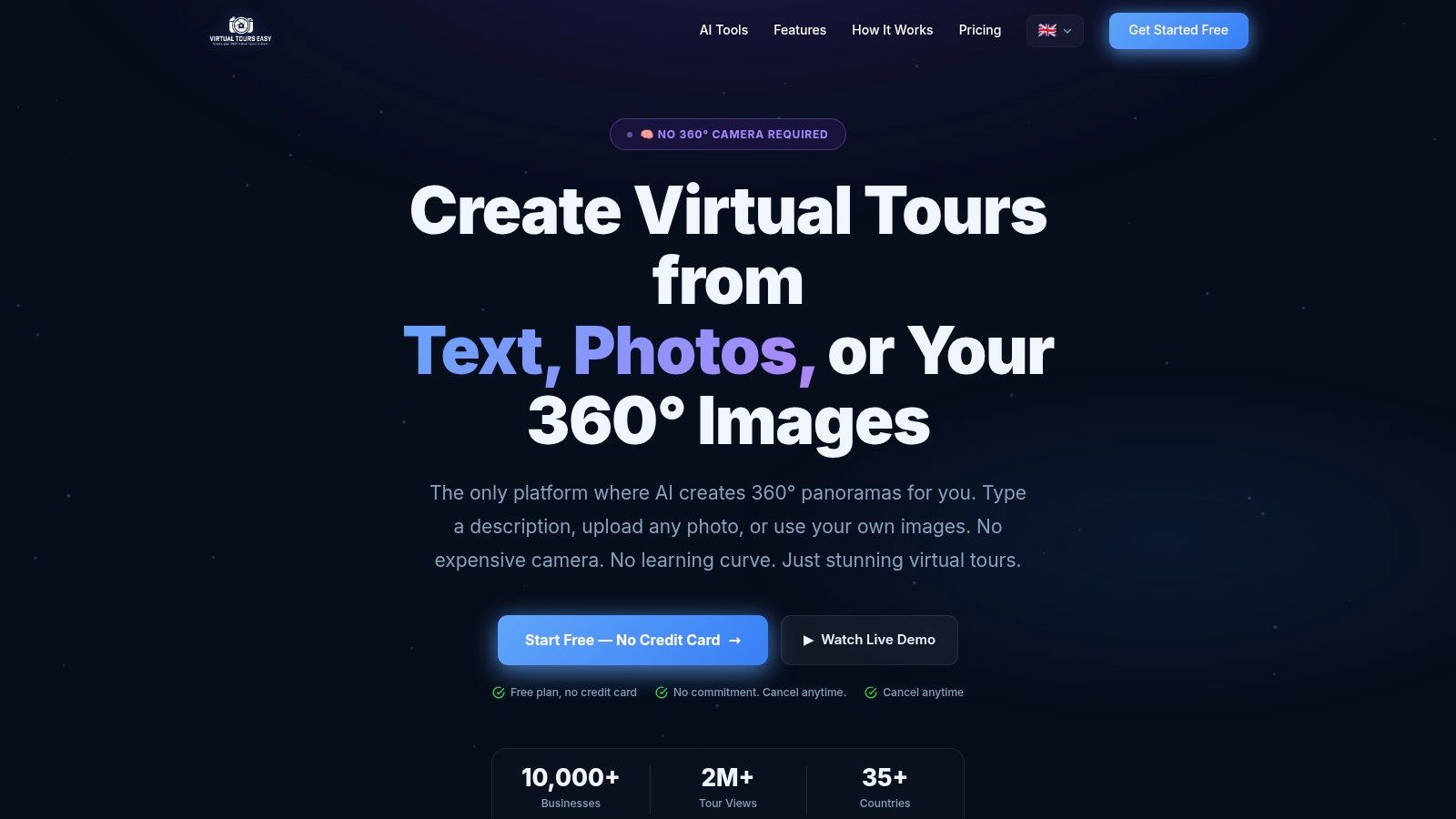
VirtualTourEasy lets agents create immersive 360° experiences from generated panoramas, transformed regular photos, or existing 360° images. Its visual builder includes drag-and-drop scenes, hotspots, information panels, audio, custom starting views, share links, embeds, and cinematic video exports.
Brand consistency depends on the details. Apply the agent's or brokerage's logo, approved colors, selected fonts, custom domain, and client-facing presentation without platform watermarking. Agencies can maintain a branded version for owned channels and an unbranded version when listing rules require it. That level of control turns the property experience into evidence of an organized, deliberate service.
Qualify interest without adding friction
Place a lead form inside or beside the tour with clear options, such as requesting a private viewing, receiving a floor-plan explanation, discussing pricing, or seeing similar properties. The agent gains useful context before the next call instead of treating every inquiry the same way. Analytics can show views, visitors, device information, geographic information, and interaction patterns, with integrations for GA4, Google Tag Manager, and tracking pixels.
Short-form video and immersive tours should support each other. Agents assessing AI-assisted production can review this guide to using Veo3 AI for property videos, then use short clips to direct attention to the full tour. The video earns the initial view. The tour gives prospects a more substantive way to evaluate the property and decide whether to continue.
Agents building a repeatable workflow can also review this guide to virtual tours for real estate agents. Every immersive asset should reinforce the brand's stated promise, whether that is accessibility, local expertise, design sensitivity, or an organized buying process. In an AI-driven discovery environment, that consistent, interactive proof gives prospects more reason to trust the agent.
Executing the Brand Rollout Strategy
A rebrand should not interrupt active transactions. It should be released in a controlled sequence, beginning with the surfaces prospects already use and ending with a repeatable property workflow. An agent doesn't need to replace every asset in one afternoon. The agent needs to prevent new and old identities from competing indefinitely.
Establish the core before publishing
The first stage is a short decision document. It should state the audience, service area, client problem, proof points, voice, visual rules, and primary call to action. This document becomes the filter for every asset that follows.
The next stages should proceed in this order:
- Update the digital footprint: Revise the website headline, biography, service pages, social bios, email signature, review profiles, and contact language so the position appears consistently.
- Rebuild conversion assets: Apply the identity to listing presentations, seller guides, buyer guides, landing pages, email templates, and follow-up sequences.
- Create a content operating system: Build reusable templates for local explanations, property features, client questions, short videos, and review highlights.
- Add the property experience: Create a standard workflow for producing a branded tour, inserting lead capture, publishing the link, and distributing supporting content.
- Activate the existing network: Send a clear update to past clients, referral partners, and the sphere of influence. Explain what the agent now specializes in and give contacts a useful resource to share.
- Review and refine: Remove outdated assets, check every public profile, and schedule periodic audits so the brand doesn't fragment again.
Protect daily capacity
The rollout should assign an owner to each recurring task. The agent may approve positioning and client-facing language, while a marketing coordinator manages templates, publishing, review collection, and tour assembly. A campaign calendar such as the planning framework from iHatePosting can help turn a positioning decision into scheduled, manageable content rather than a collection of unfinished ideas.
A brand rollout succeeds when the next listing automatically enters the new system.
For each new property, the checklist should cover photography, description, short-form content, tour creation, landing page, lead form, email distribution, social distribution, and follow-up. A repeatable process keeps the identity visible during busy periods, when improvised marketing usually causes the most inconsistency.
Measuring Brand Impact and Lead Quality
Brand measurement should focus on business signals, not applause. A logo impression rarely explains whether a prospect trusts the agent. A qualified inquiry, a completed tour, a request for a private showing, or a referral that arrives with a clear understanding of the agent's specialty tells a more useful story.
Consider a buyer who first encounters a neighborhood video. The video uses the same language and visual treatment as the agent's website, so the buyer recognizes the source when a friend forwards a property link. The buyer explores the 360° tour, opens the information panel about the property's layout, submits a request for a private viewing, and arrives at the conversation with specific questions.
That sequence doesn't prove that branding alone caused the inquiry. It does show how repeated signals can reduce uncertainty across multiple interactions. The agent can evaluate which touchpoints assisted the decision instead of judging the video, landing page, and tour as unrelated assets.
Track the quality of the journey
A quarterly review should examine:
- Source clarity: Whether inquiries identify search, social, referral, email, listing portals, or shared tour links as the first meaningful contact.
- Engagement depth: Whether visitors reach key pages, interact with tour scenes, open information panels, or complete a viewing request.
- Lead usefulness: Whether the inquiry includes timing, location, property preferences, financing context, or another detail that supports a productive response.
- Conversion movement: Whether branded landing pages and tour experiences lead to conversations, appointments, listing consultations, or referrals.
- Message alignment: Whether reviews and client feedback describe the same strengths the brand claims to offer.
Virtual tour analytics can contribute device, visitor, geographic, and view information, while GA4, Google Tag Manager, and tracking pixels can connect the experience to a broader measurement setup. Those tools don't replace judgment. They help the agent identify where prospects engage and where the experience creates friction.
Audit the promise, not just the assets
The strongest quarterly question is not “Does the brand still look current?” It is “Does the public experience still support the position?” A relocation specialist whose content has drifted into generic listings needs sharper relocation guidance. A luxury advisor whose tours feel unfinished needs to correct the experience before commissioning another logo update.
The agent should compare the intended promise with actual lead conversations, review language, referral descriptions, and property engagement. If clients consistently mention clarity, responsiveness, and local knowledge, those themes should become more visible. If prospects misunderstand the service area or client specialty, the positioning needs refinement.
Branding for realtors earns its place in the growth plan when it makes the right agent easier to recognize, easier to trust, and easier to contact. The measurement system should keep that standard visible while the market, platforms, and client expectations change.
Virtual Tour Easy gives realtors an AI-powered way to create branded 360° property experiences, add lead capture, publish across channels, and review engagement data. Agents and brokerages should visit Virtual Tour Easy to build an immersive property workflow that supports a recognizable, trust-based brand.