A prospective buyer opens a virtual tour from a property listing. The page loads, but the address bar shows a long platform URL filled with unfamiliar characters. The experience works, yet the link feels disconnected from the brokerage, hotel, or design studio promoting the space.
A branded address creates a different first impression. A URL such as tours.harborrealty.com tells the visitor where the experience belongs before the first panorama appears. For agencies, the decision goes beyond appearance. The domain ending, DNS configuration, SSL certificate, analytics setup, and client ownership model all affect whether a tour URL remains useful after a campaign ends.
Table of Contents
- Understanding Custom Domain Endings and Tour URLs
- Choosing the Right Extension for Your Brand
- Connecting Custom Domains to VirtualTourEasy
- Subdomains Versus Custom Domains for Agencies
- SEO and Analytics Benefits of Branded URLs
- Securing Your Tour Infrastructure for the Future
Understanding Custom Domain Endings and Tour URLs
A web address has several layers, and each layer has a distinct job. In tours.harborrealty.com/listing-18, com is the top-level domain, or TLD. harborrealty is the registered domain name, tours is a subdomain, and listing-18 is the path leading to a particular tour or page.
Real estate provides a useful analogy. The TLD is the neighborhood, the registered domain is the street address, the subdomain is a building or department, and the path is the specific apartment. Visitors may not think about DNS, but they do notice whether the address appears coherent, recognizable, and connected to the business.
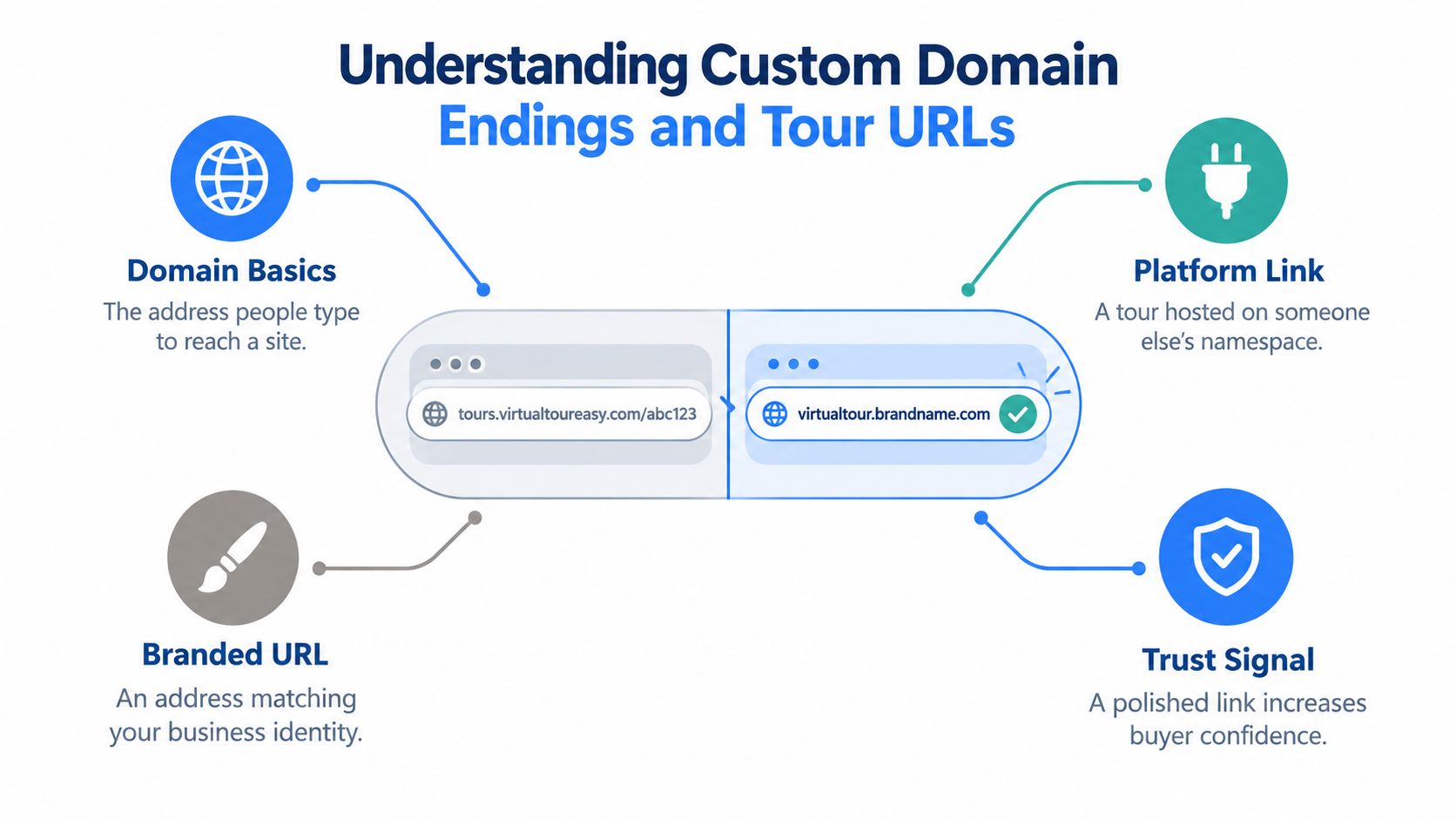
A platform-hosted link places the tour inside another company's namespace. That approach can be perfectly suitable for a quick demonstration, a private review, or an early-stage workflow. A custom domain or branded subdomain places the public address under the agency's or property brand's namespace, while the tour itself can still be rendered by an external hosting platform.
The distinction matters because a custom domain ending is only the rightmost label after the final dot. It isn't the same as the entire domain. A brand might choose a traditional ending such as .com, a sector-oriented ending such as .studio, or a location-oriented ending. The ending contributes context, but the full address must remain easy to say, type, read, and remember.
Domain ownership also belongs in the security conversation. Businesses evaluating securing your e-commerce site can apply the same principle to tour infrastructure: the public address should be treated as a business asset, not as a disposable campaign detail.
Choosing the Right Extension for Your Brand
The modern namespace gives brands more choices than the familiar legacy endings. ICANN's expansion began with the new gTLD program in 2012, when the first application round received 1,930 applications. More than 1,200 new extensions were later delegated into the root zone, and the first of those new gTLDs went live in October 2013, according to industry data based on ICANN and IANA records.
By 2026, more than 1,000 new gTLDs had been delegated to the root zone, materially expanding options for brands and geographic properties, as described by ICANN's overview of new gTLDs. That breadth creates opportunity, but it also makes selection harder. A memorable ending can support positioning, while an unfamiliar or poorly understood ending may create hesitation during a property search.
Trust and retention come before clever naming
The relevant question isn't just whether .studio, .site, .online, or a traditional .com looks attractive. The stronger question is whether the ending will remain credible to the intended audience and economically sensible to renew.
New gTLDs reached about 47.8 million registrations in 2025 and grew nearly 30% year over year, while the global domain base reached 386.9 million. New gTLDs still represented only about 10.3% of all TLD registrations in Q1 2025, and many had materially lower renewal rates than legacy extensions, according to the industry analysis of the new gTLD program. These figures don't prove that one ending will outperform another for a particular tour. They do show why renewal behavior and long-term retention deserve as much attention as initial availability.
A domain that looks distinctive at launch can become a liability if the business forgets to renew it, changes registrars without documenting access, or discovers that a client never accepted ownership terms. The apparent convenience of a niche ending should be weighed against continuity, customer familiarity, and resale potential.
A practical selection framework
A brokerage serving one market may prefer a familiar brand domain with a clear tours subdomain. A national architecture practice may consider a sector signal that reinforces its category. A regional hospitality group might assess a geographic ending if local identity is central to its audience.
Before registering an extension, teams should evaluate:
- Audience recognition: Can a buyer understand the ending when it appears in an email, listing, or printed brochure?
- Brand alignment: Does the ending support the company's actual category, or does it force visitors to interpret an unfamiliar label?
- Renewal durability: Can the organization maintain the domain through ownership changes, agency handoffs, and budget cycles?
- Campaign permanence: Will the address still make sense when the featured property is sold or the campaign is over?
- Portfolio control: Can the agency document who owns the domain, who manages DNS, and who receives renewal notices?
The white-labeling software guidance is useful when this choice forms part of a broader client-facing delivery model. A branded tour address works best when the surrounding experience, reporting, and handoff process also respect the client's identity.
Connecting Custom Domains to VirtualTourEasy
A custom domain connection usually has two separate parts. The registrar owns the domain registration, while DNS tells browsers where a subdomain should resolve. The tour platform then verifies that the requested address belongs to the authorized business and serves the tour through that route.
For most agencies, a subdomain such as tours.clientbrand.com is the cleanest starting point. It preserves the client's main website while giving the tour portfolio a distinct, organized space.
A practical DNS sequence
Register or identify the domain. The business should confirm that the agency or client controls the registrar account and can access its DNS panel. Ownership should be settled before any public campaign begins.
Open the DNS settings. Registrars label this area differently, but it normally appears under DNS, domain management, or nameservers. The person making the change should avoid editing unrelated records.
Create the required CNAME record. The subdomain is pointed to the target supplied by the tour platform. A CNAME connects the branded hostname to the platform's hosting destination without requiring the agency to operate the underlying infrastructure.
Add the hostname inside the platform. The branded address must also be entered in the platform's custom-domain settings. This allows the service to associate the incoming hostname with the correct workspace, channel, or tour collection.
Verify the address and HTTPS status. Once DNS resolves, the platform can provision the SSL certificate. Automatic SSL provisioning and renewal remove the need for the agency to purchase and manually replace certificates, provided the DNS relationship remains valid.
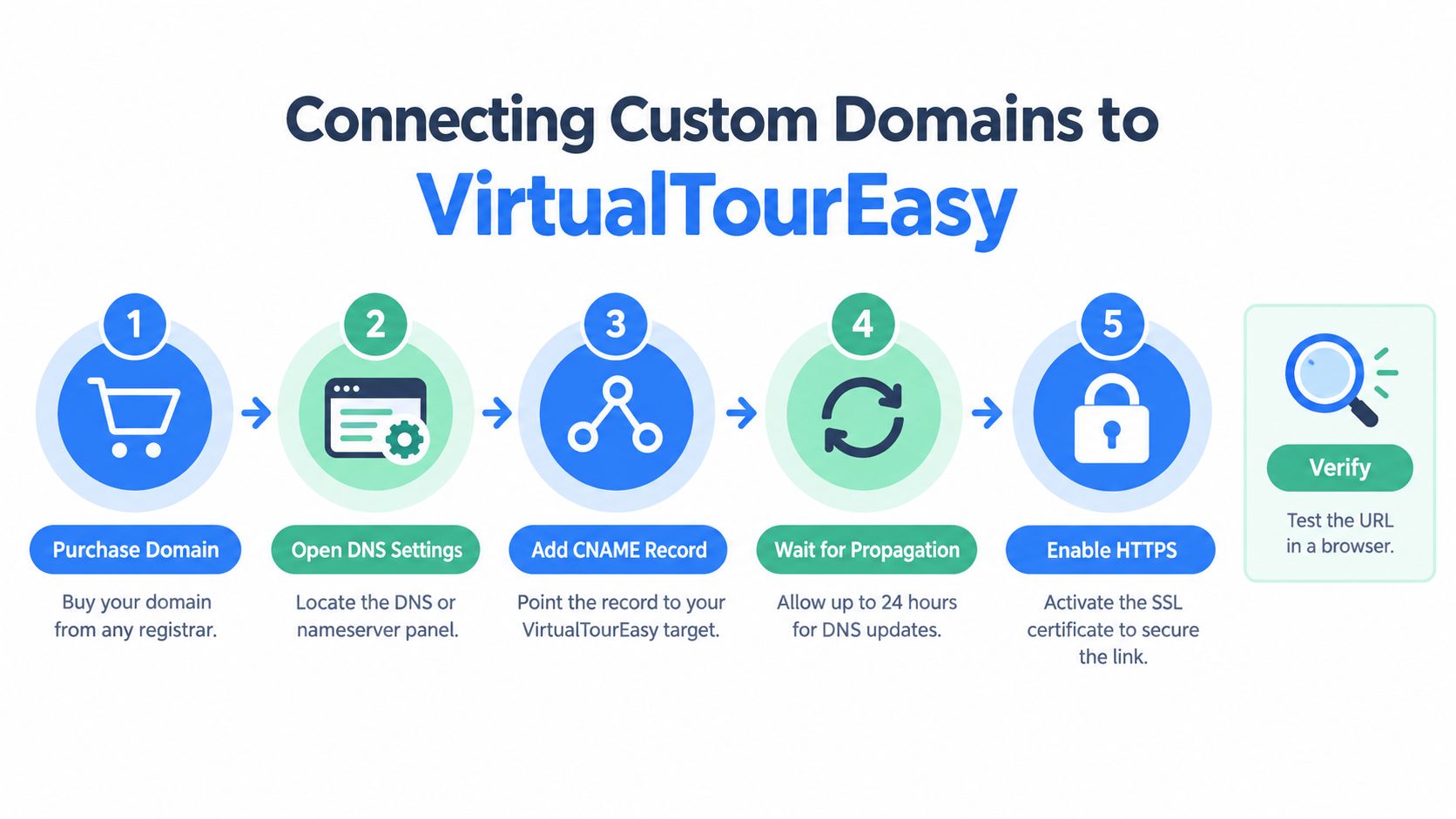
DNS changes may not appear immediately everywhere because resolvers and browsers cache earlier answers. A browser test from one office can succeed while a client in another location still sees the old result. Teams should test the hostname in a private browser window, on a separate network, and from a device that hasn't recently opened the address.
Operational rule: Keep a written record of the hostname, registrar account, DNS target, verification status, and responsible owner. A successful connection is not a substitute for documentation.
The platform's hosting environment handles the tour rendering, while the branded address handles the visitor-facing identity. That separation lets an agency maintain a consistent URL structure without running its own global delivery stack.
Subdomains Versus Custom Domains for Agencies
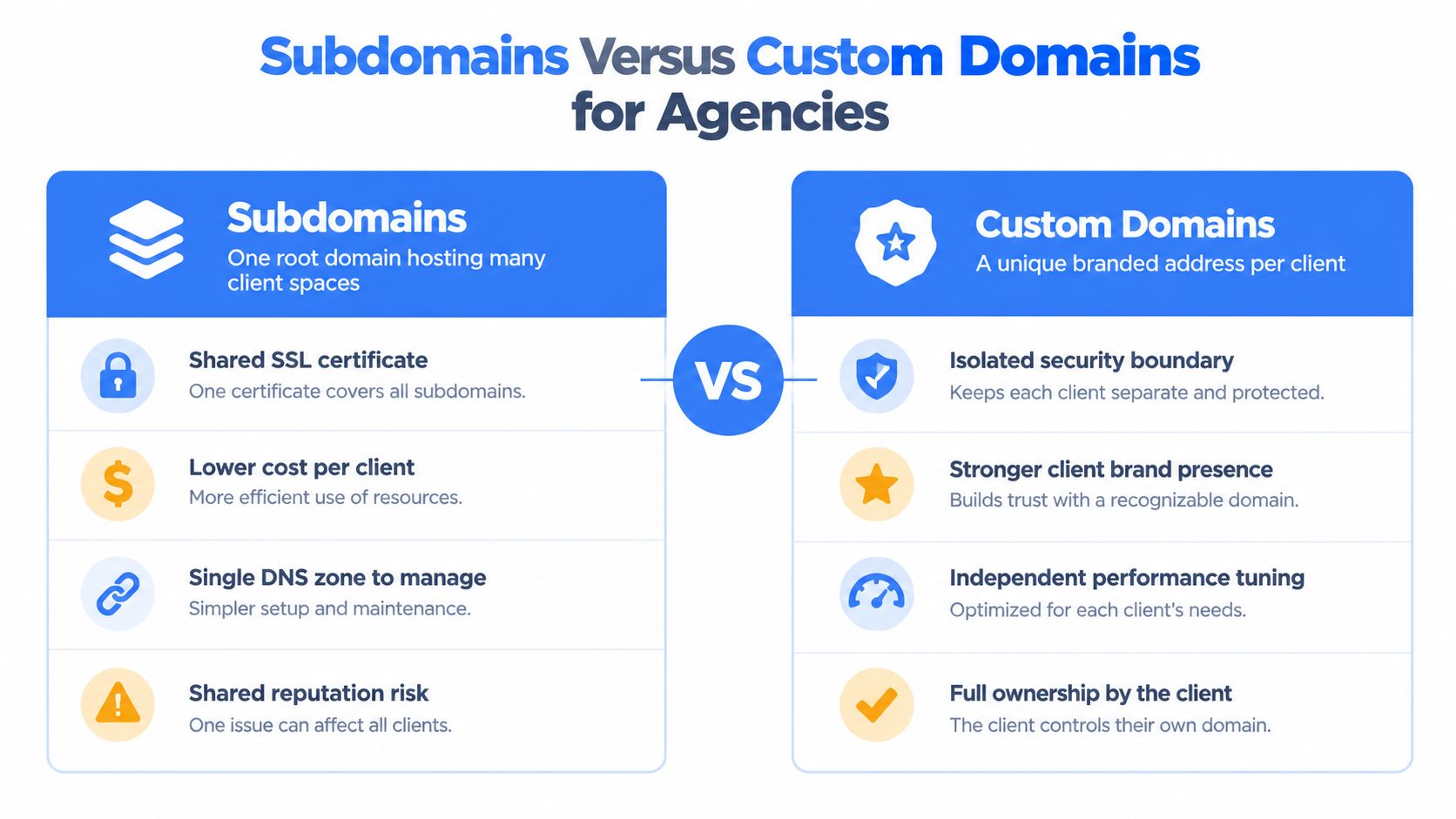
An agency managing many property portfolios usually faces a choice between one controlled naming system and separate client-owned addresses. A centralized structure might use client.agencytours.com. A client-specific structure might use tours.clientbrand.com.
Neither model is universally correct. The right choice depends on who owns the brand relationship, who pays for the domain, and how easily the tour portfolio must transfer when the contract ends.
Centralized subdomains favor operational speed
A shared root domain gives the agency one naming convention and one primary DNS zone. New client spaces can be launched without asking every client to change their website settings, and the agency can keep its public channels visually consistent.
This model suits a brokerage group, a franchise network, or an agency that sells a managed tour service. It also reduces friction during onboarding because the client doesn't need to purchase a separate domain before the first tour goes live.
The trade-off is brand distance. A property owner may feel that the tour belongs to the agency rather than the property brand. A shared root also means that a naming mistake, account dispute, or reputation problem can affect confidence in other client spaces, even when the tours themselves remain separate.
Dedicated domains favor ownership and handoff
A client-specific address gives the end client stronger control over its public identity. The domain can remain with the client when the agency relationship changes, and the tour portfolio can be connected to other marketing systems without changing the visible address.
That independence requires better administration. Each domain needs a documented registrar account, renewal process, DNS record, and billing owner. Client handoffs also need a checklist covering access credentials, analytics permissions, team roles, redirects, and the status of existing campaign links.
| Decision factor | Centralized subdomain | Dedicated custom domain |
|---|---|---|
| Launch speed | Usually faster for an agency-led rollout | Requires client-side domain coordination |
| Brand presence | Agency identity remains prominent | Client identity leads the experience |
| Administration | One naming system and DNS area | Separate ownership and renewal records |
| Handoff | Requires transfer of a client space | Domain can remain with the client |
| Risk planning | Shared root requires careful governance | Each domain needs individual monitoring |
A useful policy separates temporary campaigns from permanent client assets. Short-lived internal reviews can use the agency's structure. Public property marketing, portfolio pages, and long-term hospitality experiences generally deserve a naming system that remains meaningful after the original contract.
SEO and Analytics Benefits of Branded URLs
A branded URL doesn't automatically earn better rankings. Search visibility depends on the quality, accessibility, relevance, and indexability of the content around the tour. The domain structure still matters because it determines how the tour relates to the organization's existing website and measurement setup.
A tour on a tightly aligned subdomain can make the relationship between the agency and the experience clear to visitors. A tour path under the primary website can create a more unified information architecture when the hosting arrangement supports that structure. In both cases, the page needs descriptive titles, useful supporting copy, crawlable navigation where appropriate, and a clear purpose beyond displaying an interactive scene.
Tracking becomes easier when ownership is clear
A platform URL can introduce another hostname into the visitor journey. That may require careful configuration for referral exclusions, cross-domain measurement, consent handling, and campaign attribution. A branded hostname won't remove every analytics requirement, but it gives the marketing team a controlled address that fits the organization's tracking plan.
Virtual tour teams commonly combine native tour analytics with GA4, Google Tag Manager, and advertising pixels. The implementation should define which system is authoritative for views, visitors, leads, device information, and geographic reporting. Duplicate tags can inflate activity, while missing consent or referral settings can break the path from listing click to lead form.
The guide to GA4 cross-domain tracking provides relevant implementation context for teams that connect a tour hostname with a main website or campaign landing page. Analytics staff should test the full journey, including a listing click, tour interaction, form submission, return to the main site, and confirmation event.
Branded URLs support cleaner campaign governance
A consistent structure makes campaign naming easier. A brokerage might group property tours by agent or listing identifier. A hotel group might separate venue pages from event walkthroughs. An architecture practice might organize projects by client or location.
The URL should not carry every marketing detail. UTM parameters can identify campaigns, while the permanent path remains stable. That separation protects historical reporting when paid media ends and prevents the business from changing a valuable public address for every promotion.
The main benefit is control, not a guaranteed ranking lift. A branded address helps people recognize the source, gives analytics teams a predictable hostname, and reduces confusion when several systems contribute to the visitor experience.
Securing Your Tour Infrastructure for the Future
A custom domain becomes a durable digital asset only when someone accepts responsibility for it. Registration, DNS, SSL, analytics, and platform access can sit with different people, which creates avoidable risk during staff turnover or agency changes.
ICANN's program requirements illustrate why domain extensions involve more than visual branding. Applicants must demonstrate operational, technical, and financial capacity to run a registry, and applications undergo technical screening and testing involving evaluated Registry Service Providers. A registry must maintain the master database, generate zone files, and support DNS routing worldwide, as explained in ICANN's next round program materials.
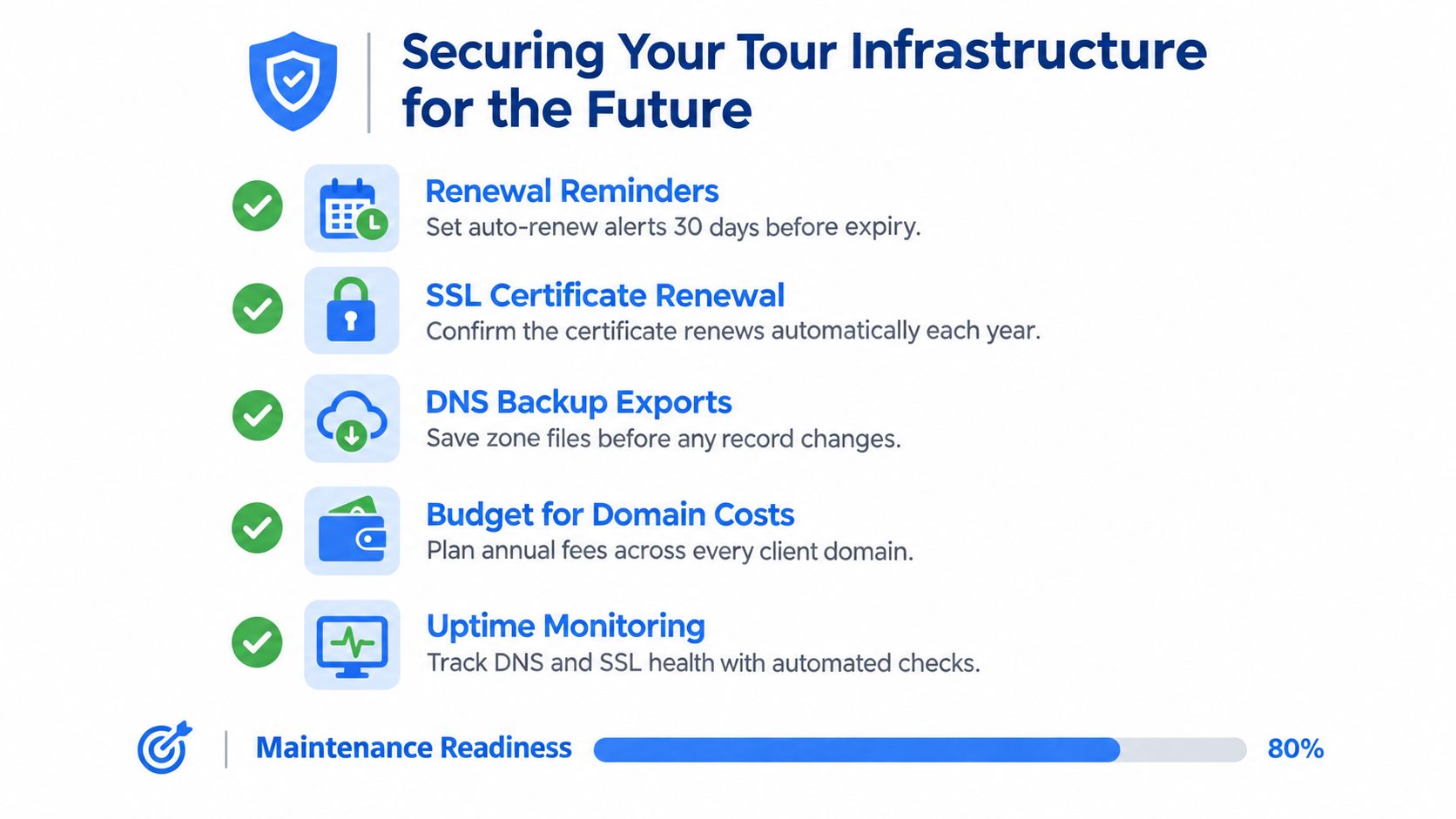
Most agencies won't operate a registry, but they still need governance for the domains they use. The following maintenance checklist keeps a tour portfolio understandable and recoverable:
- Renewal reminders: Assign an owner and enable registrar alerts before expiry.
- SSL certificate health: Confirm that automatic certificate renewal remains active after every DNS or hosting change.
- DNS documentation: Export or record the relevant zone details before changing providers or nameservers.
- Budget ownership: Decide whether the agency or client pays for registration and renewal, then document that decision.
- Uptime checks: Monitor the branded hostname, HTTPS status, and representative tour pages instead of assuming that a past test guarantees future availability.
The SSL certificate auto-renewal guide can support the certificate portion of that review. A quarterly audit should also confirm that former staff no longer control critical accounts, client ownership records are current, old URLs redirect appropriately, and analytics still receives the intended events.
The durable choice is rarely the most fashionable custom domain ending. It's the address that the audience understands, the client can retain, and the agency can operate without surprises.
Virtual Tour Easy lets agencies create immersive 360° tours, publish them through custom domains with auto-SSL, and manage branded client experiences with analytics, lead capture, and team workflows. Agencies and real estate professionals can review the platform at Virtual Tour Easy and choose a setup that keeps tour presentation aligned with long-term domain ownership.