Professional virtual tours typically cost $150 to $500 for standard residential properties, while complex or luxury projects can exceed $1,000. Basic DIY options may be free, but professional production generally provides more consistent image quality, navigation, hosting, and presentation.
The more useful question isn't just how much a virtual tour costs. It's whether the tour earns its place in the listing budget by filtering low-intent buyers, reducing unnecessary travel, expanding remote reach, or contributing to a stronger sale outcome.
A tour can be a minor listing add-on, a recurring software expense, or a substantial digital asset for a luxury development. The correct budget depends on the required output, the property, the capture method, and the cost of the human work surrounding publication. A brokerage that compares only headline prices can easily select the wrong production model.
Table of Contents
- Introduction - The Economics of Virtual Tours
- Virtual Tour Real Estate Cost Breakdown
- DIY Versus Professional Tour Production
- Calculating the Real Return on Investment
- Identifying Hidden Costs and Fees
- Streamlining Your Virtual Tour Strategy
- Conclusion - Making a Smart Investment Decision
Introduction - The Economics of Virtual Tours
Virtual tours are often treated as premium visual content, reserved for expensive homes or technically complex developments. That assumption misses the central economic issue. A tour isn't valuable because it looks immersive. It's valuable when it changes which buyers attend in person, how far a listing can reach, how confidently prospects evaluate the property, or how efficiently an agent uses time.
The available evidence supports a more measured view. A Harvard Business School analysis of virtual tours and home sales examined 75,178 homes sold in greater Los Angeles between March 2019 and March 2021. About 22% of those homes used virtual tours, and virtual tours alone were associated with approximately a 1.1% increase in sale prices after other factors were considered. That result doesn't mean every tour creates the same return, but it does establish that the feature can have a measurable economic relationship with the transaction.
The investment can sit at very different levels. A basic panorama workflow might use free software or existing equipment. A standard professional tour can include capture, editing, hosting, floor plans, and still photography. A custom experience for a luxury project can involve branded navigation, spatial computing, and interactive sales content.
Economic principle: The right comparison isn't tour price versus zero. It's tour cost versus the value of avoided work, better-qualified showings, broader reach, and any effect on the final transaction.
A brokerage evaluating real-estate virtual tour options should therefore define the commercial job before selecting a tool. Is the tour intended to help relocation buyers inspect remotely? Is it designed to reduce wasted appointments? Does the listing require measurement-grade geometry, or is visual inspection enough? Those answers determine whether a low-cost panorama, professional scan, or repeatable software workflow makes financial sense.
Virtual Tour Real Estate Cost Breakdown
The market doesn't have one virtual-tour price. It has several cost categories shaped by capture technology, property size, editing requirements, hosting, and interactivity.
A standard 360-degree photo tour is generally priced from $0 to $500, while a Matterport-style 3D scan typically costs about $100 to $1,200. Those ranges are documented in recent real-estate virtual-tour cost analysis, which also places customized virtual-reality walkthroughs for luxury developments or pre-sale projects at $20,000 to $50,000 or more. Dedicated spatial-computing applications can reach $15,000 to $80,000.
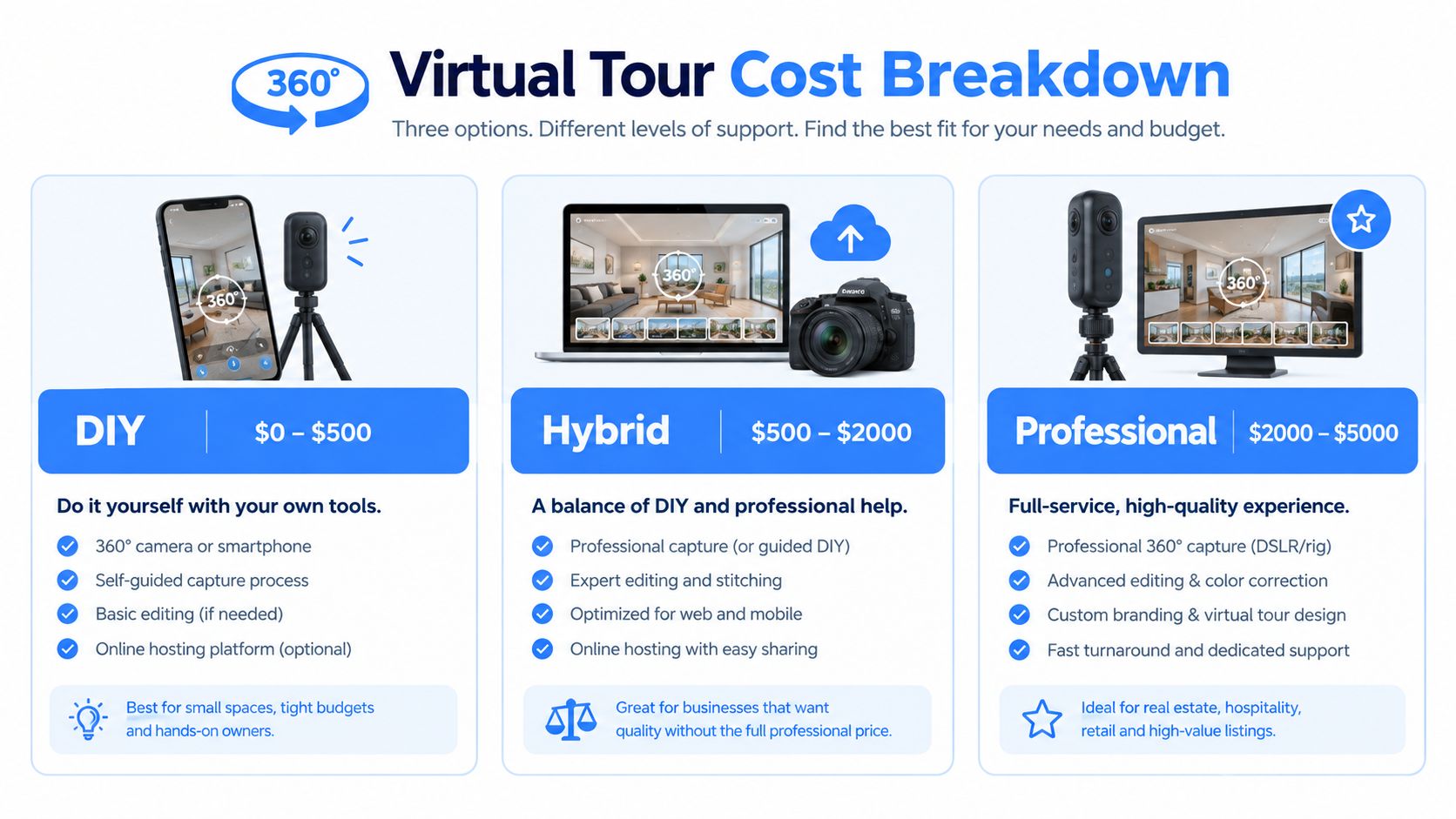
Four practical cost tiers
| Production tier | Typical economics | Suitable use |
|---|---|---|
| DIY panorama | Free software or a one-time camera purchase | Occasional listings and basic remote inspection |
| Standard professional tour | Approximately $150 to $500 for many residential add-ons | Routine listings requiring reliable presentation |
| Professional spatial scan | About $100 to $1,200, with larger properties potentially exceeding $1,000 | Floor plans, measurements, dollhouse views, and complex navigation |
| Bespoke interactive experience | Thousands to tens of thousands of dollars | Luxury developments, commercial projects, and branded sales environments |
The table is a decision aid, not a universal quotation. A small home and a multi-level commercial property don't consume the same photographer time, travel, scan points, hosting capacity, or post-production effort. A useful architectural virtual tour gallery can help a brokerage assess the difference between a simple visual walkthrough and a more deliberate presentation experience.
Independent pricing benchmarks place professional 3D or 360-degree tours around $100 to $360 on average, while broader residential guides place common add-ons near $150 to $500. Combined photo-plus-tour packages commonly fall around $350 to $700, according to real-estate photography pricing benchmarks. Bundling can therefore change the comparison, especially when still photography is already part of the listing preparation process.
A brokerage should compare the deliverables behind each quote, not just the advertised number. The software pricing options for virtual tours illustrate why recurring access, publishing, analytics, and workflow features belong in the same evaluation as capture quality. The cheapest tour may not be the lowest-cost option if it requires separate floor-plan work, manual hosting, additional revisions, or another site visit.
DIY Versus Professional Tour Production
DIY production looks inexpensive because the invoice can be close to zero. The true cost lies elsewhere. Teams still pay in equipment, setup time, capture errors, image correction, publishing, quality control, and the lost time of an agent or photographer doing technical work instead of revenue work.
A DIY workflow may require a one-time camera purchase of approximately $300 to $1,500, plus software or hosting that can cost roughly $0 to $50 per month, according to technical cost comparisons for 360-degree real-estate workflows. That model can make sense when a brokerage has repeatable internal processes, the right equipment, and staff who can keep quality consistent across listings.
Where DIY carries hidden labor
The case for DIY weakens when the property needs accurate spatial output or the team only captures listings occasionally. Operators have to place the camera consistently, manage lighting, avoid stitching errors, remove distractions, connect scenes, test mobile viewing, and confirm that the published link works across listing channels.
Professional production shifts those tasks to a specialist. The fee can cover travel, on-site capture, editing, floor plans, hosting setup, revisions, and delivery. A professional scan can also provide navigable 3D data and measurement outputs that ordinary image-based panoramas may not reproduce.
| Decision factor | DIY workflow | Professional workflow |
|---|---|---|
| Hardware | Internal equipment purchase or existing device | Specialist camera and operator |
| Labor | Staff time for capture, editing, and testing | Included or separately priced production service |
| Consistency | Depends on operator skill and process control | More standardized across listings |
| Spatial accuracy | May be visual rather than measurement-grade | Better suited to verified dimensions and complex layouts |
| Cost behavior | Lower cash cost, higher internal labor exposure | Higher transaction cost, lower technical burden |
The choice should follow the required outcome. A simple visual inspection may justify image-based production. A property where room dimensions, multi-level navigation, or a dollhouse view affects buyer decisions may justify professional spatial capture. A brokerage should decide first whether the listing needs measurement-grade output. If it does not, the DIY path's internal labor is the only real cost to model, and that number usually shows up in the agent's calendar rather than on an invoice.
Calculating the Real Return on Investment
The strongest financial case for a virtual tour doesn't depend on aesthetics alone. It depends on whether the tour improves the economics of the sales funnel.
The Harvard Business School analysis provides a useful price benchmark. After accounting for other factors, virtual tours alone were associated with approximately a 1.1% increase in sale prices. For a $400,000 property, that effect would equal roughly $4,400 in gross sale value, before production expenses. The study also found that tour adoption remained below one-quarter of observed sales in the market examined, which suggests that virtual tours were a measurable listing feature rather than a universal requirement.
That figure shouldn't be treated as a guaranteed premium. The researchers examined how tours interact with listing presentation and buyer behavior, and the result was more conservative than earlier claims of 2% to 3% price increases. Property characteristics, tour quality, market conditions, and the rest of the listing presentation all affect the outcome.
The qualification equation
A second return mechanism is easier to miss. Buyers can use a tour to reject a property before scheduling an in-person appointment. That may reduce wasted travel and allow agents to spend more time with prospects who already understand the layout, condition, and limitations.
Available market reporting indicates that only about 5% to 6% of buyers purchase without physically seeing a property, based on the real-estate virtual-tour discussion of buyer behavior. That doesn't make virtual tours ineffective. It clarifies their likely role. A tour often works as a qualification layer, not as a complete replacement for physical verification.
A basic break-even model is:
Tour value = avoided showing cost + incremental sale value + remote-reach value
Break-even condition = tour value greater than production cost plus hosting and internal labor
For example, a brokerage can estimate:
- The number of low-intent showings normally associated with comparable listings.
- The agent's hourly cost, including preparation and travel.
- The average travel expense for each showing.
- The proportion of prospects likely to self-filter after viewing the tour.
- The expected production, hosting, and update cost.
- Any defensible sale-price effect, treated as a scenario rather than a promise.
A property investment ROI guide can provide broader context for separating gross value from actual return. For listing operations, the calculation should remain conservative. The tour pays for itself when the value of avoided low-intent work and additional transaction value exceeds the complete cost of keeping it live.
Measurement matters. A conversion-tracking setup for virtual tours can connect views, lead forms, device data, and source channels to listing activity, giving the brokerage a basis for comparing tour-assisted inquiries with ordinary inquiries. Without that measurement, teams may confuse high viewing volume with commercial value.
Identifying Hidden Costs and Fees
The quoted production fee covers only one component of virtual tour real estate cost. A vendor may advertise an attractive capture price while billing separately for hosting, revisions, floor plans, publishing, storage, or advanced features. These items determine whether the tour remains economical after launch.
Production method also changes the cost profile. A professional scan for a 1,500 to 3,000-square-foot home is reported at roughly $350 to $1,000, while commercial and luxury projects can exceed $2,000. Hosting may add about $20 to $309 per month, depending on the platform tier, according to this 360-degree virtual-tour cost analysis. At the low and high ends of the quoted ranges, monthly hosting equals roughly 6% to 31% of the capture fee. That recurring charge can therefore change the break-even point even when production costs appear acceptable.
A practical total-cost checklist
Before approving a quote, a brokerage should verify whether it includes:
- Hosting duration: Confirm how long the tour stays live and what happens when the included period ends.
- Revision allowance: Check whether corrected room labels, changed details, or post-capture edits incur extra fees.
- Floor plans and measurements: Establish whether these are included, approximate, or billed as separate deliverables.
- Publishing support: Confirm coverage for Google Street View, listing portals, website embeds, and branded links.
- Travel and property size: Check whether travel, additional floors, scan points, or larger areas trigger surcharges.
- Updates after changes: Price recapture for renovated, occupied, or materially altered properties.
The internal calculator should combine capture labor + travel + editing + hosting + revisions, then divide the result by completed listings. This produces a per-listing cost that can be compared with qualified leads, avoided low-intent work, and any defensible sale-price effect. A subscription price alone omits the labor and service costs that determine whether the tour pays for itself.
A lower-cost panorama workflow can suit listings where visual inspection and quick publishing drive qualification. Dedicated spatial scanning may justify its higher cost when verified dimensions, floor plans, dollhouse views, or complex navigation influence the buyer's decision. Paying for unnecessary spatial capability wastes budget, while inaccurate geometry can create trust problems and reduce the value of otherwise qualified inquiries.
Practical rule: Normalize every quote by property area, recurring fees, and deliverables, not by the vendor's headline package.
Streamlining Your Virtual Tour Strategy
A brokerage can reduce production friction by choosing a workflow that sits between specialist capture and fully manual DIY work. The key design decision is whether every listing requires a dedicated spatial scan, or whether many listings can use ordinary photographs, generated panoramas, and a repeatable publishing process.
An AI-assisted platform can turn regular property photos into 360-degree scenes, accept existing 360-degree images, and assemble scenes through a visual builder. Hotspots, information panels, audio, starting views, short links, website embeds, Google Street View publishing, and video exports can then become part of the same workflow. That approach shifts the cost structure away from high variable production effort and toward a more predictable software process.
Matching the workflow to the listing
A brokerage can divide its inventory into practical groups:
- Routine residential listings: Use a fast panorama workflow when the primary goal is remote inspection and lead qualification.
- Complex homes: Add floor plans, stronger navigation, and professional capture when layout understanding is central to the purchase.
- Luxury and development projects: Consider bespoke branding and interactive elements when the tour supports a larger sales presentation.
- Remote and relocation inventory: Add lead capture, analytics, timestamps, disclosures, and live follow-up so the tour forms part of a verification package.
The middle-ground model works only if quality control remains deliberate. Camera perspective can distort rooms, omitted defects can damage trust, and inaccessible interfaces can exclude potential buyers. Accurate descriptions, room dimensions where available, accessibility details, captions or audio descriptions, and a follow-up walkthrough help prevent the tour from becoming a polished but incomplete representation.
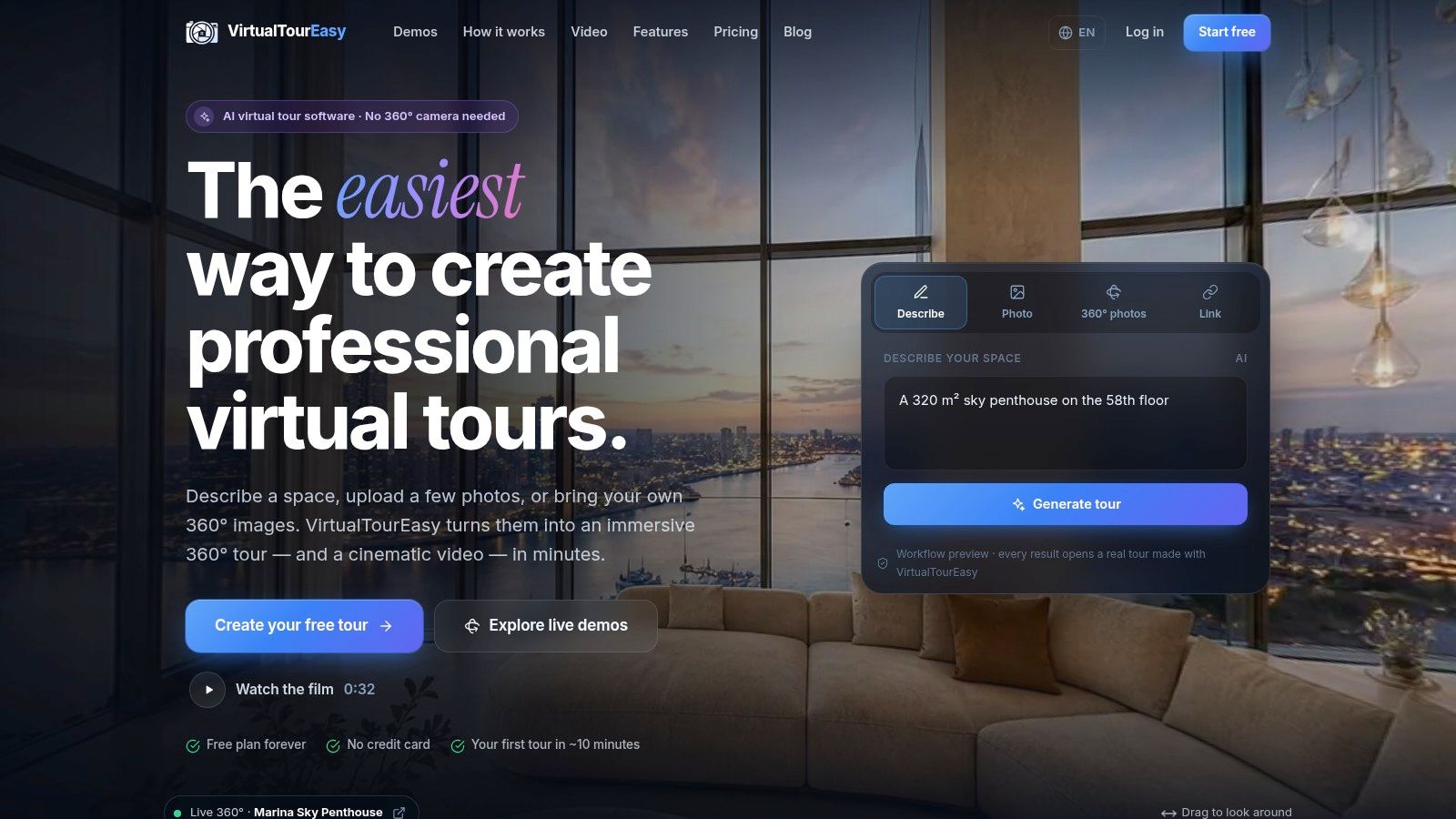
The commercial advantage comes from repeatability. A brokerage can standardize scene naming, listing templates, lead forms, publishing checks, and analytics across properties instead of rebuilding the process for each assignment. That doesn't eliminate capture or review work, but it can make the cost per published tour more stable as listing volume grows.
The right platform should also preserve the distinction between visual marketing and physical due diligence. A virtual tour can help a buyer decide whether a property deserves an appointment. It can't independently verify every defect, legal disclosure, neighborhood condition, or measurement unless those elements are deliberately added and checked by the responsible professionals.
Conclusion - Making a Smart Investment Decision
Virtual tour real estate cost is best understood as a portfolio of decisions, not a single production fee. Standard residential work often fits a modest listing budget, while professional scans, luxury walkthroughs, and spatial applications require progressively greater investment. DIY can reduce cash expense, but it transfers cost into equipment, staff time, technical risk, and quality control.
The strongest ROI case combines two mechanisms. The Harvard benchmark associates virtual tours with an approximately 1.1% sale-price effect, while the qualification model treats the tour as a filter that can reduce low-intent appointments and improve remote evaluation. Neither mechanism guarantees a result. Both become more credible when the brokerage measures production cost, showing effort, lead quality, follow-up activity, and transaction outcomes.
A sensible decision process has three steps:
- Define the buyer and operational problem.
- Match capture quality and features to that problem.
- Track the full cost per published tour and the value generated afterward.
A tour is a strategic investment when it replaces avoidable work or supports measurable transaction value. It's an unnecessary expense when the team buys advanced spatial functionality without a buyer or workflow need.
Virtual Tour Easy provides a software-based way to create immersive tours from regular photographs or existing 360-degree imagery, then add scenes, hotspots, lead capture, analytics, and sharing options. Real-estate teams can compare that repeatable workflow with DIY capture and professional scanning by visiting Virtual Tour Easy and assessing which model fits their listing volume and qualification goals.